


















Lesson 18 of 44 · Bernoulli and Energy
The Bernoulli Equation
Derive Bernoulli's equation from Newton's second law along a streamline, learn its assumptions and heads, and solve contraction and elevation problems.
Daniel Bernoulli published Hydrodynamica in 1738, and Leonhard Euler later put the idea into its modern mathematical form. The version you will use is short enough to memorize but rich enough to explain venturi meters, carburetors, and why a shower curtain blows inward. This lesson derives it from Newton's second law so you know exactly when it holds, then uses it in a series of worked problems.
What you will learn
- Derive
p + ½ρV² + ρgz = constantfrom Newton's second law. - State the four assumptions that make it valid.
- Apply it between two points on a streamline to find a pressure or a speed.
- Use pressure, velocity and elevation heads and the stagnation pressure idea.
Key terms
Static pressure: the pressure p a fluid particle feels while moving with the flow.
Dynamic pressure: ½ρV², the pressure equivalent of the kinetic energy.
Stagnation pressure: p₀ = p + ½ρV², the pressure where the fluid is brought to rest without losses.
Streamline: a curve tangent to the velocity everywhere.
Derivation
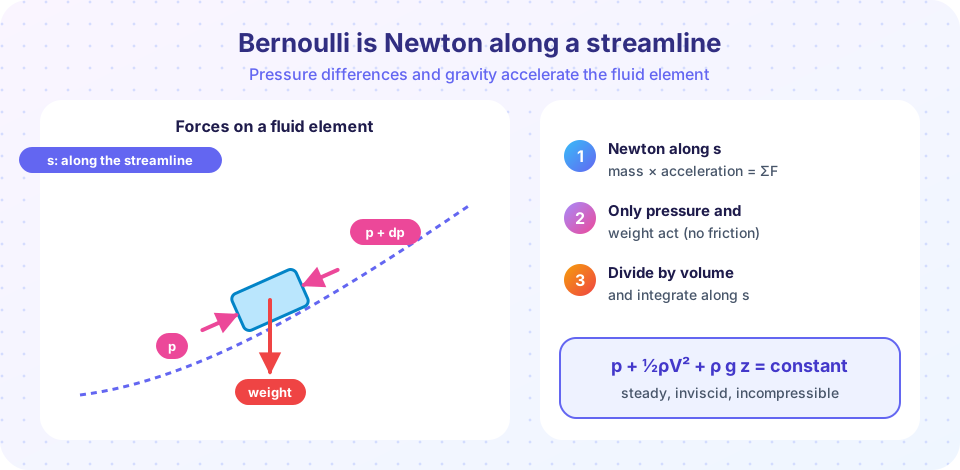
Pick a small fluid element of length ds and cross-section dA moving along a streamline, with s measured along the streamline and z the height. The streamline makes an angle θ with the horizontal, so dz = ds sin θ. Newton's second law along s reads
(p dA) − (p + dp) dA − ρ g dA ds sin θ = ρ dA ds · a_s
The three terms on the left are the pressure on the rear face, the pressure on the front face and the component of weight along the streamline. The acceleration along a streamline in steady flow is the convective one, a_s = V dV/ds. Cancel dA ds:
−dp/ds − ρ g dz/ds = ρ V dV/ds ⇒ dp + ρ V dV + ρ g dz = 0
This is Euler's equation along a streamline. For constant density it can be integrated directly:
p + ½ ρ V² + ρ g z = constant (along a streamline)
Compare with chapter 1: each term has the dimensions of pressure. For two points 1 and 2 on the streamline:
p₁/(ρg) + V₁²/(2g) + z₁ = p₂/(ρg) + V₂²/(2g) + z₂
Assumptions
- Steady flow (no
∂/∂tterm). - Along a streamline (it does not generally hold between different streamlines unless the flow is irrotational).
- Incompressible (constant ρ).
- Frictionless (no viscous forces) and no shaft work or heat transfer.
Worked example 1: a horizontal contraction
Water flows in a horizontal pipe from 100 mm to 50 mm. At section 1 the gauge pressure is 300 kPa and the speed is 2 m/s. Find the pressure in the narrow section.
- Continuity:
V₂ = V₁ (A₁/A₂) = 2 × 4 = 8 m/s. - Bernoulli (equal elevations):
p₂ = p₁ + ½ρ(V₁² − V₂²) = 300 000 + 0.5 × 998 × (4 − 64) = 300 000 − 29 940 = 270.1 kPa.
The drop of 30 kPa is the pressure spent speeding the water up. (If this were a Venturi meter, measuring p₁ − p₂ would give the flow rate: lesson on applications.)
Worked example 2: height and speed
A garden hose lies on a hill. Water at point 1 (gauge 150 kPa, speed 1 m/s, elevation 0) flows uphill to point 2 at elevation 8 m, with the same pipe diameter. Then V₂ = V₁ and
p₂ = p₁ − ρ g (z₂ − z₁) = 150 000 − 998 × 9.81 × 8 = 150 000 − 78 320 = 71.7 kPa.
If the hill were 15.3 m high (ρ g z = 150 kPa), the gauge pressure would fall to zero: the water would just reach the top at atmospheric pressure and the hose could not push it higher (without a pump).
Press Run (or Ctrl + Enter) to see the result here.
Program input · what you'd type while the program runs
Type the answers before you press Run, one per line. Each time the program reads a line (with input()), it gets the next line from this box.
Reading the heads
Divide by ρ g to give each term a length. Keeping the heads in mind helps you picture the energy:
| Head | Formula | Physical picture |
|---|---|---|
| Pressure head | p/(ρg) |
Height of a liquid column that the pressure can support |
| Velocity head | V²/(2g) |
Height a body would drop to reach speed V |
| Elevation head | z |
Height above the datum |
When water is at rest (V = 0) the equation reduces to p/(ρg) + z = constant, which is exactly the hydrostatic equation of chapter 2.
Stagnation pressure
Where a flow hits an obstacle head-on, the streamline ending at the obstacle slows to V = 0 at the stagnation point. Bernoulli gives the pressure there:
p_stag = p + ½ ρ V²
½ρV² is the dynamic pressure. At 100 km/h (27.8 m/s) in air, it is 0.5 × 1.2 × 27.8² = 463 Pa, about 0.5 % of an atmosphere. This is the pressure your hand feels when you hold it out of a car window: air that is brought to rest.
Press Run (or Ctrl + Enter) to see the result here.
Program input · what you'd type while the program runs
Type the answers before you press Run, one per line. Each time the program reads a line (with input()), it gets the next line from this box.
The bumps in the picture show elevation head rising and pressure head falling by exactly the same amount, with the speed head constant.
Common misconceptions
"The equation holds between any two points in a fluid." It holds along a streamline (or throughout an irrotational flow). Points in separated streams, or across a pump, need extra care.
"Pressure is lowest in the narrowest part because the water is squeezed." Pressure is lower there because the speed is higher; the physics is the acceleration of the fluid, not squeezing.
"Bernoulli applies to air at any speed." It is accurate for air only below roughly Mach 0.3 (about 100 m/s), where density changes are below 5 %.
Check your understanding
Quick check · 5 questions
of 5 answered You scored / 5 · perfect!
-
1. Water flows at 1 m/s and 200 kPa gauge in a horizontal pipe. It later flows at 5 m/s. The new pressure (ρ = 998 kg/m³) is about
p₂ = 200 000 + 0.5 × 998 × (1 − 25) = 200 000 − 11 976 ≈ 188 kPa. -
2. Which is NOT a required assumption of the basic Bernoulli equation?
Steady, frictionless, incompressible flow along a streamline are required; the surroundings' temperature does not matter. -
3. Stagnation pressure equals
p_stag = p + ½ρV². -
4. At a point where the fluid is at rest, Bernoulli reduces to
With V = 0, p/ρg + z = constant, the hydrostatic result. -
5. Water at 120 kPa gauge flows uphill in a pipe of constant diameter. Climbing 5 m changes the pressure by about
Δp = −ρ g Δz = −998 × 9.81 × 5 ≈ −49 kPa.
Summary
- Newton's second law along a streamline gives Euler's equation
dp + ρV dV + ρg dz = 0. - For steady, frictionless, incompressible flow:
p + ½ρV² + ρgz = constant. - Heads (
p/ρg,V²/2g,z) express energy per unit weight in meters. - Stagnation pressure
p + ½ρV²is what you read where a flow is stopped head-on.
Track your progress
Create a free account to tick off lessons and pick up where you left off on any device.
of Fluid Mechanics lessons completed