


















Lesson 25 of 44 · Dimensional Analysis
Chapter 5 review: Dimensional analysis
Review Buckingham Pi, dimensionless groups and model scaling with a one-page picture, a recap table, a code check and ten mixed practice questions.
You now have a method that works on almost any fluid problem: list the variables, count the dimensions, form the groups, then match them between model and prototype. This page puts the chapter on one sheet and tests it.
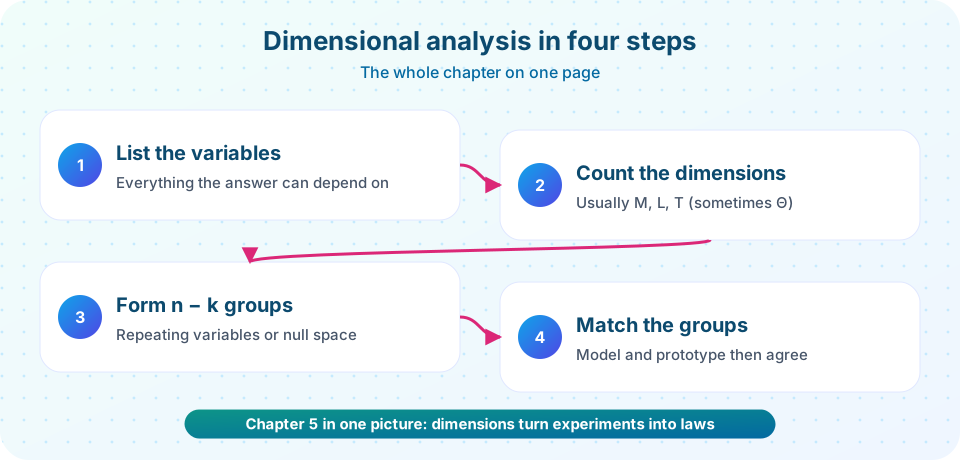
Recap table
| Idea | Rule or formula |
|---|---|
| Dimensional homogeneity | every term in an equation has the same dimensions |
| Buckingham Pi | n variables and k dimensions give n − k groups |
| Reynolds number | Re = ρ V L / μ, inertia to viscous force |
| Froude number | Fr = V / √(g L), inertia to gravity |
| Mach number | Ma = V / a, speed to sound speed |
| Euler number | Eu = Δp / (ρ V²), pressure to inertia |
| Froude scaling | V_m = V_p / √λ, force scales as λ³ (same fluid) |
| Reynolds scaling | V_m = V_p λ (ν_m/ν_p) |
| Dynamic similarity | all relevant groups equal |
| Incomplete similarity | match the dominant group, correct the rest |
Worked mini example
A pump of impeller diameter D turns at N revolutions per second, moves volume flow Q of a fluid of density ρ, produces a head that is energy per mass g H, and absorbs power P. That is six variables: P, ρ, N, D, Q, gH. They involve three dimensions, so there are 6 − 3 = 3 groups:
- flow coefficient
Q / (N D³), - head coefficient
g H / (N² D²), - power coefficient
P / (ρ N³ D⁵).
Chapter 8 will turn these three numbers into the pump affinity laws. This is dimensional analysis paying off twice.
Try it
Run a generic Pi-group counter. Add a problem of your own, with each variable written as exponents of (M, L, T).
Press Run (or Ctrl + Enter) to see the result here.
Program input · what you'd type while the program runs
Type the answers before you press Run, one per line. Each time the program reads a line (with input()), it gets the next line from this box.
Notice the pendulum: with period T, length L and gravity g there is exactly one group, T √(g/L), which is why the period does not depend on anything else, even though the numerical constant (2π) has to come from the physics.
Chapter in ten questions
Quick check · 10 questions
of 10 answered You scored / 10 · perfect!
-
1. Which pair of dimensions makes up kinematic viscosity?
Kinematic viscosity nu = mu / rho has dimensions L^2 T^-1 (m^2/s). -
2. A problem has 8 variables and the dimension matrix has rank 3. How many independent Pi groups are there?
n - k = 8 - 3 = 5. -
3. Which of these is NOT dimensionless?
rho V L has dimensions M L^-1 T^-1, the same as viscosity. Dividing by mu makes it the dimensionless Reynolds number. -
4. Under Froude scaling in the same fluid, a 1:100 model is tested at 1 m/s. What is the prototype speed?
V_p = V_m * sqrt(lambda) = 1 * 10 = 10 m/s. -
5. The same Froude-scaled model measures 5 N. With lambda = 100 and the same fluid, what is the prototype force?
Force scales as lambda^3 = 10^6, so 5 N becomes 5,000,000 N. -
6. Why is Reynolds scaling a problem for a small model in air?
In the same fluid V_m = V_p * lambda, so a small model needs a very fast flow and Mach number becomes important. -
7. Which group governs the breakup of small water droplets?
Weber number compares inertia to surface tension, which holds a droplet together. -
8. What does geometric similarity NOT guarantee?
Shape alone does not ensure the same force ratios; that needs equal dimensionless groups (dynamic similarity). -
9. The pendulum period depends on length L and gravity g only. What is the single group?
T has units of time and sqrt(L/g) has units of time, so T * sqrt(g/L) is dimensionless. -
10. A designer matches Fr but not Re in a ship test. What should the report do?
Honest practice is to list unmatched groups and apply a correction, as naval architects do for friction drag.
Summary
- The method: list variables, count dimensions, form
n − kgroups, then match groups. - Reynolds, Froude, Mach, Weber and Euler numbers each compare two effects.
- Froude scaling suits gravity-driven flows; Reynolds scaling suits viscous flows; most real tests match only one.
- Next chapter: apply these tools to the flow you will use most often, viscous flow in pipes.
Track your progress
Create a free account to tick off lessons and pick up where you left off on any device.
of Fluid Mechanics lessons completed