


















Lesson 32 of 44 · Boundary Layers and Drag
Boundary layer growth and thickness
Compute boundary layer thickness, displacement and momentum thickness, wall shear and skin friction drag on a flat plate, for laminar, turbulent and mixed layers.
The flat plate parallel to the flow is the simplest body there is, and the boundary layer on it is the best-understood in fluid mechanics. Paul Blasius, a student of Prandtl, solved the laminar case in 1908. His solution gives you the thickness of the layer, the shear stress at the wall and the total friction drag, all from one dimensionless number.
What you will learn
- How
Re_xcontrols the thickness of a laminar boundary layer. - What displacement and momentum thickness mean.
- How to compute skin friction and drag on a plate, laminar or turbulent.
- Where transition occurs and how to handle a mixed layer.
Key terms
Local Reynolds number: Re_x = U x / ν, where x is the distance from the leading edge.
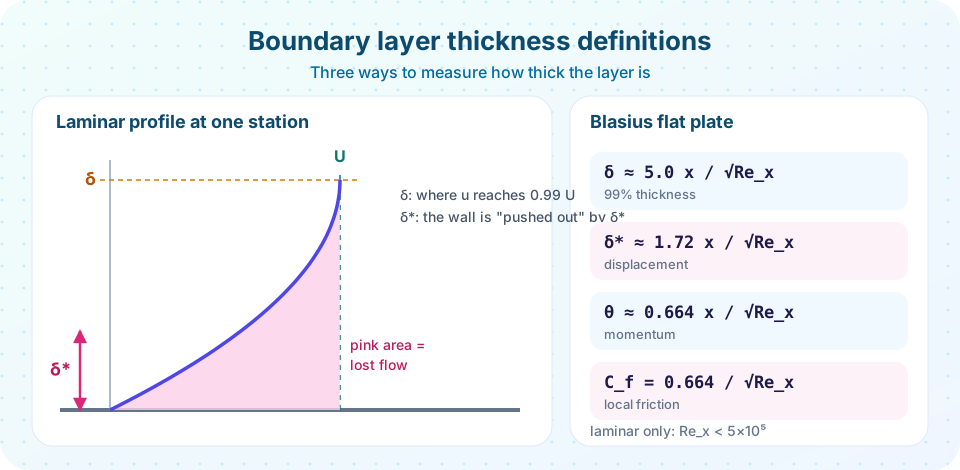
Displacement thickness (δ*): how far the outside flow is pushed away from the wall because of the slow layer. It equals the lost flow divided by U.
Momentum thickness (θ): a measure of the momentum deficit in the layer; it is proportional to the drag per unit width.
Skin friction coefficient: C_f = τ_w / (½ ρ U²), the wall shear made dimensionless.
The laminar layer (Blasius)
For a laminar boundary layer on a flat plate with no pressure gradient, the thickness grows as the square root of distance. Using the 99 percent definition for δ:
| Quantity | Laminar result |
|---|---|
Thickness δ |
5.0 x / √Re_x |
Displacement δ* |
1.72 x / √Re_x |
Momentum θ |
0.664 x / √Re_x |
Local skin friction C_f,x |
0.664 / √Re_x |
Average drag coefficient over length L |
C_D = 1.328 / √Re_L |
The thickness δ is defined as where the speed reaches 0.99 U. The displacement thickness is about a third of it: the slow layer acts as if the wall were thicker by δ*, and the outer flow bends outward by that amount. The momentum thickness gives the drag directly: the friction force per unit width up to station x is ρ U² θ.
Two lessons from the formulas:
- Thickness grows with
√xbut shrinks with√U. Doubling the speed makes the layer about 30 percent thinner. - Local friction falls with
x: the layer is thicker downstream, so its velocity gradient at the wall is gentler. The total drag still grows withLbecause friction accumulates; the average coefficient1.328/√Re_Lis exactly twice the local value atL.
Transition and the turbulent layer
Small disturbances (surface roughness, free-stream turbulence, noise) grow along the plate. On a smooth plate in a quiet stream the layer becomes turbulent near Re_x ≈ 5 × 10⁵, but depending on conditions that critical value can range from about 10⁵ to 10⁶ or more. Rough surfaces and noisy flows trip the layer earlier.
A turbulent layer is thicker and has a fuller profile (roughly u/U = (y/δ)^(1/7)). Typical correlations, valid for 5 × 10⁵ < Re < 10⁷:
δ ≈ 0.37 x / Re_x^(1/5)- Average drag coefficient
C_D = 0.074 / Re_L^(1/5)
The turbulent layer grows almost linearly with x (as x^0.8), compared with x^0.5 for laminar, and its wall friction is several times larger than a laminar layer at the same Re.
For a plate that is laminar over the front and turbulent behind (transition at Re_x = 5 × 10⁵), the average drag coefficient is
C_D = 0.074 / Re_L^(1/5) − 1742 / Re_L
The correction term removes the area that was actually laminar.
Drag on a plate
The friction force on one side of a plate of length L and width w is
F = C_D · ½ ρ U² · (L w)
Example. Air (ρ = 1.2 kg/m³, ν = 1.5 × 10⁻⁵ m²/s) at U = 5 m/s flows over a smooth plate of length L = 1 m and width w = 2 m.
Re_L = 5 × 1 / 1.5 × 10⁻⁵ = 3.3 × 10⁵, below5 × 10⁵, so the layer is laminar all the way.C_D = 1.328 / √(3.33 × 10⁵) = 0.0023.F = 0.0023 × ½ × 1.2 × 25 × 2 = 0.069 Non one side.- Thickness at the trailing edge:
δ = 5 × 1 / 577 ≈ 8.7 mm.
A tiny force, but a plate this smooth and this slow is rare. Long planes, ships and trains involve large Re and much more friction.
Common misconceptions
"The boundary layer is a sharp boundary." The velocity approaches U smoothly. δ is a convention (99 percent), and other definitions give other values.
"Thicker means more drag." Local shear is smaller where the layer is thicker. The turbulent layer is thicker and produces more drag because its profile is steeper at the wall.
"Turbulent boundary layers are always bad." They carry more skin friction but also resist separation, so on a bluff body a turbulent layer can cut total drag dramatically.
Try it
First, plot the layer thickness along a plate for three speeds. The laminar curve switches to a turbulent estimate at Re_x = 5 × 10⁵. The turbulent layer is given a virtual starting point so that its thickness matches the laminar one at transition: the formula 0.37 x/Re_x^0.2 alone assumes a turbulent layer from the leading edge, which would make the thickness jump.
Press Run (or Ctrl + Enter) to see the result here.
Program input · what you'd type while the program runs
Type the answers before you press Run, one per line. Each time the program reads a line (with input()), it gets the next line from this box.
Second, a skin-friction drag calculator for any plate, handling laminar, turbulent and mixed layers.
Press Run (or Ctrl + Enter) to see the result here.
Program input · what you'd type while the program runs
Type the answers before you press Run, one per line. Each time the program reads a line (with input()), it gets the next line from this box.
Check your understanding
Quick check · 5 questions
of 5 answered You scored / 5 · perfect!
-
1. On a laminar flat-plate boundary layer, how does the thickness delta grow with distance x?
delta = 5 x / sqrt(Re_x) and Re_x is proportional to x, so delta is proportional to sqrt(x). -
2. Air at 20 m/s (nu = 1.5e-5) flows over a plate. At x = 0.1 m what is Re_x?
Re_x = U x / nu = 20 x 0.1 / 1.5e-5 = 133,333. -
3. What is the displacement thickness a measure of?
delta* is the lost flow divided by U: the equivalent distance by which the wall seems displaced. -
4. For a plate with Re_L = 4 x 10^5 (smooth, quiet flow), which C_D formula applies?
Below Re_crit = 5 x 10^5 the layer is laminar, so the Blasius result 1.328/sqrt(Re_L) applies. -
5. Why does the local friction coefficient fall along the plate?
C_f,x = 0.664 / sqrt(Re_x) decreases with x because the velocity gradient at the wall falls as the layer grows.
Summary
- Laminar plate layer:
δ = 5x/√Re_x,C_f,x = 0.664/√Re_x, averageC_D = 1.328/√Re_L. - Transition happens near
Re_x ≈ 5 × 10⁵on a smooth plate in a quiet stream. - Turbulent layers:
δ ≈ 0.37 x/Re_x^0.2,C_D = 0.074/Re_L^0.2; for mixed layers subtract1742/Re_L. - Friction force on one side:
F = C_D · ½ρU² · L w.
Next: Drag and lift
Track your progress
Create a free account to tick off lessons and pick up where you left off on any device.
of Fluid Mechanics lessons completed