


















Lesson 22 of 44 · Dimensional Analysis
Chapter 5 overview: Dimensional analysis and similarity
Why engineers turn fluid problems into dimensionless numbers like Reynolds and Froude, and how that lets a small model predict a full-size machine.
Fluid flows are messy. A pipe has a diameter, a length, a roughness, and a fluid with a density and a viscosity. Change any one of these and the pressure drop changes. If you had to test every combination in a laboratory, you would never finish.
Dimensional analysis is the shortcut. It uses one simple rule, that an equation must make sense in its units, to shrink a problem with many variables into a problem with a few dimensionless groups. Experiments on a small model then tell you about a full-size machine. This chapter shows you how.
What you will learn
- Why dimensionless numbers make fluid problems simpler.
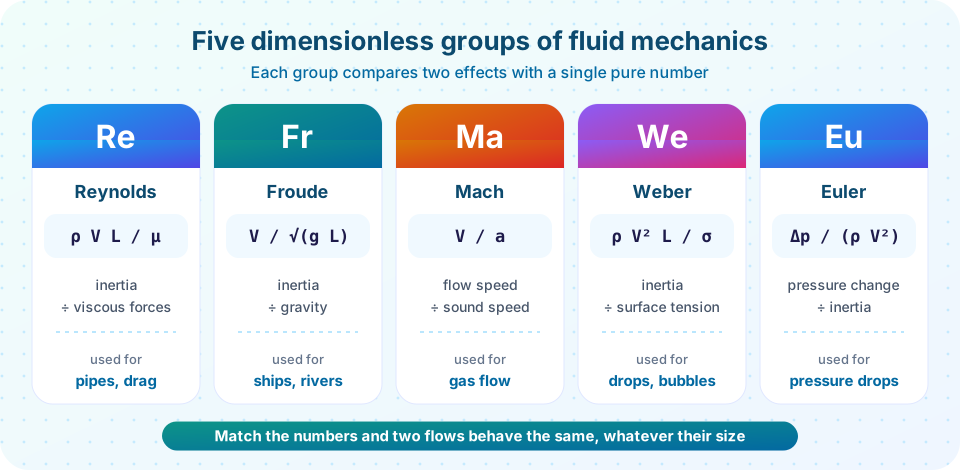
- What the five most common groups (Re, Fr, Ma, We, Eu) compare.
- How the chapter's three lessons fit together.
- How to check a quantity for dimensions in a few lines of code.
Key terms
Dimension: a kind of quantity, such as mass (M), length (L) or time (T), independent of the unit used to measure it.
Dimensionless group: a combination of variables in which every dimension cancels, so its value is a pure number.
Similarity: two flows are similar when their dimensionless groups match, even if their sizes and fluids differ.
Model and prototype: the small test version and the full-size real thing.
The big picture
Imagine you want the drag on a new submarine hull. You could build the submarine and measure the drag, which is expensive and too late. Or you could build a 1:20 model, drag it through a water tank, and scale the result. Scaling needs a rule. Dimensional analysis gives the rule.
The central idea is simple. Physical laws do not care what units you use, so every valid equation can be written using only dimensionless numbers. A drag force, for example, depends on speed, size, density and viscosity. Instead of four inputs you end up with two dimensionless numbers, a drag coefficient and a Reynolds number. One curve of drag coefficient against Reynolds number then covers every speed, size and fluid.
That is a big reduction. Rather than plotting a family of curves for each fluid, you plot one.
Why go dimensionless?
The method
Similarity
Limits
Five groups you will meet again and again
Every group is a ratio of two effects. Reading a group as a ratio tells you what it means physically.
| Group | Formula | Ratio of | Where it matters |
|---|---|---|---|
Reynolds, Re |
ρ V L / μ |
inertia to viscous force | pipes, drag, boundary layers |
Froude, Fr |
V / √(g L) |
inertia to gravity | ships, open channels, waves |
Mach, Ma |
V / a |
flow speed to sound speed | high-speed gas flow |
Weber, We |
ρ V² L / σ |
inertia to surface tension | drops, bubbles, sprays |
Euler, Eu |
Δp / (ρ V²) |
pressure change to inertia | pressure drops, cavitation |
Here ρ is density, V a typical speed, L a typical length, μ the dynamic viscosity, g the gravitational acceleration, a the speed of sound and σ the surface tension. Notice that none of these numbers has a unit. Water in a thin pipe and oil in a thick pipe can share the same Re, and when they do, the flow pattern looks the same.
How this chapter is organized
- Buckingham Pi and dimensionless groups: a step-by-step method that always produces the right number of groups.
- Similarity and model testing: matching groups between a model and a prototype, and why you often cannot match them all.
- Chapter review: a one-page recap and ten mixed questions.
Try it
The first example turns three real situations into numbers. Run it, then change the speeds or sizes and see which regime each case falls into.
Press Run (or Ctrl + Enter) to see the result here.
Program input · what you'd type while the program runs
Type the answers before you press Run, one per line. Each time the program reads a line (with input()), it gets the next line from this box.
The second example is a tiny dimension checker. It stores every quantity as three exponents of mass, length and time, and lets you multiply and divide quantities like algebra. A group is dimensionless when all three exponents are zero.
Press Run (or Ctrl + Enter) to see the result here.
Program input · what you'd type while the program runs
Type the answers before you press Run, one per line. Each time the program reads a line (with input()), it gets the next line from this box.
Check your understanding
Quick check · 4 questions
of 4 answered You scored / 4 · perfect!
-
1. What does the Reynolds number compare?
Re = ρVL/μ is the ratio of inertial to viscous forces. Froude compares inertia to gravity, Mach compares speed to sound speed. -
2. Which group matters most for waves made by a ship?
Waves on a free surface are driven by gravity, so the Froude number (inertia to gravity) governs wave patterns. -
3. What is the main benefit of using dimensionless groups?
Grouping variables turns many dimensional inputs into a few dimensionless ones, so one curve can cover many fluids and sizes. -
4. True or false: dimensional analysis alone can tell you the exact function linking the groups.
It tells you which groups matter and how many there are, but the actual function comes from experiment, theory or simulation.
Summary
- Dimensional analysis rewrites a problem with many variables as one with a few dimensionless groups.
- Each group is a ratio of two effects: Re (inertia/viscous), Fr (inertia/gravity), Ma (speed/sound), We (inertia/surface tension), Eu (pressure/inertia).
- Flows with equal groups are similar, which lets a model predict a prototype.
- The method gives the groups, not the function that links them.
Track your progress
Create a free account to tick off lessons and pick up where you left off on any device.
of Fluid Mechanics lessons completed