


















Lesson 33 of 44 · Boundary Layers and Drag
Drag and lift
Understand pressure drag and skin friction, drag coefficients of common shapes, Stokes and terminal velocity, lift coefficient and stall, with code you can run.
When a fluid flows past a body, it pushes on it. The part of that push along the flow is drag; the part across the flow is lift. Both come from only two things acting on the surface: the pressure and the wall shear stress. This lesson shows how engineers package a complicated pressure and shear field into two convenient numbers, C_D and C_L.
What you will learn
- The difference between skin-friction drag and pressure (form) drag.
- How to use
C_DandC_Land which reference area to choose. - How to compute terminal velocity in the Stokes and quadratic regimes.
- Why a wing stalls and what limits lift.
Key terms
Drag coefficient: C_D = F_D / (½ ρ V² A).
Lift coefficient: C_L = F_L / (½ ρ V² S), with S the wing area.
Frontal area (A): the area of the body's silhouette seen along the flow, the usual reference for bluff bodies.
Terminal velocity: the steady speed at which drag balances weight (net of buoyancy).
Stall: loss of lift when the flow separates over most of a wing's upper surface.
Two sources of drag
- Skin-friction drag comes from the wall shear stress, integrated over the surface. It dominates for streamlined bodies such as a thin plate parallel to the flow, an airship or a well-faired aircraft fuselage.
- Pressure (form) drag comes from the pressure difference between the front and the wake at the rear. It dominates for bluff bodies, such as a plate facing the flow, a sphere at high
Reor a truck.
Streamlining, in one sentence, means making the body gradual enough so the boundary layer stays attached, which shrinks the wake and trades large pressure drag for a small increase in skin friction.
Drag coefficients
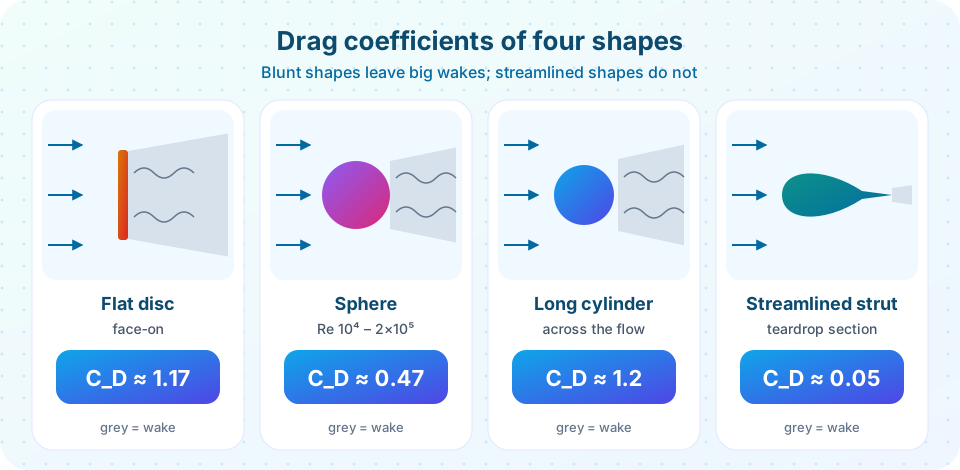
The force is F_D = C_D · ½ ρ V² A. Using the dimensional analysis of Chapter 5, C_D depends on shape and Reynolds number. Typical values based on frontal area:
| Body | C_D (approx.) |
Comment |
|---|---|---|
| Disc, face-on | 1.17 | separation at the sharp edge, almost independent of Re |
Sphere, Re about 10⁴ to 2 × 10⁵ |
0.47 | laminar layer separates early |
| Long cylinder across the flow | about 1.2 | below the critical Reynolds number |
| Streamlined strut or airfoil shape | about 0.05 | depends on thickness and Re |
| Modern passenger car | about 0.25 to 0.35 | depends on design |
For a sphere there is a famous drag crisis near Re ≈ 3 × 10⁵. The boundary layer turns turbulent before it separates, clings longer to the surface, and the wake shrinks. C_D falls to roughly 0.1 to 0.3 (the exact value depends on surface roughness and free-stream turbulence). Golf-ball dimples trip the boundary layer on purpose so the ball flies in this low-drag regime.
Terminal velocity
A falling object speeds up until drag plus buoyancy equals weight.
Quadratic drag (high Re). Ignoring buoyancy in air, m g = ½ ρ V² C_D A, so
V_t = √( 2 m g / (ρ C_D A) ).
A skydiver of mass 80 kg in a belly-down position, with a drag area C_D A of about 0.45 m² (an assumed typical value), has V_t = √(2 × 80 × 9.81 / (1.2 × 0.45)) ≈ 54 m/s, about 194 km/h. Head-down, C_D A is smaller and the speed larger.
Stokes drag (very low Re, below about 1). For a small sphere of diameter D moving slowly, George Stokes showed in 1851 that F_D = 3 π μ V D. Equating drag with net weight gives
V_t = (ρ_s − ρ) g D² / (18 μ).
A sand grain of diameter 0.05 mm (ρ_s = 2,650 kg/m³) in water settles at about 2.2 mm/s, with Re around 0.1, so Stokes applies. That is why fine silt takes hours or days to settle.
For the range in between, use an empirical law such as C_D = (24/Re)(1 + 0.15 Re^0.687) (Schiller and Naumann), good up to Re of about 800.
Lift
For a thin wing at a small angle of attack α (in radians), potential-flow theory predicts
C_L ≈ 2π α (for a symmetric thin airfoil)
Each degree adds about 0.11 to C_L. A cambered wing has lift even at α = 0.
Example: a wing of area S = 16 m² at V = 50 m/s (sea-level air) with a symmetric section at α = 4° has C_L = 2π × 0.0698 = 0.44. The lift is L = C_L · ½ ρ V² S = 0.44 × 0.5 × 1.2 × 2,500 × 16 ≈ 10.5 kN, enough for about a ton.
Lift cannot grow forever. At roughly 12 to 16 degrees for a typical wing, the adverse pressure gradient on the upper surface causes the boundary layer to separate over most of the wing. Lift drops suddenly and drag rises: stall. A wing's maximum C_L sets the minimum flying speed: V_stall = √(2 W / (ρ S C_L,max)).
A real wing also has induced drag, a by-product of lift. Long, slender wings (large aspect ratio) have less of it, which is why gliders have wings so long.
Common misconceptions
"Drag is always a force that can only be reduced by smoother surfaces." For bluff bodies it is the shape that counts. A smoother sphere can have more drag than a rough one near the drag crisis.
"Lift comes from air going faster over the top, so it must travel the same time." There is no rule that the two streams reach the trailing edge together. Lift is explained by the pressure field, the turning of the flow, and circulation; the "equal transit time" story is wrong.
"C_D is a constant of the shape." It also depends on Re (and surface roughness, turbulence, Mach number).
Try it
First, compute how fast sand grains settle in water, using the Schiller-Naumann drag law, and compare with Stokes. The curves agree for tiny grains and separate once Re approaches 1.
Press Run (or Ctrl + Enter) to see the result here.
Program input · what you'd type while the program runs
Type the answers before you press Run, one per line. Each time the program reads a line (with input()), it gets the next line from this box.
Second, a lift curve for a thin symmetric wing. Thin-airfoil theory gives the straight line; the drop after about 15 degrees is a sketch of stall, not a measurement of a specific wing.
Press Run (or Ctrl + Enter) to see the result here.
Program input · what you'd type while the program runs
Type the answers before you press Run, one per line. Each time the program reads a line (with input()), it gets the next line from this box.
Check your understanding
Quick check · 6 questions
of 6 answered You scored / 6 · perfect!
-
1. Which type of drag dominates for a flat plate facing the flow?
The sharp edges force separation and a large low-pressure wake, so pressure drag dominates. -
2. A sphere of frontal area 0.01 m^2 with C_D = 0.47 moves at 20 m/s in air (rho = 1.2). What is the drag force?
F = C_D x 0.5 x rho x V^2 x A = 0.47 x 0.5 x 1.2 x 400 x 0.01 = 1.13 N. -
3. Terminal velocity in the quadratic regime scales with:
V_t = sqrt(2 m g / (rho C_D A)), so it grows with the square root of the mass. -
4. Why do golf balls have dimples?
A turbulent layer clings longer to the ball, shrinking the wake and reducing pressure drag. -
5. What happens at stall?
Beyond the critical angle of attack the boundary layer separates, lift drops and drag increases. -
6. Thin-airfoil theory predicts C_L = 2 pi alpha. What is C_L at alpha = 3 degrees?
3 degrees = 0.05236 rad, and 2 pi x 0.05236 = 0.329.
Summary
- Drag is skin friction plus pressure drag;
F_D = C_D · ½ρV²A,F_L = C_L · ½ρV²S. - Blunt bodies have large wakes and
C_Dof order 1; streamlined bodies haveC_Dof order 0.05. - Stokes drag
3πμVDapplies belowRe ≈ 1; terminal velocity is√(2mg/ρC_D A)at highRe. C_L ≈ 2παfor a thin wing until stall at about 12 to 16 degrees.
Next: Chapter 7 review
Track your progress
Create a free account to tick off lessons and pick up where you left off on any device.
of Fluid Mechanics lessons completed