


















Lesson 31 of 44 · Boundary Layers and Drag
Chapter 7 overview: Boundary layers and drag
Meet Prandtl's boundary layer, the thin region near a surface where friction matters, and see how it leads to skin friction, separation, drag and lift.
For most of the nineteenth century fluid mechanics had a paradox. Theory for a fluid without friction (the "ideal" flow) predicted that a body in a steady stream feels no drag at all. Real bodies obviously do. Ideal theory worked well away from the body and failed completely next to it.
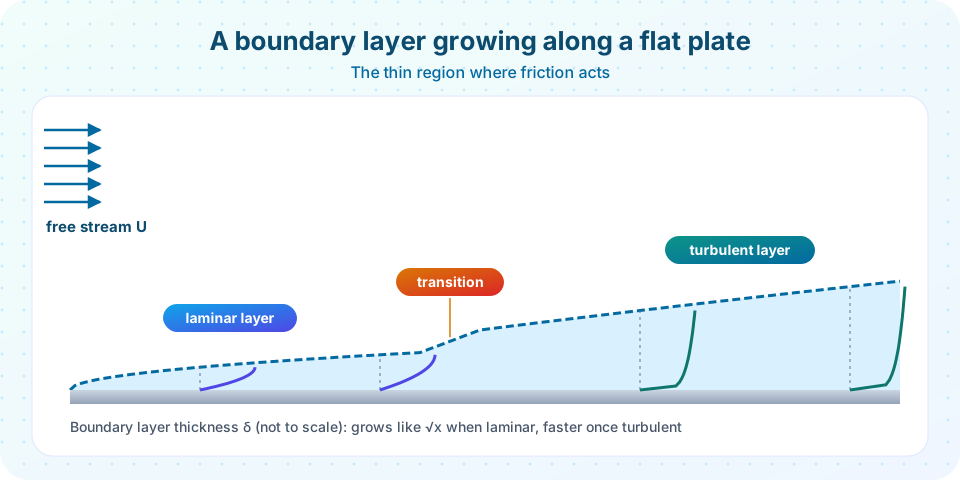
In 1904 Ludwig Prandtl solved the paradox with one idea: at high Reynolds number, friction is confined to a thin layer next to the surface. Outside that boundary layer the fluid behaves as if it had no viscosity. Inside it, the speed rises from zero at the wall to the free-stream value. Nearly everything about drag, lift and heat transfer comes from what happens in that thin layer.
What you will learn
- What a boundary layer is and why it is thin at high Reynolds number.
- How laminar and turbulent boundary layers differ.
- What separation is and why it creates wakes and drag.
- How the four lessons in this chapter connect.
Key terms
Free stream: the flow outside the boundary layer, speed U.
Boundary layer thickness (δ): the distance from the wall where the speed reaches 99 percent of U.
Skin friction: the drag caused by shear stress at the wall.
Pressure (form) drag: the drag caused by pressure differences over the body, usually from a wake.
The big picture
Consider air flowing at 10 m/s along a flat plate. Right at the surface the air sticks to the plate (the no-slip condition), so the speed is zero there. A short distance away the speed is almost 10 m/s. The region between is the boundary layer. A tenth of a meter from the leading edge, it is only about 2 millimeters thick.
The layer starts laminar. As it grows, small disturbances amplify, the layer becomes turbulent, and it thickens quickly. A turbulent layer has more wall friction than a laminar one at the same station, but it also resists separation better: this trade-off explains why golf balls have dimples and why aircraft wings have carefully designed surfaces.
The boundary layer also reveals why bodies have drag. If the pressure outside the layer rises along the surface (an adverse pressure gradient), the slow fluid near the wall can stall and reverse, and the layer lifts off the surface. This is separation. Behind a separated flow there is a low-pressure wake, and the pressure difference between front and back is the pressure drag.
Prandtl's idea
Two kinds of layer
Two kinds of drag
Coefficients
How this chapter is organized
- Boundary layer growth and thickness: laminar and turbulent layers on a flat plate, thickness definitions, wall shear and plate drag.
- Drag and lift: bluff bodies, drag coefficients, terminal velocity, lift and stall.
- Chapter review: separation, key numbers and ten questions.
Try it
How thick is the layer in practice? The code below computes the laminar boundary layer thickness δ = 5 x / √Re_x along a plate for air at 10 m/s, flags where transition is expected (Re_x ≈ 5 × 10⁵) and continues with a turbulent estimate beyond it.
Press Run (or Ctrl + Enter) to see the result here.
Program input · what you'd type while the program runs
Type the answers before you press Run, one per line. Each time the program reads a line (with input()), it gets the next line from this box.
Check your understanding
Quick check · 4 questions
of 4 answered You scored / 4 · perfect!
-
1. Who introduced the boundary layer concept, and when?
Prandtl's 1904 paper showed that friction is confined to a thin layer at high Reynolds number. -
2. What is separation?
Under an adverse pressure gradient the near-wall flow reverses and the layer leaves the surface, leaving a low-pressure wake. -
3. Which has the higher wall shear stress at the same location, laminar or turbulent boundary layer?
Turbulent mixing steepens the velocity gradient at the wall, so the shear stress is larger. -
4. Where is the free-stream speed U reached?
By definition the free stream is the flow outside the boundary layer; delta is where u reaches 0.99 U.
Summary
- Prandtl: at high
Re, friction is confined to a thin boundary layer next to the surface. - Layers begin laminar, become turbulent around
Re_x ≈ 5 × 10⁵on a flat plate, and then thicken faster. - Total drag is skin friction plus pressure drag; separation creates the wake behind bluff bodies.
Track your progress
Create a free account to tick off lessons and pick up where you left off on any device.
of Fluid Mechanics lessons completed