


















Lesson 3 of 44 · Getting Started
Units and Dimensions
Master SI units, dimensions (M, L, T) and dimensional homogeneity for fluid mechanics, with unit conversions and a runnable dimension checker.
In 1999 NASA lost its Mars Climate Orbiter because one team used pound-force seconds and another used newton seconds. A spacecraft worth hundreds of millions of dollars burned up for a unit error. Fluid mechanics mixes many quantities (pressure, viscosity, flow rate, power), so a clean habit with units is the cheapest way to avoid mistakes. This lesson sets up the SI system, the idea of dimensions, and a test called dimensional homogeneity that checks an equation before you ever use it.
What you will learn
- The SI base units and the common derived units in fluid mechanics.
- How to write the dimensions of a quantity in terms of M, L and T.
- How to test an equation using dimensional homogeneity.
- How to convert between SI, bar, atm, psi and other pressure units.
Key terms
Dimension: the kind of quantity, such as length (L) or mass (M), independent of the unit you measure it in.
Unit: a specific standard for measuring a dimension, such as meter or foot.
Dimensional homogeneity: every term in a valid physical equation has the same dimensions.
Dimensionless quantity: a ratio with no dimensions, such as a Reynolds number or a drag coefficient.
Dimensions and units
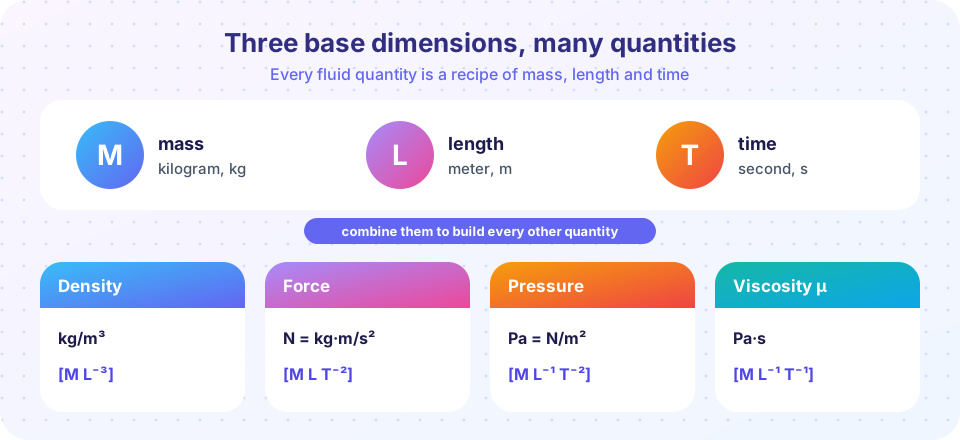
A dimension says what kind of thing you measure; a unit says how you measure it. Length is a dimension; meters, feet and miles are units of it. In mechanics, three base dimensions are enough:
| Dimension | Symbol | SI base unit |
|---|---|---|
| Mass | M | kilogram (kg) |
| Length | L | meter (m) |
| Time | T | second (s) |
(Temperature, Θ, joins them when heat flow or gas properties matter.) Everything else is a combination. Square brackets mean "dimensions of":
| Quantity | Symbol | Dimensions | SI unit |
|---|---|---|---|
| Velocity | V | [L T⁻¹] |
m/s |
| Acceleration | a, g | [L T⁻²] |
m/s² |
| Force | F | [M L T⁻²] |
newton, N = kg·m/s² |
| Pressure, stress | p, τ | [M L⁻¹ T⁻²] |
pascal, Pa = N/m² |
| Density | ρ | [M L⁻³] |
kg/m³ |
| Dynamic viscosity | μ | [M L⁻¹ T⁻¹] |
Pa·s |
| Kinematic viscosity | ν = μ/ρ | [L² T⁻¹] |
m²/s |
| Volume flow rate | Q | [L³ T⁻¹] |
m³/s |
| Mass flow rate | ṁ | [M T⁻¹] |
kg/s |
| Power | P | [M L² T⁻³] |
watt, W |
| Surface tension | σ | [M T⁻²] |
N/m |
You can derive any entry from a defining equation. Force is mass times acceleration, so [F] = M · L T⁻² = M L T⁻². Pressure is force per area, so [p] = M L T⁻² / L² = M L⁻¹ T⁻². Viscosity comes from τ = μ du/dy: [μ] = [τ] / [du/dy] = M L⁻¹ T⁻² / T⁻¹ = M L⁻¹ T⁻¹.
Dimensional homogeneity
A physical equation must make sense whatever units you pick, so it can only add or equate quantities with the same dimensions. You cannot add a length to a time. That principle gives a powerful check.
Test the hydrostatic equation p = ρ g h:
- Left side:
[p] = M L⁻¹ T⁻². - Right side:
[ρ][g][h] = (M L⁻³)(L T⁻²)(L) = M L⁻¹ T⁻². ✓
Now test the Bernoulli equation p + ½ρV² + ρ g z = constant. Each term must have the dimensions of pressure:
[½ρV²] = (M L⁻³)(L² T⁻²) = M L⁻¹ T⁻²✓[ρ g z] = (M L⁻³)(L T⁻²)(L) = M L⁻¹ T⁻²✓
Dimensional homogeneity does not prove an equation is correct (a wrong factor of 2 passes the test), but it catches a large share of algebra slips. It is also the basis of dimensional analysis in chapter 5.
Unit conversions
Always convert to SI before substituting. Some useful values:
| Quantity | Conversion |
|---|---|
| Standard atmosphere | 1 atm = 101 325 Pa |
| Bar | 1 bar = 100 000 Pa = 100 kPa |
| Pound per square inch | 1 psi = 6894.76 Pa |
| mm of mercury | 1 mmHg = 133.322 Pa |
| Standard gravity | g = 9.80665 m/s² |
| Liter | 1 L = 0.001 m³ |
| US gallon | 1 gal = 3.785 × 10⁻³ m³ |
| Horsepower (mechanical) | 1 hp = 745.7 W |
Worked example. A tire gauge reads 32 psi. In pascals: 32 × 6894.76 ≈ 220 600 Pa = 2.21 bar (gauge). A pump delivers 120 L/min: 120 × 0.001 / 60 = 0.0020 m³/s.
Press Run (or Ctrl + Enter) to see the result here.
Program input · what you'd type while the program runs
Type the answers before you press Run, one per line. Each time the program reads a line (with input()), it gets the next line from this box.
Try adding your own quantity, such as surface tension (1, 0, -2), and build the Weber number ρ V² D / σ to confirm it is dimensionless.
Press Run (or Ctrl + Enter) to see the result here.
Program input · what you'd type while the program runs
Type the answers before you press Run, one per line. Each time the program reads a line (with input()), it gets the next line from this box.
Notice that 1 atm is about 10.3 to 10.4 meters of water, the height of a water column that the atmosphere can support (Hydrostatic Pressure explains why).
Common misconceptions
"If the units balance, the equation is right." Homogeneity is necessary, not sufficient. p = 2ρgh passes the test but is wrong.
"kg and N are the same on Earth." A kilogram measures mass; a newton measures force. A 1 kg object weighs 1 × 9.81 = 9.81 N.
"Pounds are always mass." In US customary units, lb (pound-mass) and lbf (pound-force) differ. SI avoids the confusion, so this course uses SI throughout.
Check your understanding
Quick check · 5 questions
of 5 answered You scored / 5 · perfect!
-
1. What are the dimensions of dynamic viscosity μ?
From τ = μ du/dy: [μ] = [M L⁻¹ T⁻²] / [T⁻¹] = M L⁻¹ T⁻¹, with SI unit Pa·s. -
2. Which expression has the dimensions of pressure?
ρV² = (M L⁻³)(L² T⁻²) = M L⁻¹ T⁻², the dimensions of pressure. -
3. A pump delivers 90 L/min. What is the flow rate in m³/s?
90 L/min = 90 × 0.001 m³ / 60 s = 0.0015 m³/s. -
4. Which pressure is the largest?
1 atm = 101.325 kPa, 1 bar = 100 kPa, 14 psi ≈ 96.5 kPa, 700 mmHg ≈ 93.3 kPa. -
5. Dimensional homogeneity can prove that an equation is
If the terms do not share dimensions the equation must be wrong. Passing the test only means it might be right.
Summary
- Dimensions (M, L, T) say what a quantity is; units say how it is measured.
- Pressure is
[M L⁻¹ T⁻²], viscosity[M L⁻¹ T⁻¹], density[M L⁻³]. - Every term in a valid equation has the same dimensions (homogeneity).
- Convert everything to SI first: 1 atm = 101 325 Pa, 1 psi ≈ 6895 Pa, 1 L = 10⁻³ m³.
- Dimensionless groups such as
ρVD/μhave all exponents equal to zero.
Next: Describing Flow
Track your progress
Create a free account to tick off lessons and pick up where you left off on any device.
of Fluid Mechanics lessons completed