


















Lesson 35 of 44 · Compressible Flow and Machinery
Chapter 8 overview: Compressible flow and machinery
See why gas flow changes near the speed of sound, what Mach number, nozzles and shock waves do, and how pumps and turbines add or extract energy.
Water is hard to squeeze, so for most liquid problems we treat the density as constant. Gases are different. When air moves slowly, it can be treated as incompressible too, but when the speed approaches the speed of sound, pressure changes become large enough to change the density, and a new kind of physics appears: choking, shock waves and flows that speed up when the channel widens.
The second half of this chapter turns to machines: the pumps, fans, compressors and turbines that put energy into a fluid or take it out. Together the two halves cover how fluid power systems actually work.
What you will learn
- Why the Mach number controls whether density changes matter.
- What isentropic flow, a nozzle, choking and a shock wave are.
- What turbomachines do and how a pump meets its system.
- How the five lessons of this chapter connect.
Key terms
Compressible flow: flow in which density changes significantly, in practice when Ma exceeds about 0.3.
Speed of sound (a): the speed of small pressure disturbances, a = √(γ R T) for an ideal gas.
Stagnation properties: the values that would be reached if the flow were brought to rest without loss (T₀, p₀).
Turbomachine: a machine with a rotating blade row that exchanges energy with a flowing fluid: pump, fan, compressor, turbine.
The big picture
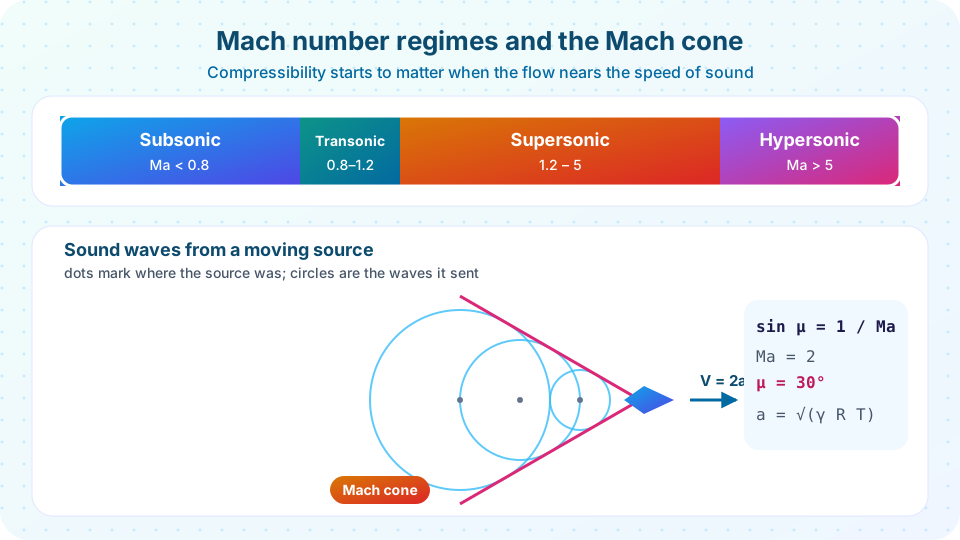
Information in a gas travels as sound. If a body moves slower than sound, it sends pressure signals ahead and the gas gets out of the way smoothly. If the body moves faster than sound, the signals cannot outrun it; they pile up into a thin front called a shock wave, across which pressure, density and temperature jump.
The Mach number Ma = V / a is the key dimensionless group. For Ma < 0.3 density changes are under about 5 percent, and incompressible methods are fine. Between 0.3 and 0.8 compressibility corrections matter. Near 1 (transonic) the flow is mixed, with subsonic and supersonic regions. Above 1 (supersonic) shocks form. Above about 5 (hypersonic) the gas gets so hot that its chemistry changes.
One of the strangest facts of compressible flow: in a subsonic flow a duct that narrows speeds the gas up, but in a supersonic flow a duct that widens speeds it up. This is how rocket nozzles work, and it is the heart of the next lesson.
Mach number
Nozzles
Shock waves
Machines
How this chapter is organized
- Isentropic flow: stagnation properties, the area-Mach relation and choked flow.
- Nozzles and shock waves: back pressure effects and normal shock relations.
- Pumps and turbines: Euler's equation, head, power, affinity laws and the operating point.
- Chapter review: a recap and ten questions.
Try it
The speed of sound depends on temperature, and temperature drops with altitude in the standard atmosphere (6.5 K per kilometer up to 11 km, then constant at 216.65 K). The code finds a at several altitudes and the Mach number of an aircraft at 250 m/s.
Press Run (or Ctrl + Enter) to see the result here.
Program input · what you'd type while the program runs
Type the answers before you press Run, one per line. Each time the program reads a line (with input()), it gets the next line from this box.
Check your understanding
Quick check · 4 questions
of 4 answered You scored / 4 · perfect!
-
1. Above roughly what Mach number must a gas flow be treated as compressible?
At Ma about 0.3 density changes reach roughly 5 percent, so compressibility corrections begin to matter. -
2. What is the speed of sound in air at 300 K? (gamma = 1.4, R = 287 J/kg K)
a = sqrt(1.4 x 287 x 300) = sqrt(120,540) = 347 m/s. -
3. A supersonic flow in a diverging duct will:
For Ma above 1, an increase in area makes the gas accelerate, the opposite of subsonic behavior. -
4. What happens across a shock wave?
A shock compresses the gas: pressure, density and temperature jump up, and the flow decelerates.
Summary
Ma = V/a, witha = √(γRT), decides whether compressibility matters.- Subsonic and supersonic flows react oppositely to area changes; the throat of a nozzle is where
Ma = 1. - Shock waves compress supersonic gas suddenly.
- Turbomachines add or remove energy; a pump settles where its curve meets the system curve.
Next: Isentropic flow
Track your progress
Create a free account to tick off lessons and pick up where you left off on any device.
of Fluid Mechanics lessons completed