


















Lesson 21 of 44 · Bernoulli and Energy
Chapter 4 Review: Bernoulli and Energy
Review Bernoulli's equation, Pitot tubes, Venturi meters, the energy equation with pumps and losses, and grade lines with a recap table and a 10-question quiz.
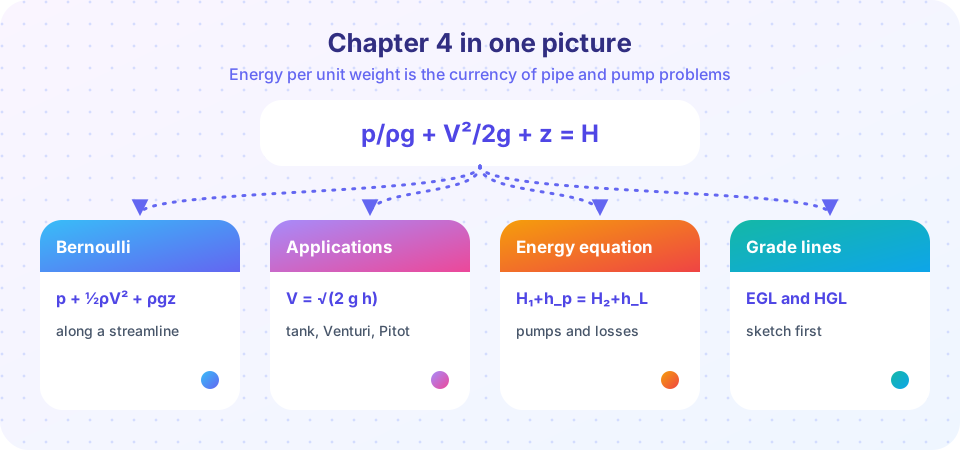
You now have the three conservation tools for ideal and simple real flows: continuity (mass), the momentum equation (forces) and the energy equation (heads). This review pulls chapter 4 together and gives you a mixed quiz. After this, chapter 5 introduces dimensional analysis, the method that tells you how to scale experiments and how to organise results when no equation is available.
What you will learn
- How the four lessons of chapter 4 connect.
- A checklist for choosing between Bernoulli and the energy equation.
- The formulas and sign conventions to memorize.
Recap table
| Lesson | Key equation | Remember |
|---|---|---|
| Overview | p/ρg + V²/2g + z = H |
Heads are energy per unit weight |
| Bernoulli equation | p + ½ρV² + ρgz = constant |
Steady, frictionless, incompressible, along a streamline |
| Applications | V = √(2gh), V = √(2Δp/ρ), Venturi Q |
Use C_d for real devices |
| Energy equation | … + h_p = … + h_T + h_L |
P = ρ g Q h_p/η; EGL only falls |
Choosing the right tool
- Is there friction, a pump or a turbine between the points? Use the energy equation.
- Short, smooth, no machines? Bernoulli is accurate.
- Need a force? Use the momentum equation.
- Unknown velocity? Add continuity.
- Gas near Mach 0.3 or faster? Chapter 8 (compressible flow).
A combined problem
Water flows at 0.05 m³/s through a horizontal Venturi (inlet 150 mm, throat 75 mm) and then through a nozzle into the air.
V₁ = 0.05/(π 0.075²) = 2.83 m/s;V₂ = 4 V₁ = 11.3 m/s.- Pressure drop (Bernoulli):
Δp = ½ρ(V₂² − V₁²) = 0.5 × 998 × (128.2 − 8.0) = 60 kPa. - Jet momentum force if it hits a flat plate with a 50 mm nozzle:
V = 0.05/(π 0.025²) = 25.5 m/s,F = ρ Q V = 998 × 0.05 × 25.5 ≈ 1270 N.
Press Run (or Ctrl + Enter) to see the result here.
Program input · what you'd type while the program runs
Type the answers before you press Run, one per line. Each time the program reads a line (with input()), it gets the next line from this box.
Check your understanding
Quick check · 10 questions
of 10 answered You scored / 10 · perfect!
-
1. Which of these is NOT an assumption of Bernoulli's equation?
Velocity changes along the streamline (that is the whole point); the other three are required. -
2. Water flows in a horizontal pipe at 1 m/s and 150 kPa gauge, then at 4 m/s. The new gauge pressure is about
p₂ = 150 000 + 0.5 × 998 × (1 − 16) = 142.5 kPa. -
3. The jet speed from a hole 8 m below the surface of a large open tank is about
√(2 × 9.81 × 8) = 12.5 m/s. -
4. A Pitot-static tube in water (998 kg/m³) reads Δp = 5 kPa. The speed is
V = √(2 × 5000/998) = 3.17 m/s. -
5. A pump supplies 25 m of head at 0.03 m³/s of water (η = 0.8). Shaft power is about
ρ g Q h_p/η = 998 × 9.81 × 0.03 × 25 / 0.8 ≈ 9.18 kW. -
6. The HGL lies below the EGL by
EGL − HGL = V²/2g. -
7. In a passive pipe (no pump), the EGL
Friction continuously converts mechanical energy to heat. -
8. The kinetic energy correction factor α for laminar pipe flow is
The parabolic laminar profile has α = 2. -
9. At a stagnation point
The stagnation pressure is static plus dynamic pressure of the oncoming flow. -
10. Which is the main limit on how high a water siphon can lift?
The crest pressure cannot fall below the vapor pressure, which limits the lift to roughly 10 m.
Summary
- Bernoulli = energy conservation along a streamline in ideal flow.
- Add
h_p,h_Tandh_Lfor the energy equation of real systems. - The EGL tracks total head and only falls except at pumps; HGL = EGL − V²/2g.
- Applications: Torricelli, Pitot, Venturi, siphon.
Next: Chapter 5 overview: Dimensional analysis and similarity
Track your progress
Create a free account to tick off lessons and pick up where you left off on any device.
of Fluid Mechanics lessons completed