


















Lesson 41 of 44 · Projects and Practice
Project: Cyclist drag and power
Apply drag and rolling resistance to a cyclist: solve the speed for a given power, see why aero position matters, and test the effects of hills and headwinds.
On a flat road at racing speed, a cyclist spends most of their effort pushing air out of the way. That makes cycling a perfect real-world exercise in drag: the physics is the same as for aircraft and cars, the numbers are small enough to feel, and you can measure the results with a power meter.
In this project you will build a power model, solve it for speed, and use it to answer practical questions such as "how much faster is a tucked position?" and "how much does a headwind cost?"
What you will learn
- How air drag and rolling resistance combine into a power equation.
- How to solve the cubic for speed with a few lines of code.
- Why drag area
C_D Amatters more than any other variable at speed. - How hills, headwinds and drafting change the answer.
Key terms
Drag area (C_D A): the product of drag coefficient and frontal area, in m². It is the quantity a rider can compare between positions and equipment.
Rolling resistance coefficient (C_rr): the rolling force divided by the normal load; about 0.003 to 0.006 for good road tires.
Drivetrain efficiency (η): the fraction of pedal power that reaches the wheel; about 0.95 to 0.98 for a clean chain.
Air speed: the speed of the rider relative to the air: ground speed plus the headwind.
The model
At steady speed v on a flat road with no wind, the power at the wheel balances two resistive forces:
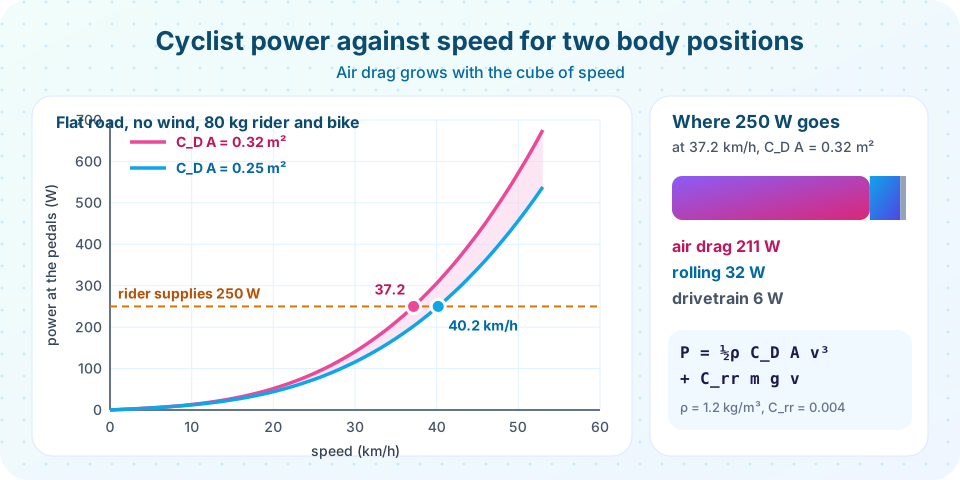
η P = ½ ρ C_D A v³ + C_rr m g v
- The first term is air drag times speed: force
½ ρ C_D A v²timesvgives av³dependence. - The second is rolling resistance, force
C_rr m g, timesv. - On a slope with angle
θthere is a third termm g v sinθ. - With a headwind
w, air drag uses the air speed(v + w)and the power is½ ρ C_D A (v + w)² v.
Take a rider and bike of total mass m = 80 kg, C_rr = 0.004, air density ρ = 1.2 kg/m³, η = 0.975, and the upright-ish drag area C_D A = 0.32 m². For a power P = 250 W the equation gives v ≈ 10.3 m/s, or about 37 km/h. Of the 244 W reaching the wheel, about 211 W (87 percent) goes into air drag and only 32 W into rolling resistance.
Move to a tucked position with C_D A = 0.25 m² at the same 250 W and the speed becomes about 40.2 km/h: three more kilometers per hour, with no extra fitness.
Why the cubic matters
Power scales with the cube of speed, so extra speed costs a lot. Going from 37 to 40 km/h is only 8 percent faster but needs about 26 percent more aerodynamic power. For this reason, riders fight for every hundredth of a square meter of drag area: helmets, clothing, handlebar position and even where the water bottle sits all change C_D A.
At low speeds, such as a steep climb at 6 km/h, the cubic term is tiny. Climbing is dominated by gravity, so weight matters more than aerodynamics.
Common misconceptions
"Drag is proportional to speed." Drag force grows as v² and drag power as v³.
"A tailwind cancels a headwind." Over a loop, the headwind costs more than the tailwind returns, because power depends on the cube of the air speed and the rider spends more time in the headwind.
"Rolling resistance is negligible." It is small at racing speed (13 percent in our example) but dominates at walking pace and on rough surfaces.
Try it
First, solve for the speed by bisection and compare positions and slopes. The power equation includes the gravity term for a slope given in percent.
Press Run (or Ctrl + Enter) to see the result here.
Program input · what you'd type while the program runs
Type the answers before you press Run, one per line. Each time the program reads a line (with input()), it gets the next line from this box.
Second, the effect of wind. The plot shows ground speed at 250 W for headwinds and tailwinds, and compares a tucked rider with an upright one.
Press Run (or Ctrl + Enter) to see the result here.
Program input · what you'd type while the program runs
Type the answers before you press Run, one per line. Each time the program reads a line (with input()), it gets the next line from this box.
Check your understanding
Quick check · 5 questions
of 5 answered You scored / 5 · perfect!
-
1. Doubling the speed of a cyclist on the flat multiplies the aerodynamic power by about:
Air drag power is proportional to v^3, and 2^3 = 8. -
2. Which has the biggest effect at 40 km/h on a flat road?
At this speed about 85 percent of the power fights air drag, so a 10 percent cut in CdA is worth much more than the other changes. -
3. A rider with CdA = 0.30 m^2 rides at 10 m/s in still air (rho = 1.2). What is the aerodynamic drag force?
F = 0.5 x 1.2 x 0.30 x 100 = 18 N. -
4. What is the correct air speed for a rider at 10 m/s into a 4 m/s headwind?
The air speed is the ground speed plus the headwind: 14 m/s. -
5. Why does a headwind cost more than a tailwind of the same speed gives back?
The nonlinear dependence on air speed and the longer time in the slower headwind leg make the trip slower on average.
Summary
- Steady speed on the flat:
η P = ½ ρ C_D A v³ + C_rr m g v; addm g v sinθfor a slope. - Air drag grows with
v²as a force andv³as power, so aerodynamics dominates at racing speed and gravity dominates on steep climbs. - Drag area is the most valuable variable to improve; headwinds cost more than tailwinds give back.
Track your progress
Create a free account to tick off lessons and pick up where you left off on any device.
of Fluid Mechanics lessons completed