


















Lesson 4 of 44 · Getting Started
Describing Flow: Fields, Streamlines and Regimes
Learn the Eulerian velocity field, streamlines, steady versus unsteady flow, laminar versus turbulent flow and the Reynolds number, with live plots.
To study a flow you first need a way to describe it. Do you follow one drop of water as it travels, or do you stand still and watch the water pass by? Engineers almost always choose the second. This lesson introduces the velocity field, the lines we draw to visualize it, and the key question of whether a flow is smooth (laminar) or chaotic (turbulent).
What you will learn
- The difference between the Lagrangian and Eulerian descriptions.
- How to read and sketch streamlines and what steady, uniform and one-dimensional mean.
- How to find the acceleration of a fluid particle in a steady field.
- How the Reynolds number predicts laminar or turbulent flow in a pipe.
Key terms
Velocity field: the velocity vector V(x, y, z, t) at every point and time.
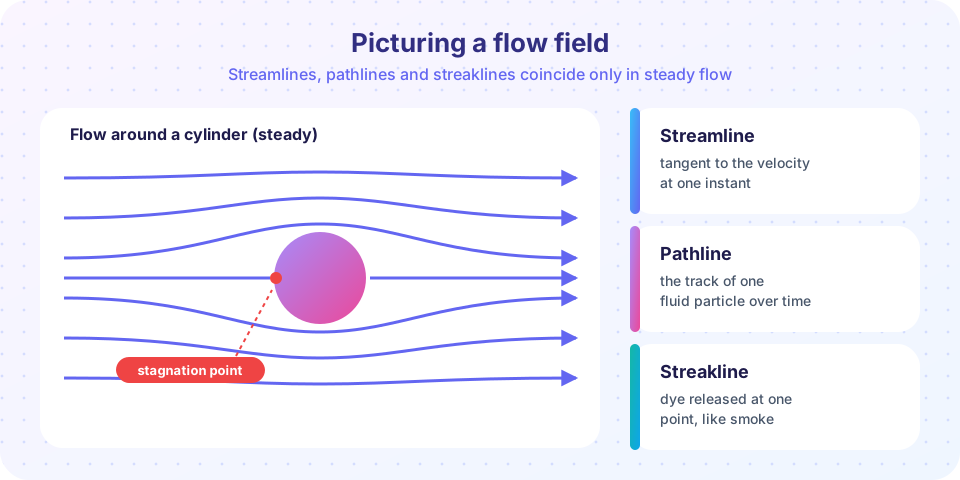
Streamline: a curve tangent to the velocity vector everywhere at one instant.
Steady flow: at each point, nothing changes with time (∂/∂t = 0).
Reynolds number: Re = ρVL/μ, the ratio of inertial to viscous effects.
Material derivative: the rate of change seen by a particle moving with the fluid.
Two ways to describe motion
In the Lagrangian description you follow individual fluid particles, as in particle mechanics: each one has a position r(t). That is natural for a single drifting leaf but impractical for the countless particles in a river.
In the Eulerian description (after Leonhard Euler) you fix attention on points in space and ask what the velocity, pressure and density are there. The velocity is a field:
V = u(x, y, z, t) i + v(x, y, z, t) j + w(x, y, z, t) k
Nearly all of fluid mechanics uses the Eulerian view, because instruments (pressure taps, Pitot tubes, cameras with a fixed frame) are fixed in space.
Classifying flows
| Term | Meaning | Example |
|---|---|---|
| Steady | Properties at a point do not change with time | Water leaving a fully open tap |
| Unsteady | They do change | A tap just opened; a heartbeat |
| Uniform | Properties do not change with position | Flow far inside a long, straight pipe |
| 1D, 2D, 3D | Number of space coordinates the velocity depends on | Pipe flow (1D idealized); flow past a long cylinder (2D) |
| Incompressible | Density is constant | Water; air well below the speed of sound |
| Laminar | Smooth layers | Honey pouring |
| Turbulent | Chaotic eddies | A waterfall, smoke from a fire |
"Steady" and "uniform" are different. Water in a nozzle that speeds up along its length is steady (nothing changes at a given point) but not uniform (the velocity changes from point to point).
Streamlines, pathlines and streaklines
- A streamline is tangent to the velocity at every point at one instant. No fluid crosses a streamline, and two streamlines never cross (except at a stagnation point, where
V = 0). - A pathline is the actual track of one particle over time.
- A streakline joins all particles that passed through one point, like a thin plume of smoke from a pin.
In steady flow the three coincide. In unsteady flow they differ, so be careful when you read a photograph of dye.
A streamtube is a bundle of streamlines through a small closed curve. Fluid cannot leave a streamtube through its sides, so a tube whose cross-section narrows must speed up (Conservation of Mass shows that formally).
The acceleration of a particle
Even a steady flow can have accelerating particles. In a nozzle each particle speeds up as it enters the narrow part. Its acceleration is the material derivative:
a = ∂V/∂t  +  (V · ∇)V
      local      convective
The local term is the change at a fixed point with time (zero in steady flow). The convective term is the change caused by moving to a place where the velocity is different. For one-dimensional flow along x the convective part is u ∂u/∂x.
Worked example: stagnation-point flow. A simple model of flow hitting a wall at x = 0 is u = a x, v = −a y, where a = 2 s⁻¹. The streamlines satisfy dy/dx = v/u = −y/x, so xy = constant: hyperbolas. The acceleration is
aₓ = u ∂u/∂x + v ∂u/∂y = (a x)(a) + 0 = a² xaᵧ = u ∂v/∂x + v ∂v/∂y = 0 + (−a y)(−a) = a² y
At (x, y) = (0.5 m, 0.5 m) each component is 4 × 0.5 = 2 m/s², though the flow is steady.
Press Run (or Ctrl + Enter) to see the result here.
Program input · what you'd type while the program runs
Type the answers before you press Run, one per line. Each time the program reads a line (with input()), it gets the next line from this box.
Laminar or turbulent? The Reynolds number
In 1883 Osborne Reynolds injected a thread of dye into water flowing in a glass tube. At low speed the dye stayed a straight line (laminar flow). Past a certain speed it broke into swirling eddies (turbulent flow). He found that one combination of variables decided it:
Re = ρ V D / μ = V D / ν
It compares inertia (which makes flow chaotic) to viscosity (which smooths it). For flow in a round pipe of diameter D, a good guide is:
Re < 2300: laminar.2300 < Re < 4000: transitional (can flicker between the two).Re > 4000: turbulent.
Worked example. Water (ρ = 998 kg/m³, μ = 1.0 × 10⁻³ Pa·s) flows at 1 m/s in a 25 mm pipe. Re = 998 × 1 × 0.025 / 0.001 ≈ 25 000: turbulent. Almost all engineering pipe flows are turbulent. Light oil with μ = 0.1 Pa·s and ρ = 870 kg/m³ at the same speed gives Re = 870 × 1 × 0.025 / 0.1 ≈ 218, comfortably laminar.
Press Run (or Ctrl + Enter) to see the result here.
Program input · what you'd type while the program runs
Type the answers before you press Run, one per line. Each time the program reads a line (with input()), it gets the next line from this box.
The numbers for blood and honey use typical values; blood is not exactly Newtonian, so treat that Reynolds number as an estimate.
Common misconceptions
"Streamlines show where particles actually go." Only in steady flow. In an unsteady flow, pathlines and streamlines differ.
"Steady means the fluid is not moving." Steady means the pattern does not change with time. The fluid can be moving fast.
"Re = 2300 is a hard switch." It is a rough guide. Very smooth, quiet pipes can stay laminar to much higher Re, and disturbances can trigger turbulence earlier.
Check your understanding
Quick check · 5 questions
of 5 answered You scored / 5 · perfect!
-
1. In the Eulerian description, what do you follow?
The Eulerian view records velocity, pressure and density as fields in space and time. -
2. Water flows steadily through a nozzle that narrows. The flow is
Nothing changes with time at a given point (steady), but the velocity changes with position along the nozzle (not uniform). -
3. Compute Re for water (998 kg/m³, μ = 1.0 × 10⁻³ Pa·s) at 0.05 m/s in a 20 mm tube. The regime is
Re = 998 × 0.05 × 0.02 / 0.001 ≈ 998, well below 2300. -
4. Which statement about streamlines is true?
Streamlines are tangent to the velocity, so no flow crosses them; they meet only where the velocity is zero. -
5. In steady flow, the acceleration of a fluid particle is
With ∂V/∂t = 0 only the convective term (V·∇)V remains, and it is nonzero where the velocity changes along the path.
Summary
- Fluid mechanics uses the Eulerian view: velocity is a field
V(x, y, z, t). - Streamlines are tangent to the velocity at one instant; in steady flow they equal pathlines and streaklines.
- Steady means "no change with time", uniform means "no change with position".
- Particle acceleration is local plus convective; steady flow can still accelerate.
Re = ρVD/μdecides laminar (below about 2300) or turbulent (above about 4000) pipe flow.
Next: Chapter 1 Review
Track your progress
Create a free account to tick off lessons and pick up where you left off on any device.
of Fluid Mechanics lessons completed