


















Lesson 42 of 44 · Projects and Practice
Glossary of fluid mechanics
A plain-language glossary of the key terms in fluid mechanics, from boundary layer and Bernoulli equation to Reynolds number and choked flow, with flashcards.
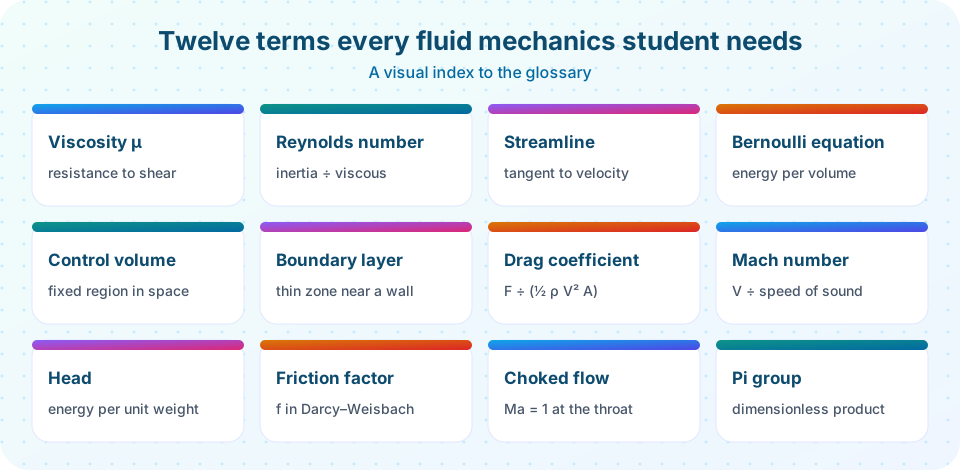
Fluid mechanics has a lot of vocabulary, and the words often hide an equation or an idea. This glossary collects the terms you have met, with a short definition and, where it helps, the formula. Use it as a quick reference or as flashcards.
What you will learn
- The precise meaning of the main terms in the course.
- Which formula or lesson each term connects to.
- How to test yourself with flashcards.
Key terms
Glossary: an alphabetical list of terms with short definitions.
Dimensionless group: a combination of variables with no units, such as Re.
Head: energy per unit weight, measured as a height of fluid.
Operating point: the flow and head where a machine and a system agree.
Terms from A to Z
| Term | Meaning |
|---|---|
| Adverse pressure gradient | pressure rising in the flow direction, which slows near-wall fluid and can cause separation |
| Affinity laws | scaling rules for similar pumps: Q ∝ N D³, H ∝ N² D², P ∝ N³ D⁵ |
| Back pressure | the pressure outside a nozzle exit |
| Bernoulli equation | along a streamline of steady, frictionless, incompressible flow, p + ½ρV² + ρgz is constant |
| Boundary layer | the thin region next to a surface where viscosity changes the velocity from zero to the free-stream value |
| Buckingham Pi theorem | n variables in k dimensions give n − k dimensionless groups |
| Cavitation | formation and collapse of vapor bubbles where the pressure falls to the vapor pressure |
| Choked flow | flow whose throat is at Ma = 1, so mass flow is at its maximum |
| Control volume | a fixed region in space across which mass, momentum and energy balances are written |
| Darcy friction factor | f in h_f = f (L/D) V²/2g |
| Displacement thickness | how much the outer flow is pushed away from the wall by the boundary layer, δ* |
| Drag coefficient | C_D = F_D / (½ ρ V² A) |
| Drag crisis | the sudden drop of a sphere's or cylinder's C_D when the boundary layer becomes turbulent |
| Dynamic similarity | equal relevant dimensionless groups for model and prototype |
| Euler number | Eu = Δp / (ρ V²) |
| Free stream | the flow outside the boundary layer |
| Froude number | Fr = V / √(g L), inertia to gravity |
| Head loss | energy lost per unit weight, h_L |
| Hydraulically smooth | a turbulent pipe where the roughness is hidden in the viscous sublayer |
| Isentropic | adiabatic and reversible, constant entropy |
| Kinematic viscosity | ν = μ/ρ, in m²/s |
| Laminar flow | smooth, layered flow at low Re |
| Lift coefficient | C_L = F_L / (½ ρ V² S) |
| Mach number | Ma = V / a, flow speed to sound speed |
| Minor loss | head loss at a fitting, K V²/2g |
| Momentum thickness | a measure of the momentum deficit in the boundary layer, θ |
| Newtonian fluid | one whose shear stress is proportional to the rate of strain, τ = μ du/dy |
| No-slip condition | fluid next to a solid surface moves with the surface |
| Normal shock | a thin surface across which supersonic flow becomes subsonic and pressure, density and temperature jump |
| NPSH | net positive suction head, the margin of a pump inlet above the vapor pressure |
| Operating point | where the pump curve meets the system curve |
| Pi group | a dimensionless product of the variables of a problem |
| Reynolds number | Re = ρ V L / μ, inertia to viscous force |
| Separation | the boundary layer leaving the surface, creating a wake |
| Speed of sound | a = √(γ R T) in an ideal gas |
| Stagnation pressure | the pressure reached when the flow is brought to rest isentropically |
| Stall | loss of lift when flow separates over most of a wing |
| Stokes drag | F = 3π μ V D on a sphere at Re < 1 |
| Streamline | a curve everywhere tangent to the velocity vector |
| Terminal velocity | the steady falling speed where drag balances weight |
| Turbulent flow | irregular flow with eddies and strong mixing |
| Viscosity | resistance of a fluid to shearing, μ in Pa·s |
| Weber number | We = ρ V² L / σ, inertia to surface tension |
Common misconceptions
"Head is a pressure." Head is a length. Pressure and head are related by p = ρ g h, but they are not the same quantity.
"Viscosity and density mean the same thing." Honey is much more viscous than water, but it is only 1.4 times as dense. Kinematic viscosity combines the two.
"Streamlines and pathlines are always the same." They coincide only in steady flow.
Try it
Flip through the cards below. Click a card to reveal the definition, then use the buttons to move on. This is a study aid only.
The second example tests the one numerical relation in the glossary that students most often mix up, the relation between viscosity, kinematic viscosity and density.
Press Run (or Ctrl + Enter) to see the result here.
Program input · what you'd type while the program runs
Type the answers before you press Run, one per line. Each time the program reads a line (with input()), it gets the next line from this box.
Check your understanding
Quick check · 5 questions
of 5 answered You scored / 5 · perfect!
-
1. Which pair is correctly matched?
We = rho V^2 L / sigma compares inertia with surface tension. -
2. What is head?
Head is energy per weight of fluid, with units of meters. -
3. What does the no-slip condition say?
The fluid layer touching a solid surface has the same velocity as the surface. -
4. Choked flow means:
Once the throat is sonic, the mass flow rate cannot be increased by lowering the back pressure. -
5. Which quantity combines dynamic viscosity and density?
nu = mu / rho, in m^2/s.
Summary
- The glossary is a map: each term points to a formula or a lesson.
- Many pairs of terms look alike (head and pressure, dynamic and kinematic viscosity); know the difference.
- Dimensionless numbers are each a ratio of two effects.
Track your progress
Create a free account to tick off lessons and pick up where you left off on any device.
of Fluid Mechanics lessons completed