


















Lesson 8 of 44 · Fluid Properties and Statics
Hydrostatic Pressure and Manometers
Derive the hydrostatic equation p = p0 + rho g h, tell absolute from gauge pressure, apply Pascal's law and read U-tube manometers and barometers.
Why does your ears hurt in a deep swimming pool? Why can a straw lift your drink? Why does a mercury barometer stand 760 mm high? All three come from one equation that links pressure to depth. In this lesson you will derive it from a force balance, extend it to layered fluids and to the atmosphere, and use it to read pressure with a manometer.
What you will learn
- Derive
dp/dz = −ρ gand its integrated formp = p₀ + ρ g h. - Distinguish absolute, gauge and vacuum pressure.
- State Pascal's law and see how it enables hydraulic lifts.
- Read U-tube and differential manometers and a mercury barometer.
Key terms
Absolute pressure: measured from a perfect vacuum.
Gauge pressure: absolute pressure minus local atmospheric pressure (negative values are called vacuum).
Pascal's law: a pressure change applied to an enclosed static fluid is transmitted undiminished everywhere in the fluid.
Manometer: a tube containing liquid used to measure pressure differences from height differences.
Deriving the hydrostatic equation
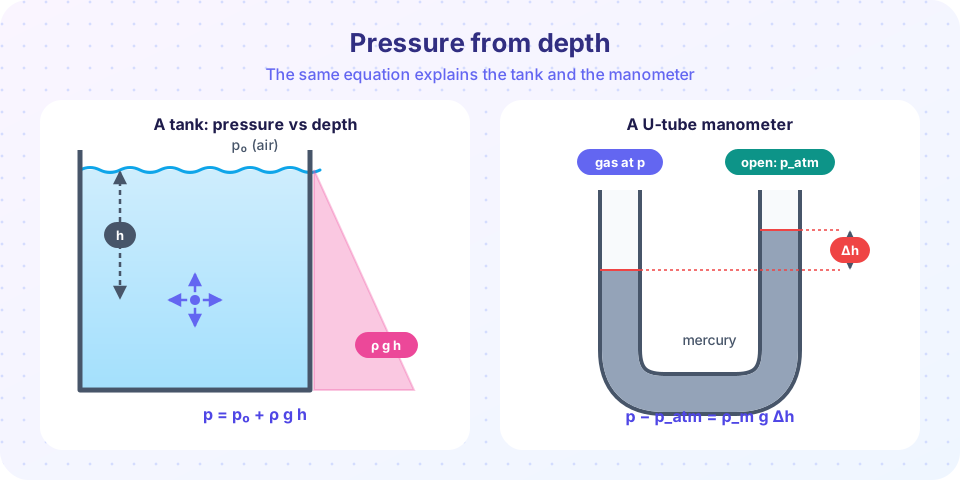
Take a small vertical column of fluid of cross-section A and height dz, at rest. Three vertical forces act on it: the pressure force from below p A (upward), the pressure force from above (p + dp) A (downward), and its weight ρ g A dz (downward). Balance requires
p A − (p + dp) A − ρ g A dz = 0 ⇒ dp/dz = −ρ g
If ρ is constant, integrate from a free surface (where the pressure is p₀, usually atmospheric) down to a depth h:
p = p₀ + ρ g h
This is the hydrostatic equation. Three consequences follow:
- Pressure depends only on depth, not on the shape of the container (the hydrostatic paradox).
- All points at the same depth in a connected, static fluid have the same pressure, so open vessels connected at the bottom hold the same level.
- At a point, pressure acts equally in all directions (Pascal's law for a point).
Worked example. In a swimming pool, p₀ = 101.3 kPa. At 3.0 m depth: ρ g h = 998 × 9.81 × 3.0 = 29.4 kPa gauge, so p = 130.7 kPa absolute, about 1.29 atm.
Absolute, gauge and vacuum
| Name | Meaning | Example |
|---|---|---|
| Absolute | Relative to a perfect vacuum, always positive | 130.7 kPa at 3 m in a pool |
| Gauge | Relative to the surrounding atmosphere | 29.4 kPa at the same point; a tire gauge reading |
| Vacuum | How far below atmospheric | A pressure of 70 kPa absolute is a vacuum of 31.3 kPa |
The standard atmosphere is 101 325 Pa. Weather changes it by a few kPa. Always write "gauge" or "absolute" after a pressure (kPa(g), kPa(abs)). Gas laws and cavitation need absolute pressure; most pipe and force calculations can use gauge.
Pascal's law and hydraulics
A pressure applied to an enclosed fluid appears everywhere. In a hydraulic jack a small force F₁ on a small piston of area A₁ creates a pressure p = F₁/A₁; the large piston of area A₂ feels the same pressure and lifts F₂ = p A₂ = F₁ (A₂/A₁). With A₂/A₁ = 100, a 100 N push lifts 10 000 N, about a tonne. Energy is conserved: the small piston must move 100 times farther.
Manometers and barometers
A barometer is an inverted tube of mercury closed at the top (a near-vacuum above the mercury). The atmosphere pushes mercury up until p_atm = ρ_Hg g h. With ρ_Hg = 13 595 kg/m³ (at 0 °C), g = 9.80665 m/s² and h = 0.760 m: p = 101 325 Pa. Water would stand 10.3 m high, which is why a straw cannot lift water more than about 10 m, even with a perfect vacuum.
A U-tube manometer measures gauge pressure. One end connects to the pressure source, the other to the atmosphere. Walk from one end to the other: add ρ g h when moving down in the same fluid, subtract when moving up.
For a gas at gauge pressure p pushing mercury down by a height difference Δh:
p_gauge = ρ_m g Δh (the gas's own weight is negligible)
Worked example. A mercury manometer (ρ = 13 546 kg/m³) shows Δh = 0.25 m. p = 13 546 × 9.81 × 0.25 = 33.2 kPa gauge.
When a different fluid sits above the manometer fluid, include its weight in the walk. This is the recipe:
- Start at one end with a known pressure.
- Move along the tube, adding
+ρ g Δhfor each downward step and−ρ g Δhfor each upward step, in the right fluid. - End at the other end and set equal to its pressure.
Press Run (or Ctrl + Enter) to see the result here.
Program input · what you'd type while the program runs
Type the answers before you press Run, one per line. Each time the program reads a line (with input()), it gets the next line from this box.
In the second case the mercury is pushed apart by the pressure difference minus the water weight in the legs, which gives the factor (ρ_Hg − ρ_w).
Pressure in the atmosphere
Gases change density with height, so integrate dp/dz = −ρ g with ρ = p/(R T). In the lower atmosphere, the International Standard Atmosphere uses a temperature falling at 6.5 K per kilometer. The pressure is
p = p₀ (1 − L z / T₀)^(g / (R L)), L = 0.0065 K/m, T₀ = 288.15 K, g/(R L) ≈ 5.256
valid up to 11 km. The pressure at 5 km is about 54 kPa and at the cruising altitude of a jet (11 km) about 22.6 kPa, which is why cabins are pressurized.
Press Run (or Ctrl + Enter) to see the result here.
Program input · what you'd type while the program runs
Type the answers before you press Run, one per line. Each time the program reads a line (with input()), it gets the next line from this box.
Common misconceptions
"A barometer would read a different pressure with a wider tube." The height is set by pressure, density and g only. A wider tube holds more mercury at the same height.
"The weight of the water in a container equals the force on its bottom." Not for non-prismatic containers. A cone-shaped container widening upward has a bottom force less than the water weight; a container narrowing upward has a bottom force greater than the water weight. The pressure on the bottom is always ρ g h.
"Gauge pressure cannot be negative." It can: a gauge reading below atmospheric is a vacuum.
Check your understanding
Quick check · 5 questions
of 5 answered You scored / 5 · perfect!
-
1. What is the gauge pressure at 20 m depth in fresh water (ρ = 998 kg/m³, g = 9.81 m/s²)?
ρ g h = 998 × 9.81 × 20 ≈ 195.8 kPa, about 1.9 atm gauge. -
2. A tire gauge reads 220 kPa. Atmospheric pressure is 101 kPa. The absolute pressure is
Absolute = gauge + atmospheric = 220 + 101 = 321 kPa. -
3. A hydraulic jack has piston areas 5 cm² and 250 cm². What force on the small piston lifts 5000 N?
F₁ = F₂ A₁/A₂ = 5000 × 5/250 = 100 N. -
4. The pressure at a point in a static fluid depends on
p = p₀ + ρ g h does not depend on container shape or direction. -
5. Why can a straw not draw water higher than about 10 m even with a perfect vacuum pump?
p_atm / (ρ g) = 101 325 / (998 × 9.81) ≈ 10.3 m.
Summary
- Force balance on a fluid column gives
dp/dz = −ρ g; for constant ρ,p = p₀ + ρ g h. - Pressure depends only on depth, density and g, and acts equally in all directions at a point.
- Absolute = gauge + atmospheric; vacuum is negative gauge.
- Pascal's law lets hydraulics multiply force by the area ratio.
- Manometers read pressure differences as
ρ g Δh; a mercury barometer stands about 760 mm at 1 atm.
Track your progress
Create a free account to tick off lessons and pick up where you left off on any device.
of Fluid Mechanics lessons completed