


















Lesson 11 of 44 · Fluid Properties and Statics
Chapter 2 Review: Properties and Statics
Review fluid properties, hydrostatic pressure, manometers, forces on submerged surfaces and buoyancy with a one-picture summary, recap table and 9-question quiz.
Chapter 2 gave you one equation and four applications. If you can derive p = p₀ + ρ g h from a force balance and use it on a manometer, a gate and a floating body, you have mastered fluid statics. Use this page to check.
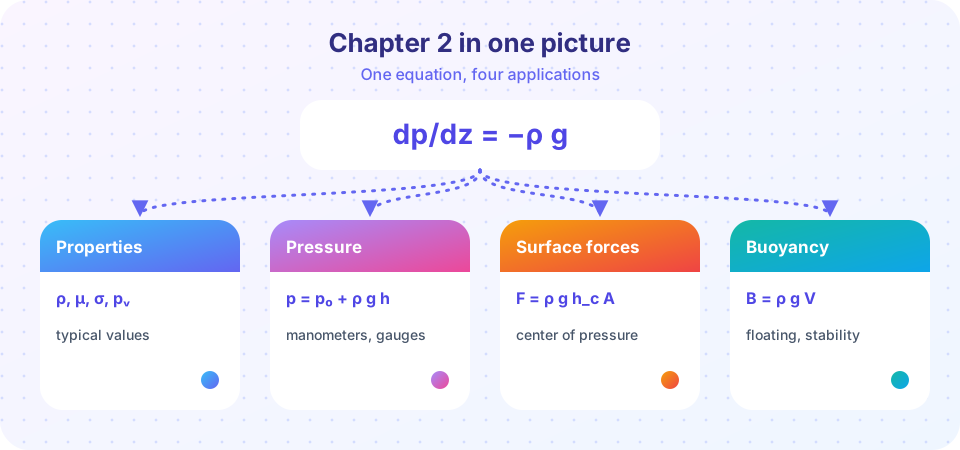
What you will learn
- How the lessons of chapter 2 connect.
- The formulas and values to memorize.
- Which topics need another look before chapter 3.
Recap table
| Topic | Key formula | Watch out for |
|---|---|---|
| Properties | γ = ρ g, SG = ρ/ρ_w, ν = μ/ρ, h = 2σ cos θ/(ρ g r) |
Liquid viscosity falls with T, gas viscosity rises |
| Hydrostatic pressure | p = p₀ + ρ g h, p_abs = p_gauge + p_atm |
Label gauge vs absolute |
| Surface forces | F = ρ g h_c A, y_cp = y_c + I_c/(y_c A) |
The resultant acts below the centroid |
| Buoyancy | F_B = ρ g V_disp, GM = I_wl/V_sub − BG |
Stable if M is above G |
Worked review example
A rectangular tank of seawater (ρ = 1025 kg/m³) is 4 m deep. A circular porthole 0.5 m in diameter is in the vertical wall with its center 3 m below the surface.
- Area
A = π (0.25)² = 0.1963 m²;h_c = 3 m. F = 1025 × 9.81 × 3 × 0.1963 = 5923 N, about 5.9 kN.I_c = π R⁴/4 = π (0.25)⁴ / 4 = 0.003068 m⁴;y_cp − y_c = 0.003068/(3 × 0.1963) = 0.0052 m, only 5 mm below the center.
The tiny offset reminds you that for small surfaces deep underwater the center of pressure almost coincides with the centroid.
Press Run (or Ctrl + Enter) to see the result here.
Program input · what you'd type while the program runs
Type the answers before you press Run, one per line. Each time the program reads a line (with input()), it gets the next line from this box.
Check your understanding
Quick check · 9 questions
of 9 answered You scored / 9 · perfect!
-
1. The gauge pressure at the bottom of a 12 m deep freshwater lake (ρ = 998 kg/m³) is about
ρ g h = 998 × 9.81 × 12 ≈ 117.5 kPa. -
2. Gauge pressure of 50 kPa in a tank at sea level means an absolute pressure of about
Absolute = 50 + 101.3 ≈ 151 kPa. -
3. Mercury has SG = 13.5. A mercury manometer with Δh = 10 cm measures a gauge pressure of about
13 546 × 9.81 × 0.1 ≈ 13.3 kPa. -
4. The resultant hydrostatic force on a vertical surface acts
Pressure increases with depth, so the resultant is lower than the centroid. -
5. A 4 m wide vertical wall holds back water 2 m deep. The force on it is about
h_c = 1 m, A = 8 m²: F = 998 × 9.81 × 1 × 8 ≈ 78.3 kN. -
6. A floating cube of side 1 m has ρ = 600 kg/m³ in fresh water. How deep does it sit?
Submerged fraction = 600/998 ≈ 0.60, so a 1 m cube sinks 0.60 m. -
7. A ship has GM = −0.2 m. It is
A negative metacentric height means M is below G and the ship will heel until a new equilibrium or capsizes. -
8. Which does NOT change the pressure at a given depth in a static fluid?
Only ρ, g and depth (and the surface pressure) matter. -
9. Water rises in a 0.5 mm radius clean glass tube by about 30 mm because of
Capillary rise h = 2σ cos θ/(ρ g r) is caused by surface tension.
Summary
- Statics rests on
dp/dz = −ρ g. - Use gauge pressure when the atmosphere acts on both sides, absolute for gas laws and cavitation.
- Resultant force on a flat surface is the centroid pressure times area; it acts below the centroid.
- Buoyancy equals the weight of displaced fluid; ship stability needs
GM > 0.
Track your progress
Create a free account to tick off lessons and pick up where you left off on any device.
of Fluid Mechanics lessons completed