


















Lesson 19 of 44 · Bernoulli and Energy
Applications of Bernoulli: Tanks, Pitot Tubes and Venturi Meters
Use Bernoulli's equation for Torricelli's law, Pitot tube airspeed, Venturi flow meters and siphons, with worked examples, calculators and cavitation limits.
Bernoulli's equation is a tool for a very practical job: measuring flow with pressure. The airspeed indicator in an aircraft, the flow meter in a water main and the speed of water leaving a leaking tank all come from the same equation. This lesson works through four classic devices, shows how to build calculators for them, and ends with the limit that stops a siphon from lifting water more than about ten meters.
What you will learn
- Derive Torricelli's law
V = √(2 g h)and estimate discharge. - Find airspeed or flow speed from a Pitot-static tube.
- Compute flow rate from a Venturi meter, including the discharge coefficient.
- Check a siphon for the limit imposed by atmospheric pressure and vapor pressure.
Key terms
Pitot tube: an open-ended tube facing the flow that measures stagnation pressure.
Static tap: a hole in a wall (or a side opening on a probe) that senses the undisturbed static pressure.
Venturi meter: a pipe section with a smooth contraction (throat) where pressure drop measures flow.
Discharge coefficient (C_d): the ratio of actual to ideal flow, accounting for friction and contraction of the stream.
Torricelli's law
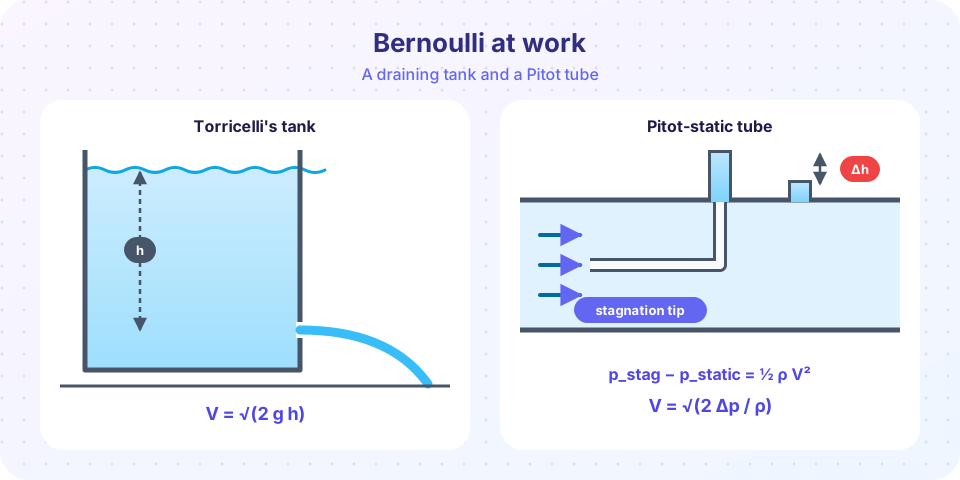
Water in a large open tank leaves through a hole at depth h below the surface. Apply Bernoulli from point 1 (the free surface: p = p_atm, V ≈ 0, z = h) to point 2 (the jet: p = p_atm, V = V₂, z = 0):
p_atm/(ρg) + 0 + h = p_atm/(ρg) + V₂²/(2g) + 0 ⇒ V₂ = √(2 g h)
This is Torricelli's law: the speed is the same as a stone dropped from height h. For h = 3 m: V = √(2 × 9.81 × 3) = 7.67 m/s. If the hole has area a, the ideal discharge is Q = a √(2 g h). A real sharp-edged hole has a jet that contracts just past the opening (the vena contracta) and C_d ≈ 0.61.
An interesting consequence: the jet from a hole at depth h also shoots a horizontal distance x = 2√(h (H − h)) when it falls to the ground from a tank of height H, which is greatest when the hole is halfway down.
The Pitot tube
A Pitot tube has an open end facing the flow. The fluid in the tube is brought to rest, so the pressure there is the stagnation pressure p_stag = p + ½ρV². A second small hole in the side wall of a Pitot-static tube senses the static pressure p. The difference is the dynamic pressure:
p_stag − p = ½ ρ V² ⇒ V = √(2 (p_stag − p) / ρ)
An aircraft airspeed indicator measures exactly this pressure difference. If a Pitot-static probe in air (ρ = 1.2 kg/m³) reads Δp = 600 Pa, then V = √(2 × 600 / 1.2) = √1000 = 31.6 m/s, about 114 km/h. Remember: use the density of the flowing fluid. When the tube is connected to a liquid manometer, Δp = (ρ_m − ρ) g Δh.
An airspeed indicator reads true speed only at the density for which it is calibrated (sea-level standard). At altitude, the thinner air gives a lower Δp for the same ground-relative speed, so pilots distinguish indicated from true airspeed.
The Venturi meter
A Venturi meter has an inlet of diameter D₁, a narrow throat D₂, and a gradual diffuser. Continuity gives V₁ = V₂ (A₂/A₁) = V₂ β², where β = D₂/D₁. Bernoulli between inlet and throat (same elevation):
p₁ − p₂ = ½ρ (V₂² − V₁²) = ½ρ V₂² (1 − β⁴)
Q = C_d A₂ √( 2 (p₁ − p₂) / (ρ (1 − β⁴)) )
For good Venturi meters, C_d is typically 0.95–0.99. Venturis recover most of the pressure in the diffuser, so the permanent loss is small, which is why they are popular in large water lines.
Worked example. D₁ = 100 mm, D₂ = 50 mm (β = 0.5, β⁴ = 0.0625), Δp = 30 kPa, C_d = 0.98:
A₂ = π(0.05)²/4 = 1.9635 × 10⁻³ m². Q = 0.98 × 1.9635 × 10⁻³ × √(2 × 30 000 / (998 × 0.9375)) = 0.98 × 1.9635 × 10⁻³ × 8.008 = 0.01541 m³/s, about 15.4 L/s.
Press Run (or Ctrl + Enter) to see the result here.
Program input · what you'd type while the program runs
Type the answers before you press Run, one per line. Each time the program reads a line (with input()), it gets the next line from this box.
Siphons and the limit of atmospheric pressure
A siphon carries liquid over a high point using only gravity and a primed tube. Applying Bernoulli from the upper reservoir surface (point 1) to the outlet (point 2, a distance h below the surface) gives V = √(2 g h), as in Torricelli. At the top of the loop (point 3, at height H above the surface) the speed is the same as in the tube, and the absolute pressure is
p₃ = p_atm − ρ g H − ½ ρ V²
If p₃ falls to the vapor pressure pᵥ, the water boils (cavitates) and the flow breaks. For water at 20 °C, pᵥ = 2.3 kPa, and the maximum height is about
H_max = (p_atm − pᵥ)/(ρ g) − V²/(2g) ≈ (101.3 − 2.3)×10³/(9790) − V²/2g ≈ 10.1 m − V²/(2g).
With any real flow it is smaller, say 7 to 9 m. In practice, siphons are kept below about 6 m.
Press Run (or Ctrl + Enter) to see the result here.
Program input · what you'd type while the program runs
Type the answers before you press Run, one per line. Each time the program reads a line (with input()), it gets the next line from this box.
Common misconceptions
"Torricelli's law needs a small hole." It needs a hole small compared with the tank so the surface speed is negligible, and a smooth edge for the ideal result. Include C_d for real orifices.
"A siphon pulls water up with suction." Atmospheric pressure pushes the water up; the siphon cannot work with the crest above about 10 m because the pressure there would fall below the vapor pressure.
"The Venturi meter loses a lot of energy." A well-designed Venturi recovers most of the pressure in the diffuser; an orifice plate loses much more.
Check your understanding
Quick check · 5 questions
of 5 answered You scored / 5 · perfect!
-
1. Water leaves a large open tank through a small hole 5 m below the surface. The ideal jet speed is about
V = √(2 g h) = √(2 × 9.81 × 5) = 9.9 m/s. -
2. A Pitot-static tube in air (ρ = 1.2 kg/m³) reads Δp = 300 Pa. The speed is about
V = √(2 × 300/1.2) = √500 ≈ 22.4 m/s. -
3. In a Venturi meter, the pressure at the throat is lower than at the inlet because
Continuity makes the throat faster; Bernoulli lowers the pressure. -
4. The maximum height at the crest of a water siphon (ignoring speed) is limited to about
Atmospheric pressure supports only about 10.3 m of water, and vapor pressure takes some of that. -
5. A discharge coefficient of 0.6 for a sharp-edged orifice means
C_d = Q_actual / Q_ideal; it combines jet contraction and friction.
Summary
- Torricelli:
V = √(2 g h),Q = C_d a √(2 g h). - Pitot-static tube:
V = √(2Δp/ρ), with the density of the flowing fluid. - Venturi meter:
Q = C_d A₂ √(2Δp / (ρ (1 − β⁴))). - A siphon is limited by atmospheric and vapor pressure to roughly 6–9 m of crest height.
Track your progress
Create a free account to tick off lessons and pick up where you left off on any device.
of Fluid Mechanics lessons completed