


















Lesson 27 of 44 · Viscous Flow in Pipes
Laminar flow in pipes
Derive the parabolic velocity profile and Hagen-Poiseuille law for laminar pipe flow, find friction factor 64/Re, and work a numerical example with code.
Laminar pipe flow is the one case in fluid mechanics that can be solved exactly with pencil and paper. The result, worked out independently by Gotthilf Hagen and Jean Poiseuille in the 1830s and 1840s (Poiseuille was a physician studying blood flow), is simple and powerful: the flow rate depends on the fourth power of the diameter.
What you will learn
- How a force balance on a fluid cylinder gives the shear stress and the parabolic profile.
- How to compute flow rate, mean speed and wall shear stress.
- Why
f = 64/Refor laminar flow. - Why halving a tube's diameter cuts the flow by sixteen.
Key terms
Fully developed flow: the velocity profile no longer changes along the pipe.
Shear stress (τ): the friction force per unit area between fluid layers.
Newtonian fluid: a fluid whose shear stress is proportional to the velocity gradient, τ = μ du/dy.
Entrance length: the distance a pipe needs before the profile is fully developed, about 0.06 Re D for laminar flow.
Deriving the velocity profile
Take a steady, fully developed, laminar flow of a Newtonian fluid in a horizontal pipe of radius R. Cut out a cylinder of fluid of radius r and length L.
The pressure pushes the cylinder forward with force (p₁ − p₂) π r² = Δp π r². The shear stress at its surface pulls back with force τ · 2π r L. The fluid is not accelerating, so the forces balance:
Δp π r² = τ 2π r L, so τ = Δp r / (2L).
The stress grows linearly from zero at the centerline to τ_w = Δp R / (2L) = Δp D / (4L) at the wall. Now use Newton's law of viscosity, with the velocity falling as r increases: τ = −μ du/dr. Then
du/dr = −Δp r / (2 μ L).
Integrate and use the no-slip condition u(R) = 0:
u(r) = Δp / (4 μ L) · (R² − r²).
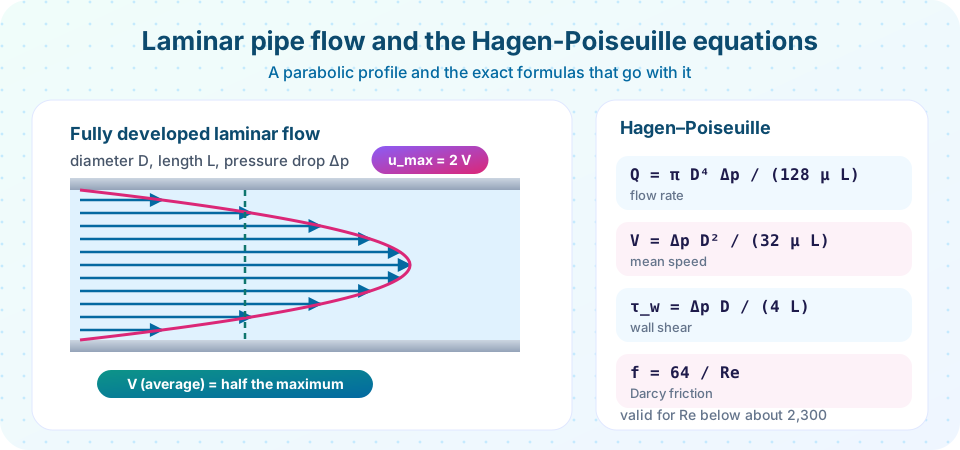
That is a parabola. The maximum, at r = 0, is u_max = Δp R² / (4 μ L).
Flow rate, mean speed and friction factor
Integrate the profile over the cross-section: Q = ∫ u 2π r dr.
Q = π R⁴ Δp / (8 μ L) = π D⁴ Δp / (128 μ L)
Divide by the area π R² to get the mean speed
V = Δp D² / (32 μ L), and notice u_max = 2 V.
Now express the pressure drop as head loss with the Darcy-Weisbach equation, Δp = f (L/D) ½ ρ V². Substituting Δp = 32 μ L V / D² gives
f = 64 μ / (ρ V D) = 64 / Re.
So the friction factor of laminar flow depends on Reynolds number only: the pipe's roughness does not matter, because everything happens in smooth layers.
A worked example
A light oil (μ = 0.10 Pa·s, ρ = 870 kg/m³) flows through a smooth tube of diameter D = 10 mm and length L = 3 m under a pressure difference of Δp = 30 kPa.
- Mean speed:
V = Δp D² / (32 μ L) = 30,000 × 10⁻⁴ / (32 × 0.1 × 3) = 0.3125 m/s. - Check the regime:
Re = 870 × 0.3125 × 0.01 / 0.1 ≈ 27. That is far below 2,300, so laminar flow is justified. - Flow rate:
Q = V π D²/4 = 0.3125 × 7.854 × 10⁻⁵ ≈ 2.45 × 10⁻⁵ m³/s, about 24.5 mL/s. - Maximum speed:
2V = 0.625 m/s. - Wall shear stress:
τ_w = Δp D / (4L) = 30,000 × 0.01 / 12 = 25 Pa.
Always check Re after using a laminar formula. If it comes out above about 2,300, the formula does not apply.
The fourth-power rule
Since Q ∝ D⁴, a small change in diameter has a huge effect on flow at fixed pressure. Halving the diameter cuts the flow to one sixteenth. This explains why a cholesterol plaque that narrows an artery by half cuts the blood flow so sharply, and why a thin intravenous needle needs a larger pressure or a longer time than a thick one.
Real blood is not Newtonian and arteries are elastic, so this is an idealization, but the strong sensitivity to radius holds.
Entrance effects
Near the pipe entrance the profile is flatter and the wall shear is larger. The laminar entrance length is about L_e ≈ 0.06 Re D. At Re = 2,000 that is 120 diameters, which is long. For short tubes at moderate Re, the formulas above underestimate the pressure drop.
Common misconceptions
"Faster flow always means turbulent." The criterion is Re, not speed. A thick oil can move quickly and remain laminar, while water in a large pipe is turbulent even at walking pace.
"The profile is flat because the fluid is moving." In laminar flow the fluid at the wall is stationary (no-slip) and the centerline moves fastest; the profile is a parabola.
"f = 64/Re works for all pipes." It works only for laminar flow in round pipes. Other shapes have other constants.
Try it
First, a calculator for the worked example, with the velocity and shear profiles plotted. The shear is a straight line from zero at the center to τ_w at the wall, while the velocity is a parabola.
Press Run (or Ctrl + Enter) to see the result here.
Program input · what you'd type while the program runs
Type the answers before you press Run, one per line. Each time the program reads a line (with input()), it gets the next line from this box.
Second, the fourth-power rule. Hold the pressure drop fixed and shrink the tube.
Press Run (or Ctrl + Enter) to see the result here.
Program input · what you'd type while the program runs
Type the answers before you press Run, one per line. Each time the program reads a line (with input()), it gets the next line from this box.
Check your understanding
Quick check · 5 questions
of 5 answered You scored / 5 · perfect!
-
1. In laminar pipe flow, how is the maximum velocity related to the mean velocity?
The parabolic profile has u_max = 2 V. -
2. A laminar flow has D halved and everything else the same (same pressure drop). The flow rate becomes:
Q is proportional to D^4, so (1/2)^4 = 1/16. -
3. What is the Darcy friction factor for laminar flow at Re = 800?
f = 64 / Re = 64 / 800 = 0.08. -
4. Where is the shear stress zero in a laminar pipe flow?
Shear stress grows linearly with radius, tau = dp r / (2L), so it is zero at r = 0. -
5. Why does wall roughness not affect laminar friction?
In laminar flow the friction comes from viscosity alone; ordinary roughness does not trigger turbulence.
Summary
- A force balance gives
τ = Δp r / (2L); Newton's viscosity law then gives a parabolic profile. Q = π D⁴ Δp / (128 μ L),V = Δp D² / (32 μ L),u_max = 2V,τ_w = Δp D / (4L).f = 64/Re, independent of roughness.Q ∝ D⁴: small diameter changes have large effects.- Always check
Re < 2,300after using a laminar formula.
Track your progress
Create a free account to tick off lessons and pick up where you left off on any device.
of Fluid Mechanics lessons completed