


















Lesson 9 of 44 · Fluid Properties and Statics
Forces on Submerged Surfaces
Find the resultant hydrostatic force and center of pressure on gates, walls and curved surfaces, using F = rho g h_c A with worked examples and a solver.
A dam, a lock gate, a submarine window and the side of an aquarium all feel the same thing: pressure that grows with depth, pushing on a surface. To design them you need two answers: how big is the total force, and where does it act? This lesson gives you a short formula for each answer on flat surfaces, and a method for curved ones.
What you will learn
- Compute the resultant force on a plane surface with
F = ρ g h_c A. - Locate the center of pressure with
y_cp = y_c + I_c / (y_c A). - Work out horizontal and vertical force components on a curved surface.
- Decide which pressure (gauge or absolute) to use.
Key terms
Centroid: the geometric center of the surface area.
Center of pressure: the point where the resultant pressure force acts.
Second moment of area (I_c): how the area is distributed about the centroidal axis; for a rectangle b h³ / 12.
Projected area: the area of a surface as seen from a given direction.
Force on a plane surface
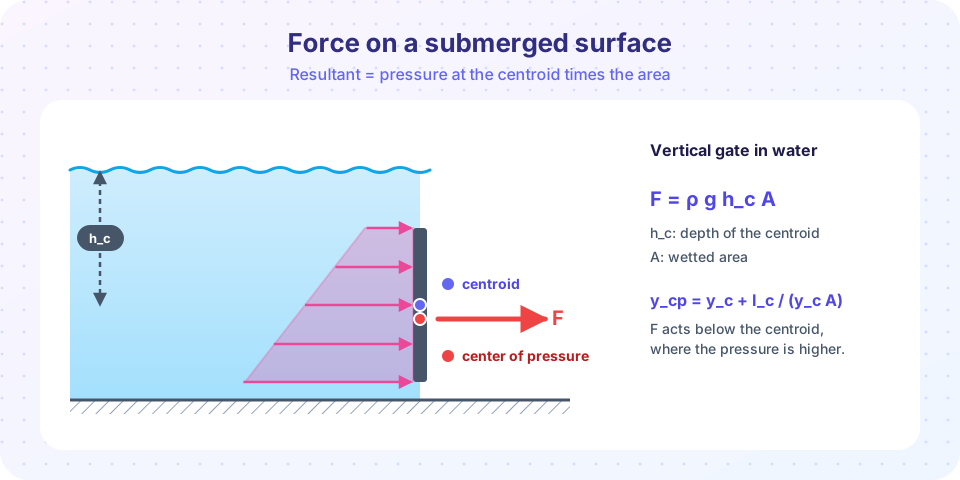
For a flat surface submerged at any angle, split it into tiny strips. The pressure on each strip is ρ g h, where h is its depth. Adding all forces gives
F = ρ g h_c A
where h_c is the depth of the centroid and A is the area. In words: the resultant equals the pressure at the centroid times the area. This works because the pressure varies linearly with depth, so the average pressure acts at the centroid depth.
The line of action is not through the centroid. Deeper strips push harder, so the resultant sits lower. For a surface inclined at angle θ to the free surface, with y measured along the surface from the free-surface line:
y_cp = y_c + I_c / (y_c A)
The second term is always positive, so the center of pressure lies below the centroid. As the surface sinks deeper (y_c large), the term shrinks and the center of pressure approaches the centroid, because the pressure becomes nearly uniform.
Useful second moments about the centroidal axis parallel to the free surface:
| Shape | A | I_c |
|---|---|---|
| Rectangle (width b, height h) | b h | b h³ / 12 |
| Triangle (base b, height h) | b h / 2 | b h³ / 36 |
| Circle (radius R) | π R² | π R⁴ / 4 |
Worked example. A vertical rectangular gate, 2 m wide and 1.5 m tall, has its top edge 1.0 m below the water surface (water, ρ = 998 kg/m³).
- Centroid depth:
h_c = 1.0 + 0.75 = 1.75 m. Area:A = 2 × 1.5 = 3 m². - Force:
F = 998 × 9.81 × 1.75 × 3 = 51 400 N ≈ 51.4 kN. I_c = 2 × 1.5³ / 12 = 0.5625 m⁴, soy_cp − y_c = 0.5625 / (1.75 × 3) = 0.107 m.- Center of pressure at depth
1.75 + 0.107 = 1.857 m.
Press Run (or Ctrl + Enter) to see the result here.
Program input · what you'd type while the program runs
Type the answers before you press Run, one per line. Each time the program reads a line (with input()), it gets the next line from this box.
The next run shows how the gap between the two points closes as the gate goes deeper.
Press Run (or Ctrl + Enter) to see the result here.
Program input · what you'd type while the program runs
Type the answers before you press Run, one per line. Each time the program reads a line (with input()), it gets the next line from this box.
Inclined surfaces
If the surface is inclined at angle θ to the horizontal, depth is h = y sin θ. The same formulas apply with h_c = y_c sin θ, and y_cp = y_c + I_c / (y_c A) stays valid as long as y is measured along the incline from the point where the surface plane meets the free surface. Pressure is still ρ g h, so the force F = ρ g h_c A is perpendicular to the surface.
Curved surfaces
For a curved surface, resolve the force instead of integrating directly.
- Horizontal component
F_H: equals the force on the vertical projection of the surface (the projected area). ApplyF_H = ρ g h_c A_projand the center-of-pressure formula to the projection. - Vertical component
F_V: equals the weight of the fluid vertically above the surface up to the free surface (real fluid) or the weight of the fluid that would fill the region above it (imaginary fluid, when the surface has fluid below).
The two components act through a common point only for circular surfaces, because every pressure force then passes through the center of curvature. For a circular arc, the resultant F = √(F_H² + F_V²) passes through the center.
Worked example. A quarter-circular gate of radius 2 m and width 3 m has water on its concave side. Its center of curvature lies on the free surface, and the arc runs down from the surface to a depth of 2 m. The horizontal force acts on the 2 m × 3 m projection: h_c = 1 m, A = 6 m², F_H = 998 × 9.81 × 1 × 6 = 58.7 kN. The vertical component is the weight of water above the curved surface: a quarter circle of area π R²/4 = π m² times 3 m width: V = 3π m³ = 9.42 m³, F_V = 998 × 9.81 × 9.42 = 92.3 kN. The resultant is √(58.7² + 92.3²) ≈ 109 kN.
Gauge or absolute pressure?
If the atmosphere also acts on the dry side of the surface, it cancels, and gauge pressure is the right one. If only one side is exposed to the atmosphere and the other side has a vacuum (say, a window of a vacuum chamber), absolute pressure matters. State which you used.
Common misconceptions
"The force acts at the centroid." Only if the pressure is uniform (horizontal surface). For a vertical or inclined surface the resultant is below the centroid.
"A wider reservoir exerts a larger force on the same dam." The force depends on the depth, not on how far the water extends behind the dam.
"I can use the full pressure at the bottom times the area." That overestimates the force. Use the pressure at the centroid (the average).
Check your understanding
Quick check · 5 questions
of 5 answered You scored / 5 · perfect!
-
1. A vertical wall 4 m wide holds back water 3 m deep. The resultant force is about
h_c = 1.5 m, A = 12 m², F = 998 × 9.81 × 1.5 × 12 ≈ 176 kN. -
2. At what depth does that resultant act (a rectangle from the surface down to depth H)?
For a rectangle starting at the surface, y_cp = H/2 + (b H³/12)/((H/2)(b H)) = H/2 + H/6 = 2H/3. -
3. As a submerged plate is lowered deeper, the center of pressure
The term I_c/(y_c A) shrinks as y_c grows, so the two points converge. -
4. The vertical force component on a curved surface equals
F_V is the weight of the (real or imaginary) fluid column above the surface. -
5. The horizontal force on a curved surface equals
Only the projection onto a vertical plane matters for the horizontal component.
Summary
- Resultant force on a plane surface:
F = ρ g h_c A, acting perpendicular to the surface. - The center of pressure lies below the centroid by
I_c / (y_c A), which shrinks with depth. - For curved surfaces,
F_His the force on the vertical projection andF_Vis the weight of fluid above. - Use gauge pressure when the atmosphere acts on both sides.
Next: Buoyancy and Stability
Track your progress
Create a free account to tick off lessons and pick up where you left off on any device.
of Fluid Mechanics lessons completed