


















Lesson 14 of 44 · Control Volumes and Conservation
The Momentum Equation: Forces from Flow
Apply the steady control-volume momentum equation to find forces on pipe bends and nozzles. Includes sign conventions, gauge pressure and a runnable solver.
When you hold a fire hose, it pushes back. When a rocket fires, it accelerates. When water rushes round a pipe bend, the bend must be anchored or it will move. Each of these is Newton's second law applied to flowing fluid: a force is needed to change the momentum of the stream. The control-volume form of that law turns difficult-looking problems into a short list of vectors you can add up.
What you will learn
- State the steady momentum equation
ΣF = Σ ṁ V_out − Σ ṁ V_inand each term's meaning. - Include pressure forces correctly using gauge pressures.
- Solve for the force on a pipe bend and on a nozzle.
- Avoid sign mistakes by using a coordinate system and components.
Key terms
Momentum flux: ṁ V, the momentum carried across a surface per second; a vector.
Body force: a force acting throughout the volume, such as weight.
Surface force: a force acting on the boundary: pressure and shear.
Reaction force: the force the supports must supply to hold a device in place.
Deriving the equation
Newton's second law says the sum of external forces on a system equals the rate of change of its momentum. Apply the transport theorem with B = momentum and b = V:
ΣF = d/dt ∫_CV ρ V dV + ∮_CS ρ V (V · n) dA
For steady flow the first term is zero, and with uniform velocity over each opening the integral becomes a sum over inlets and outlets:
ΣF = Σ ṁ_out V_out − Σ ṁ_in V_in
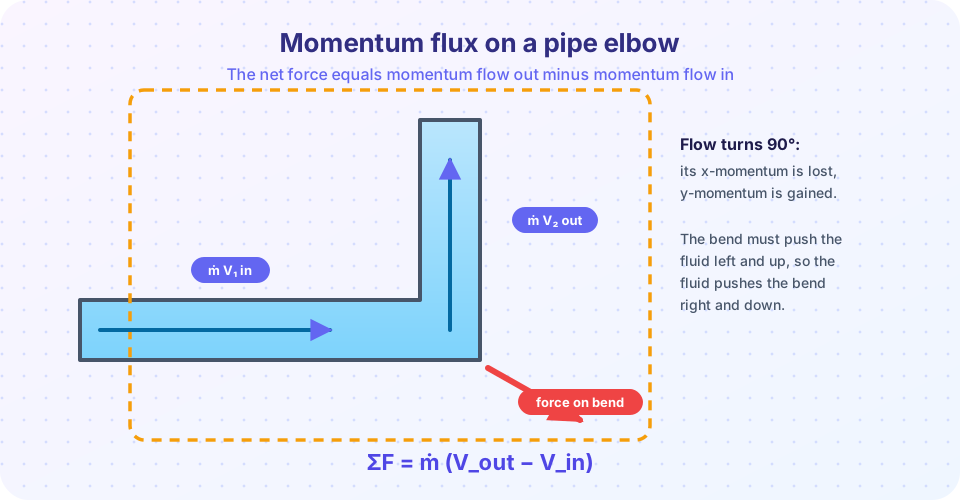
This is a vector equation. Write it in components (x and y), choosing axes that make the problem easy. In words: the net force on the fluid in the control volume equals the momentum leaving per second minus the momentum entering per second.
The forces ΣF on the fluid inside the CV include:
- Pressure forces on every inlet and outlet:
p Apushing into the CV (use gauge pressures, because the atmosphere pushes on all sides and cancels). - Weight of the fluid,
m g, downward (often small, so check). - The reaction
Rfrom solid walls on the fluid (the force you want).
The force of the fluid on the wall is −R, equal and opposite.
A procedure that works
- Sketch the device and pick a control volume that cuts the flow at inlets and outlets and goes around the solid so that the support force is included (or cut inside the solid).
- Choose x and y axes.
- List every force on the fluid in the CV, with directions.
- Compute
ṁ = ρ A Vand eachVvector. - Write the x and y equations and solve for the unknown reaction components.
- Convert to the force on the device by flipping the sign.
Worked example: a 90° elbow
Water (ρ = 998 kg/m³) flows at Q = 0.03 m³/s through a horizontal 90° bend of constant diameter 0.10 m. Inlet gauge pressure is p₁ = 100 kPa; ignore friction and weight so p₂ = p₁. Flow enters in +x and leaves in +y.
- Area
A = π(0.1)²/4 = 7.854 × 10⁻³ m², speedV = Q/A = 3.82 m/s,ṁ = 998 × 0.03 = 29.9 kg/s. - Momentum flux:
ṁ V = 29.9 × 3.82 = 114.4 N. - Pressure force:
p A = 100 000 × 7.854 × 10⁻³ = 785.4 N. - x-direction (flow in at +x, out has zero x-velocity):
R_x + p₁A₁ = ṁ(0) − ṁ V = −114.4, soR_x = −114.4 − 785.4 = −899.8 N(on the fluid, toward −x). - y-direction (the exit pressure force on the fluid points −y, because the outlet normal is +y):
R_y − p₂A₂ = ṁ V − 0, soR_y = 114.4 + 785.4 = +899.8 N. - The force of the fluid on the bend is
+899.8 Nin x and−899.8 Nin y: about 1.27 kN toward the lower right, at 45° down from the x axis.
The pressure terms dominate here (785 N vs 114 N). Pipe bends in high-pressure lines need strong anchor blocks. The 45° angle appears because both openings have equal area and pressure.
Press Run (or Ctrl + Enter) to see the result here.
Program input · what you'd type while the program runs
Type the answers before you press Run, one per line. Each time the program reads a line (with input()), it gets the next line from this box.
The code uses Bernoulli's equation (chapter 4) to find p₂ when the exit is smaller. For equal diameters it reproduces the 899.8 N components from the text.
Worked example: a nozzle on a hose
A hose of diameter 40 mm carries Q = 0.004 m³/s to a nozzle with exit diameter 15 mm. Speeds: V₁ = 0.004/(π 0.02²) = 3.18 m/s, V₂ = 0.004/(π 0.0075²) = 22.6 m/s. With Bernoulli, the gauge pressure at the inlet (the exit is at atmosphere, p₂ = 0) is p₁ = ½ρ(V₂² − V₁²) = 0.5 × 998 × (511.8 − 10.1) ≈ 251 kPa. The force the nozzle exerts on the fluid in the x-direction (flow in +x): R_x + p₁A₁ = ṁ(V₂ − V₁), so R_x = 3.99 × (22.6 − 3.18) − 251 000 × 1.257 × 10⁻³ ≈ 77.7 − 315 = −237 N. The fluid pushes the nozzle forward with about 237 N; the hose holder must provide about 237 N backward to keep it still. That is a noticeable push you can feel.
Press Run (or Ctrl + Enter) to see the result here.
Program input · what you'd type while the program runs
Type the answers before you press Run, one per line. Each time the program reads a line (with input()), it gets the next line from this box.
Common misconceptions
"I should use absolute pressure." Use gauge pressure, because the atmosphere acts on the outside of the whole control volume and cancels.
"The force on the bend equals the force on the fluid." It is equal and opposite: the bend pushes the fluid one way; the fluid pushes the bend the other way.
"Momentum flux is a scalar." It is a vector ṁ V; the x and y components of each opening must be tracked separately.
Check your understanding
Quick check · 4 questions
of 4 answered You scored / 4 · perfect!
-
1. Steady water flow (ṁ = 20 kg/s) leaves a nozzle at 15 m/s and enters at 5 m/s along the same line. The net force on the fluid (momentum only) is
ΣF = ṁ (V₂ − V₁) = 20 × (15 − 5) = 200 N. -
2. Which pressure do you use for the pressure forces in the momentum equation?
Atmospheric pressure acts on all sides of the control volume, so only gauge pressures contribute. -
3. A bend turns a jet from +x to −x (180°) with speed V and mass flow ṁ and negligible pressure forces. The force on the fluid is
Momentum changes from +ṁV to −ṁV, a change of 2ṁV. -
4. The force of the fluid on the elbow is
Newton's third law: equal in magnitude and opposite in direction.
Summary
- Steady momentum equation:
ΣF = Σ ṁ V_out − Σ ṁ V_in(a vector equation). - Forces on the fluid include gauge-pressure forces on openings, weight, and the reaction from solid walls.
- Force on a device = minus the reaction on the fluid.
- Pressure forces often dominate the force on bends and nozzles at high pressure.
Next: Jets, Plates and Vanes
Track your progress
Create a free account to tick off lessons and pick up where you left off on any device.
of Fluid Mechanics lessons completed