


















Lesson 30 of 44 · Viscous Flow in Pipes
Chapter 6 review: Viscous flow in pipes
Review laminar and turbulent pipe flow, Reynolds number, friction factor, minor losses and pipe systems with a recap table, a reusable calculator and ten questions.
You can now estimate how much head a pipe system wastes, and how much flow a given head will push through it. This page collects the whole chapter in one picture, one table and one reusable calculator, then checks your understanding with ten mixed questions.
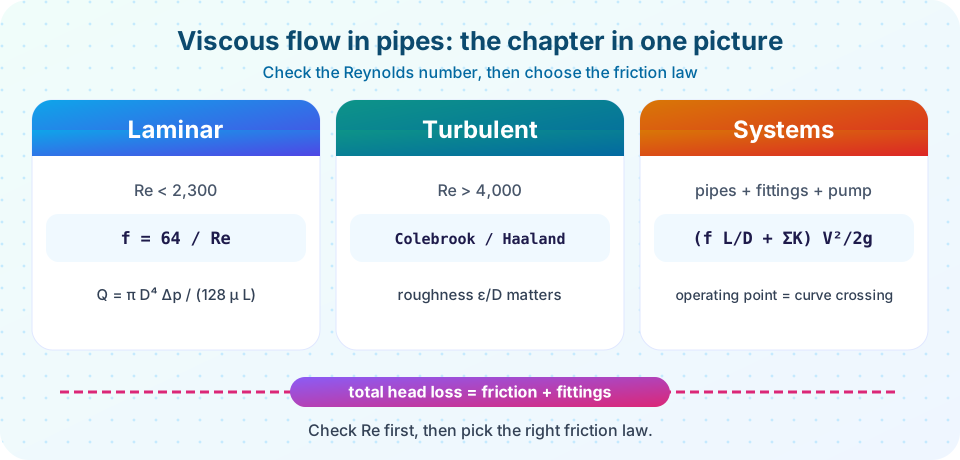
Recap table
| Topic | Key result |
|---|---|
| Reynolds number | Re = ρ V D / μ; laminar below about 2,300, turbulent above about 4,000 |
| Darcy-Weisbach | h_f = f (L/D) V² / 2g, Δp = ρ g h_f |
| Laminar profile | parabola, u_max = 2V, τ_w = Δp D / 4L |
| Hagen-Poiseuille | Q = π D⁴ Δp / (128 μ L), so Q ∝ D⁴ |
| Laminar friction | f = 64 / Re |
| Turbulent friction | Colebrook (implicit) or Haaland (explicit); depends on Re and ε/D |
| Minor losses | h_m = K V² / 2g; exit K = 1, sharp entrance K = 0.5 |
| System energy equation | p/ρg + V²/2g + z + h_p = … + h_L |
| Parallel pipes | same head loss, flows add |
| Series pipes | same flow, losses add |
A recipe for any pipe problem
- Sketch the system and mark the two points where you will write the energy equation.
- Choose which unknown you want: head loss, flow rate or diameter.
- Compute (or guess)
V, thenRe. Decide laminar or turbulent. - Get
f:64/Reif laminar, Colebrook or Haaland if turbulent. - Add the minor losses
Σ K. - Solve the energy equation. For flow-rate and diameter problems, iterate until the guess and the result agree.
- Check: is
Reconsistent with the regime you assumed? Is the answer physically sensible?
Try it
This calculator wraps the recipe. Use it to check your hand answers to the questions below and to explore "what if" changes.
Press Run (or Ctrl + Enter) to see the result here.
Program input · what you'd type while the program runs
Type the answers before you press Run, one per line. Each time the program reads a line (with input()), it gets the next line from this box.
Notice that the head loss grows a little more slowly than the square of the flow while f is still falling with Re, and almost exactly as the square once the pipe is near the fully rough limit.
Chapter in ten questions
Quick check · 10 questions
of 10 answered You scored / 10 · perfect!
-
1. Water flows at 0.5 m/s in a 20 mm pipe (nu = 1.0e-6 m^2/s). What is Re?
Re = V D / nu = 0.5 x 0.02 / 1e-6 = 10,000, so the flow is turbulent. -
2. Laminar flow, same pressure drop, diameter doubled. The flow rate changes by a factor of:
Q is proportional to D^4, so doubling D gives 2^4 = 16 times the flow. -
3. The friction factor for laminar flow at Re = 1,600 is:
f = 64 / 1,600 = 0.04. -
4. In fully rough turbulent flow, f depends on:
At high Re the Moody curves are horizontal: f is set by eps/D. -
5. The head loss in a pipe is 5 m for a speed of 2 m/s. If the speed doubles and f stays the same, h_f becomes:
h_f is proportional to V^2, so doubling V multiplies it by 4: 20 m. -
6. A sudden expansion from area A1 to A2 = 4 A1 has K (based on V1) equal to:
K = (1 - A1/A2)^2 = (1 - 0.25)^2 = 0.5625. -
7. Which pipe flow problem usually needs iteration?
With V unknown, neither Re nor f is known, so you guess f and refine. -
8. In the energy equation for two open tanks, which terms vanish?
Both surfaces are at atmospheric (gauge zero) pressure and move slowly, so those terms are zero. -
9. Two pipes are in parallel. Branch A carries 30 L/s. What must be true about branch B?
Parallel branches share the same head loss; the flows can differ. -
10. What is the Darcy friction factor if the Fanning factor is 0.0045?
f_Darcy = 4 x f_Fanning = 0.018.
Summary
- Always start with
Re; it decides the friction law. - Total loss is
(f L/D + ΣK) V²/2g; the energy equation adds pump head and elevation. - Flow-rate and diameter problems are solved by iteration, which is easy in code.
- Next chapter: what happens to the fluid next to a solid surface, and how it creates drag.
Track your progress
Create a free account to tick off lessons and pick up where you left off on any device.
of Fluid Mechanics lessons completed