


















Lesson 12 of 44 · Control Volumes and Conservation
Control Volumes: Chapter Overview
See how the control volume turns fluid flow into bookkeeping: system versus control volume, the Reynolds transport theorem, and the plan for mass and momentum.
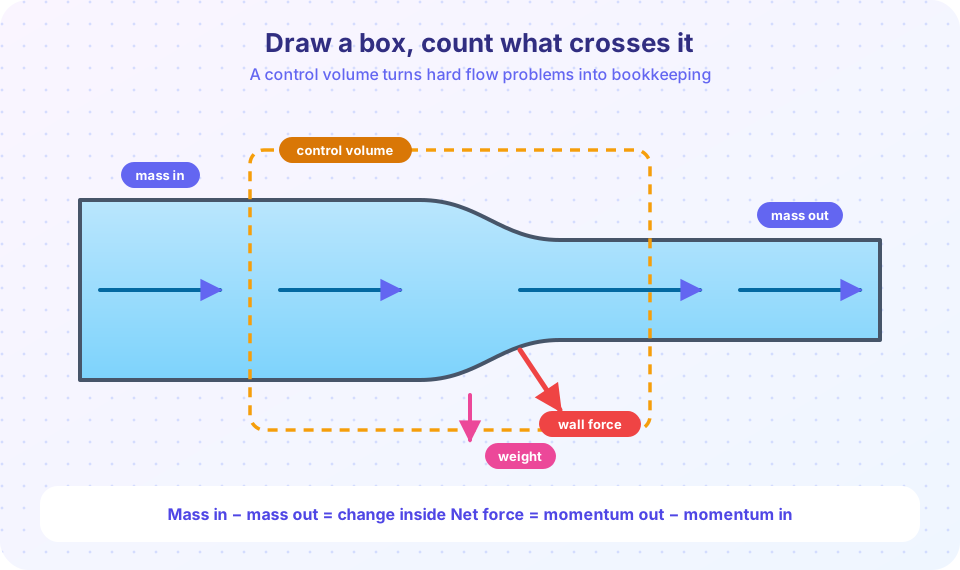
The laws of physics are written for a fixed amount of matter: a system. Newton's second law talks about "a body of mass m". But a river, a jet engine or a garden hose has no fixed body; fluid keeps flowing through. The trick that makes fluid mechanics practical is to switch from following a lump of fluid to watching a fixed region of space and counting what crosses its boundary. This region is called a control volume, and this chapter shows how to use it for mass and momentum.
What you will learn
- The difference between a system and a control volume.
- Why a transport theorem is needed to convert system laws to control-volume laws.
- How the chapter's lessons use the idea for mass and momentum.
- How to choose and draw a good control volume.
Key terms
System: a fixed collection of fluid particles that always contains the same mass.
Control volume (CV): a fixed (or moving) region in space chosen for analysis; fluid can cross its control surface (CS).
Flux: the amount of a quantity (mass, momentum, energy) crossing a surface per unit time.
Reynolds transport theorem (RTT): the rule that converts a system's rate of change into control-volume terms.
System versus control volume
A system follows the same matter forever. A control volume stays put in space and matter flows through it. Think of a bathtub. The system view tracks the particular liters of water that are now in the tub. The control-volume view says: draw a box around the tub; the water level changes at a rate equal to the inflow from the tap minus the outflow through the drain.
For solids you always use systems (a ball, a car). For fluids you almost always use control volumes, because the fluid's boundary is hard to follow and the boundaries you care about (a pipe inlet and outlet, a wing, a nozzle) are fixed.
The Reynolds transport theorem
Let B be any extensive property of a system (mass, momentum, energy) and b = B/m its value per unit mass. Reynolds showed that for a control volume
dB_sys/dt = d/dt ∫_CV ρ b dV + ∮_CS ρ b (V · n) dA
In words: the rate of change of B for the matter currently inside the CV equals the rate at which B accumulates inside the CV, plus the net rate at which B flows out through the control surface. V · n is the velocity component normal to the surface, positive for outflow and negative for inflow.
Plug in B = m, b = 1 and you get conservation of mass. Plug in B = momentum, b = V and you get Newton's second law for flows. The same theorem will later give the energy equation.
Choosing a control volume
Then apply the laws
The lessons in this chapter
| Lesson | What you will do |
|---|---|
| Conservation of Mass | Use ρ A V flows, continuity and draining-tank problems. |
| The Momentum Equation | Find forces on nozzles and bends from momentum flux. |
| Jets, Plates and Vanes | Compute jet forces on fixed and moving surfaces. |
| Chapter 3 Review | Consolidate with a recap and a mixed quiz. |
A first example: bathtub bookkeeping
A tub has a surface area of 0.9 m². Water enters at 0.20 L/s and leaves through the drain at 0.15 L/s. How fast does the level rise? The control volume is the tub. Mass in minus mass out equals storage: ρ (Q_in − Q_out) = ρ A dh/dt, so dh/dt = (Q_in − Q_out) / A.
Press Run (or Ctrl + Enter) to see the result here.
Program input · what you'd type while the program runs
Type the answers before you press Run, one per line. Each time the program reads a line (with input()), it gets the next line from this box.
Press Run (or Ctrl + Enter) to see the result here.
Program input · what you'd type while the program runs
Type the answers before you press Run, one per line. Each time the program reads a line (with input()), it gets the next line from this box.
Common misconceptions
"The control volume must be the whole device." Choose it for convenience. Often the best box is a small piece around one inlet or one bend.
"Mass flowing out equals mass flowing in always." Only in steady flow. When the level in a tank changes, the mass inside is changing.
Check your understanding
Quick check · 4 questions
of 4 answered You scored / 4 · perfect!
-
1. A control volume differs from a system because
A control volume is a chosen region; the matter inside changes as fluid crosses its boundary. -
2. In the Reynolds transport theorem, the surface term describes
∮ρ b (V·n) dA is the net outflow of the property b. -
3. A tub of area 1.2 m² receives 0.3 L/s and drains 0.1 L/s. How fast does the level rise?
dh/dt = (0.3 − 0.1)×10⁻³ / 1.2 = 1.67 × 10⁻⁴ m/s ≈ 0.17 mm/s. -
4. When choosing a control volume, where is it best to cut through the flow?
Cutting where the velocity and pressure are known leaves fewer unknowns.
Summary
- Fluid analysis uses a control volume: a region fixed in space that matter flows through.
- The Reynolds transport theorem turns system laws into: accumulation inside plus net flux out.
- Mass and momentum come next; energy follows in chapter 4.
- Choose the CV boundary where velocity and pressure are known.
Next: Conservation of Mass
Track your progress
Create a free account to tick off lessons and pick up where you left off on any device.
of Fluid Mechanics lessons completed