


















Lesson 36 of 44 · Compressible Flow and Machinery
Isentropic flow, nozzles and choking
Learn isentropic flow of an ideal gas: stagnation properties, the area-Mach relation, why a nozzle chokes and how to compute the maximum mass flow rate.
If a gas flows fast through a short, smooth nozzle, there is no time for heat to flow in or out, and friction is small. The flow is then approximately adiabatic and reversible, which is what the word isentropic means: constant entropy. This one assumption produces a complete set of clean formulas that connect Mach number, temperature, pressure, density and area.
They explain rocket nozzles, jet engines, steam turbines, gas leaks and the speed limit of a hole in a pressurized tank.
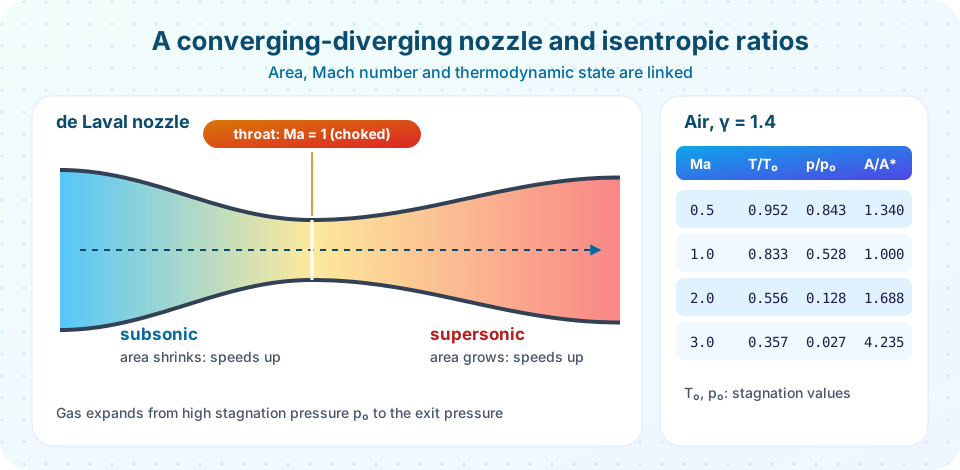
What you will learn
- What stagnation properties are and how to compute them.
- How
T,pandρrelate toMaalong an isentropic flow. - Why subsonic and supersonic flows respond oppositely to area changes.
- How a nozzle chokes and how to compute the maximum mass flow rate.
Key terms
Isentropic: adiabatic and reversible, so entropy stays constant.
Stagnation (total) properties: T₀, p₀, ρ₀, reached when the flow is slowed to rest isentropically. They are constant along an isentropic flow.
Choked flow: the condition where the flow at the throat reaches Ma = 1 and the mass flow rate cannot rise further by lowering the downstream pressure.
Throat: the smallest cross-section of a nozzle; A* is the area where Ma = 1 would be reached.
Stagnation properties and isentropic relations
For an ideal gas with constant specific-heat ratio γ (1.4 for air), the energy equation h + V²/2 = const gives the stagnation temperature
T₀ / T = 1 + (γ − 1)/2 · Ma²
and the isentropic relations then give
p₀ / p = (T₀/T)^(γ/(γ−1)), ρ₀ / ρ = (T₀/T)^(1/(γ−1)).
For air (γ = 1.4) these become T₀/T = 1 + 0.2 Ma², p₀/p = (1 + 0.2 Ma²)^3.5 and ρ₀/ρ = (1 + 0.2 Ma²)^2.5.
Ma |
T/T₀ |
p/p₀ |
ρ/ρ₀ |
|---|---|---|---|
| 0.5 | 0.952 | 0.843 | 0.885 |
| 1.0 | 0.833 | 0.528 | 0.634 |
| 2.0 | 0.556 | 0.128 | 0.230 |
| 3.0 | 0.357 | 0.0272 | 0.0762 |
At Ma = 1 the values T* / T₀ = 0.833 and p* / p₀ = 0.528 are called the critical ratios. Notice that already at Ma = 0.5 the density has changed by 11 percent, which is why Ma > 0.3 needs compressible treatment.
Example. Air with p₀ = 500 kPa and T₀ = 300 K expands isentropically to Ma = 2. Then T = 300 × 0.5556 = 166.7 K, p = 500 × 0.1278 = 63.9 kPa, a = √(1.4 × 287 × 166.7) = 258.8 m/s and V = 2 × 258.8 ≈ 518 m/s. The gas cools by 133 K as it accelerates: thermal energy has become kinetic energy.
Area and Mach number
Combining mass conservation ρ A V = const with the momentum equation gives a famous relation between small changes in area and speed:
dA / A = (Ma² − 1) · dV / V
- Subsonic (
Ma < 1): the factor is negative. Area falls as speed rises, so a converging duct accelerates the gas, like water in a hose nozzle. - Supersonic (
Ma > 1): the factor is positive. Area must rise for speed to rise, so a diverging duct accelerates the gas. - Sonic (
Ma = 1):dA = 0, so sonic flow can occur only at a minimum area, the throat.
A converging-diverging (de Laval) nozzle therefore accelerates gas from subsonic through Ma = 1 at the throat to supersonic in the diverging part. Gustaf de Laval introduced it for steam turbines in the 1880s. The area needed for a given Mach number, relative to the throat area, is
A / A* = (1 / Ma) · [ (2 / (γ+1)) · (1 + (γ−1)/2 · Ma²) ]^((γ+1) / (2(γ−1)))
For air: A/A* = 1.34 at Ma = 0.5 (subsonic), 1 at Ma = 1, 1.69 at Ma = 2 and 4.23 at Ma = 3. Notice that each A/A* above 1 corresponds to two Mach numbers, one subsonic and one supersonic; which one occurs depends on the downstream pressure.
Choked flow
As you lower the pressure downstream of a converging nozzle, the flow speeds up and the mass flow rate rises. When the throat reaches Ma = 1 (pressure ratio p_b / p₀ = 0.528 for air), the flow is choked. Lowering the back pressure further cannot change the flow upstream, because pressure signals travel at the speed of sound and the throat flow already moves at that speed: the news cannot go upstream.
The maximum mass flow rate depends only on stagnation conditions and throat area:
ṁ_max = A* p₀ √( γ / (R T₀) ) · ( 2 / (γ+1) )^((γ+1) / (2(γ−1)))
For air this is ṁ_max ≈ 0.0404 · A* p₀ / √T₀ (SI units). For p₀ = 500 kPa, T₀ = 300 K and a throat of 1 cm², ṁ_max = 0.0404 × 10⁻⁴ × 5 × 10⁵ / √300 ≈ 0.117 kg/s. Doubling p₀ doubles the mass flow, which is why gas leaks from high-pressure tanks are so dangerous, and why a "sonic nozzle" can meter gas flow independently of downstream pressure.
Common misconceptions
"A nozzle always speeds the flow up when it narrows." Only for subsonic flow. In supersonic flow a narrowing duct slows the gas.
"Choking means the flow has stopped." It means the flow is at its maximum for the given upstream state: Ma = 1 at the throat and the mass flow is at a maximum.
"Isentropic means constant temperature." The temperature changes a great deal. Entropy is what is constant.
Try it
First, code the isentropic relations and the area-Mach relation, then invert A/A* to find both the subsonic and the supersonic Mach number.
Press Run (or Ctrl + Enter) to see the result here.
Program input · what you'd type while the program runs
Type the answers before you press Run, one per line. Each time the program reads a line (with input()), it gets the next line from this box.
Second, plot the whole picture: area ratio and the property ratios against Mach number, with the sonic point marked.
Press Run (or Ctrl + Enter) to see the result here.
Program input · what you'd type while the program runs
Type the answers before you press Run, one per line. Each time the program reads a line (with input()), it gets the next line from this box.
Check your understanding
Quick check · 5 questions
of 5 answered You scored / 5 · perfect!
-
1. Air at T0 = 400 K flows at Ma = 1. What is its static temperature?
T/T0 = 1 / (1 + 0.2) = 0.8333, so T = 333 K. -
2. A supersonic flow enters a converging duct. The Mach number will:
For Ma above 1, a decreasing area slows the gas, so the Mach number falls. -
3. Where in a de Laval nozzle can Ma = 1 occur (in isentropic flow)?
dA = 0 is required for sonic flow, which happens only at a minimum area. -
4. What does it mean for a nozzle to be choked?
Once the throat is sonic, lowering the back pressure cannot increase the mass flow. -
5. If the stagnation pressure doubles with T0 and the throat area fixed, the choked mass flow:
ṁ_max is proportional to p0 (and to 1/sqrt(T0)).
Summary
- Isentropic flow:
T₀/T = 1 + (γ−1)/2 Ma²,p₀/p = (T₀/T)^(γ/(γ−1)),ρ₀/ρ = (T₀/T)^(1/(γ−1)). dA/A = (Ma² − 1) dV/V: converging ducts accelerate subsonic flow, diverging ducts accelerate supersonic flow;Ma = 1only at a throat.- A given
A/A*has a subsonic and a supersonic solution. - A choked nozzle passes
ṁ_max ≈ 0.0404 A* p₀/√T₀for air.
Next: Nozzles and shock waves
Track your progress
Create a free account to tick off lessons and pick up where you left off on any device.
of Fluid Mechanics lessons completed