


















Lesson 16 of 44 · Control Volumes and Conservation
Chapter 3 Review: Control Volumes and Conservation
Review control volumes, continuity, the momentum equation and jet forces with a one-picture summary, a recap table and a 9-question mixed quiz.
This chapter replaced "follow the fluid" with "watch a box". With one drawing and two equations (mass and momentum), you can find velocities, flow rates and forces on nozzles, bends and plates without knowing what happens inside the box. This review checks that you can use the box correctly.
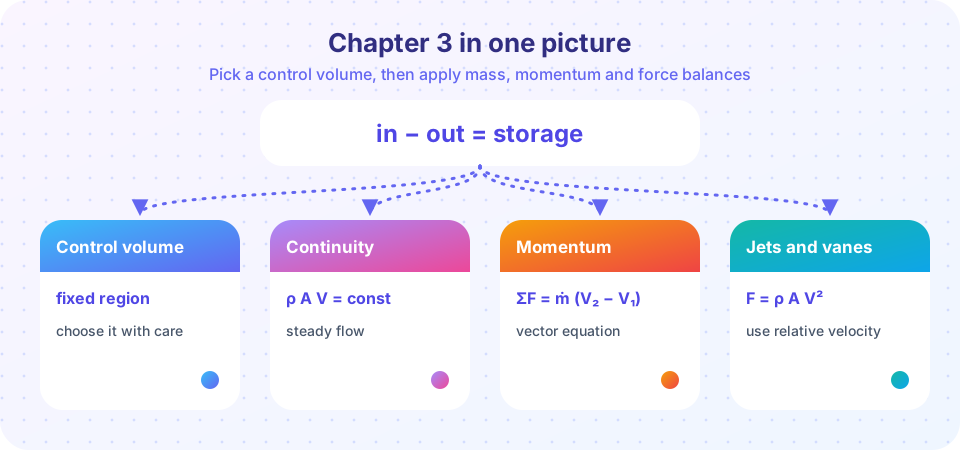
What you will learn
- How the three tools of the chapter fit together.
- The equations and sign conventions to memorize.
- Where to look again if the quiz exposes a gap.
Recap table
| Lesson | Key equation | Remember |
|---|---|---|
| Overview | RTT: system rate = storage + net flux | Choose a CV that cuts where V and p are known |
| Conservation of mass | dm/dt = Σṁ_in − Σṁ_out, ρ₁A₁V₁ = ρ₂A₂V₂ |
Steady incompressible: Q is constant |
| Momentum | ΣF = Σṁ V_out − Σṁ V_in |
Vector equation; use gauge pressures |
| Jets and vanes | F = ρ A V², F = ρ A V² (1 − cos θ) |
Moving vane uses relative speed V − u |
A combined problem
Water flows steadily at Q = 0.012 m³/s from a 60 mm pipe through a nozzle into the air, forming a 20 mm jet that strikes a vertical plate head-on.
- Jet speed:
V = 0.012 / (π × 0.01²) = 38.2 m/s. - Force on the plate:
F = ρ Q V = 998 × 0.012 × 38.2 = 457 N. - Inlet speed in the pipe:
V₁ = 0.012/(π 0.03²) = 4.24 m/s. - Gauge pressure at the nozzle inlet (Bernoulli, chapter 4):
p₁ = ½ρ(V² − V₁²) = 0.5 × 998 × (1459 − 18) = 719 kPa.
Press Run (or Ctrl + Enter) to see the result here.
Program input · what you'd type while the program runs
Type the answers before you press Run, one per line. Each time the program reads a line (with input()), it gets the next line from this box.
Check your understanding
Quick check · 9 questions
of 9 answered You scored / 9 · perfect!
-
1. In steady incompressible flow, a pipe of diameter 200 mm narrows to 100 mm. If the speed in the large pipe is 1.5 m/s, the speed in the narrow pipe is
Area ratio (200/100)² = 4, so V₂ = 4 × 1.5 = 6 m/s. -
2. A tank has inflow 5 L/s and outflow 8 L/s. Its water volume
Storage rate = in − out = −3 L/s. -
3. In the momentum equation you should use pressure forces based on
Atmospheric pressure cancels over the whole control surface. -
4. A jet of 15 kg/s moving at 12 m/s is completely stopped by a plate. The force on the plate is
F = ṁ V = 15 × 12 = 180 N. -
5. A fixed vane that reverses a jet (θ = 180°) gives a force of
F = ρAV²(1 − cos 180°) = 2ρAV². -
6. A flat plate moves away from a jet at u. The force is proportional to
Relative speed controls both the mass flow reaching the plate and the momentum change. -
7. The momentum equation is
ΣF and ṁV are vectors, so write x and y components separately. -
8. In a draining tank, the level falls most slowly
Outflow ∝ √h so the level drops more slowly as h decreases. -
9. The force of a fluid on a nozzle is
Newton's third law.
Summary
- Draw a control volume, then use mass and momentum balances.
- Continuity:
ρ₁A₁V₁ = ρ₂A₂V₂; unsteady: storage = in − out. - Momentum:
ΣF = Σṁ V_out − Σṁ V_in, in components, with gauge pressures. - Jets:
F = ρAV²(flat),ρAV²(1 − cos θ)(vane), relative speedV − ufor moving surfaces.
Track your progress
Create a free account to tick off lessons and pick up where you left off on any device.
of Fluid Mechanics lessons completed