


















Lesson 34 of 44 · Boundary Layers and Drag
Chapter 7 review: Boundary layers and drag
Review boundary layer thickness, skin friction, separation, drag and lift with a one-page picture, a recap table, a profile plot and ten mixed practice questions.
This chapter began with Prandtl's idea that friction lives in a thin layer. It ends with the two big payoffs: formulas for the friction drag on a surface, and an understanding of why bodies have wakes. This page lines up the key numbers and tests them.
Recap table
| Topic | Key result |
|---|---|
| Local Reynolds number | Re_x = U x / ν |
| Transition (smooth plate) | Re_x ≈ 5 × 10⁵ |
| Laminar thickness | δ = 5.0 x / √Re_x |
Laminar C_f,x |
0.664 / √Re_x |
Laminar average C_D |
1.328 / √Re_L |
| Turbulent thickness | δ ≈ 0.37 x / Re_x^0.2 |
Turbulent average C_D |
0.074 / Re_L^0.2 |
Mixed layer C_D |
0.074/Re_L^0.2 − 1742/Re_L |
| Drag force | F_D = C_D ½ ρ V² A |
| Lift force | F_L = C_L ½ ρ V² S, C_L ≈ 2π α before stall |
| Stokes drag | F = 3π μ V D, valid for Re < 1 |
| Terminal velocity | √(2mg / ρ C_D A) (high Re) |
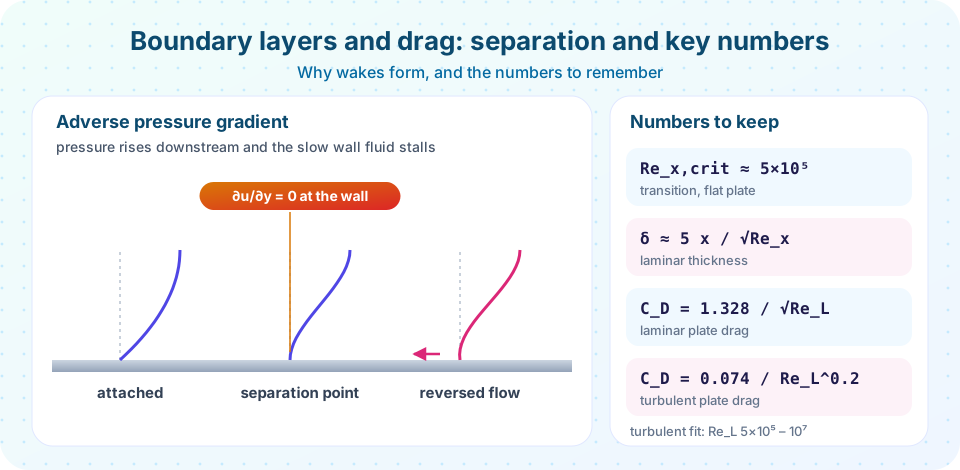
| Separation | wall shear τ_w = 0 (∂u/∂y = 0 at the wall) |
Separation in one idea
Along a body, the free-stream pressure falls where the flow accelerates (the front of an airfoil) and rises where it slows (the rear). A boundary layer can climb a mild pressure rise, but near the wall the fluid has little momentum. A strong adverse pressure gradient first stops the fluid next to the wall (zero shear at the wall: the separation point), then pushes it backward. The layer lifts off and a wake forms.
Remedies are based on re-energizing the layer: a turbulent layer (dimples, trip wires, vortex generators), suction or blowing, or a more gradual (streamlined) shape.
Try it
This example plots the three velocity profiles from the picture and prints the wall velocity gradient. A positive gradient means attached flow, zero means separation and a negative one means backflow.
Press Run (or Ctrl + Enter) to see the result here.
Program input · what you'd type while the program runs
Type the answers before you press Run, one per line. Each time the program reads a line (with input()), it gets the next line from this box.
Chapter in ten questions
Quick check · 10 questions
of 10 answered You scored / 10 · perfect!
-
1. Air (nu = 1.5e-5 m^2/s) flows at 15 m/s over a smooth plate. Where does transition begin, assuming Re_x = 5e5?
x = Re_crit nu / U = 5e5 x 1.5e-5 / 15 = 0.5 m. -
2. The laminar layer thickness at x = 0.4 m has Re_x = 1.6e5. What is delta (delta = 5x / sqrt(Re_x))?
sqrt(1.6e5) = 400, so delta = 5 x 0.4 / 400 = 0.005 m = 5 mm. -
3. At the separation point, the wall shear stress is:
Separation is defined by du/dy = 0 at the wall, so tau_w = 0. -
4. Which flat-plate formula applies to a fully turbulent layer?
0.074/Re_L^0.2 is the turbulent average drag coefficient correlation. -
5. What is the lift on a 10 m^2 wing at C_L = 0.5, V = 60 m/s, rho = 1.2 kg/m^3?
L = C_L x 0.5 x rho x V^2 x S = 0.5 x 0.5 x 1.2 x 3600 x 10 = 10,800 N. -
6. Which change typically reduces the total drag of a sphere near Re = 2e5?
A tripped turbulent layer separates later, shrinking the wake and cutting pressure drag, the drag-crisis effect. -
7. A turbulent boundary layer, compared with a laminar one at the same station, is:
Turbulent mixing thickens the layer and steepens the velocity gradient at the wall. -
8. The Stokes drag formula is valid for:
Stokes drag assumes creeping flow, where inertia is negligible, so Re is below about 1. -
9. A car with C_D = 0.30 and frontal area 2.2 m^2 drives at 30 m/s (rho = 1.2). Which is the drag force?
F = 0.30 x 0.5 x 1.2 x 900 x 2.2 = 356 N. -
10. Why does skin-friction drag matter more for a streamlined body than for a bluff body?
Pressure drag is small when the flow stays attached, so the shear stress over the surface is the dominant contribution.
Summary
- Compute
Re_xfirst; laminar below about5 × 10⁵, turbulent beyond. - Use
δ = 5x/√Re_x,C_D = 1.328/√Re_L(laminar) or0.074/Re_L^0.2(turbulent) for plate friction. - Separation (zero wall shear) creates wakes and pressure drag; streamlining and turbulent layers delay it.
F_D = C_D ½ρV²A,F_L = C_L ½ρV²S, andC_L ≈ 2παup to stall.- Next: what happens when the speed approaches the speed of sound, and how pumps and turbines add or extract energy.
Track your progress
Create a free account to tick off lessons and pick up where you left off on any device.
of Fluid Mechanics lessons completed