


















Lesson 1 of 44 · Getting Started
Course Map: Your Route Through Fluid Mechanics
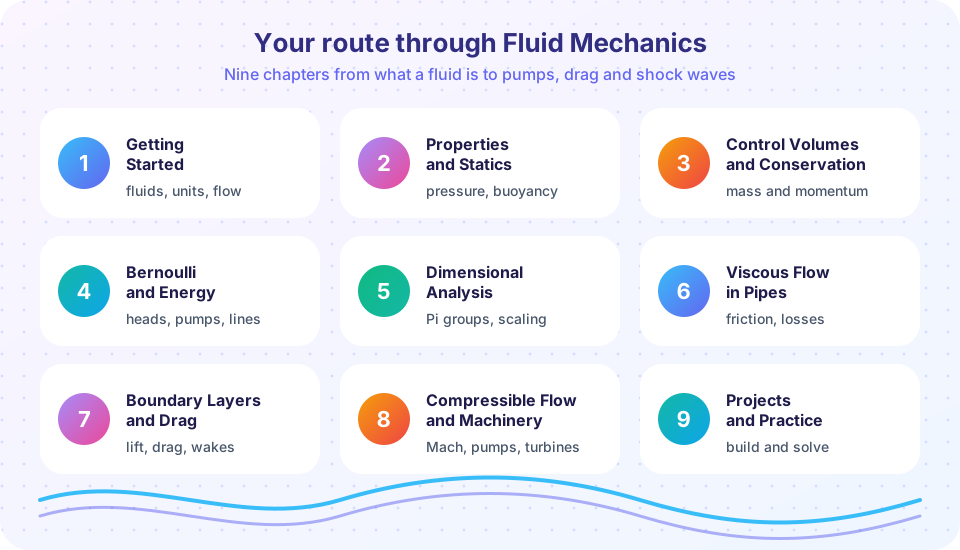
See the whole Fluid Mechanics course at a glance: who it is for, what you need first, how the nine chapters connect, and how to study it effectively.
Fluid mechanics is the science of things that flow: water in a pipe, air over a wing, blood in an artery, oil in a pipeline, wind around a skyscraper. It decides how big a pump must be, how much drag a car has, why a dam is thicker at the bottom, and why a golf ball has dimples. This course takes you from the very first definition, "what is a fluid?", to pumps, turbines, drag and shock waves.
What you will learn
- What the course covers and how the nine chapters build on one another.
- Which math and physics you should be comfortable with before you start.
- A study routine that turns reading into skill: sketch, set up, solve, check.
- How the interactive examples and quizzes on each page fit into your learning.
Key terms
Fluid: a substance that deforms continuously under any shear stress, however small (liquids and gases).
Statics: the study of fluids at rest, where pressure is the only stress.
Control volume: a region of space you draw around a flow so you can count what crosses its boundary.
Dimensionless number: a pure number such as the Reynolds number that tells you which physical effects matter.
Who this course is for
The course follows the common core of an introductory university course in fluid mechanics and of the fluid parts of physics and engineering syllabi taught worldwide: Cambridge A Level physics and further courses, the IB, US AP physics and first-year engineering. If you are an engineering student, a physics student, or an adult who simply wants to understand how flow works, you are in the right place.
You do not need to have seen fluid mechanics before. You do need:
- Algebra and basic calculus. Derivatives and simple integrals appear from chapter 2. We always explain what the symbols mean before using them.
- Newtonian mechanics. Force, mass, acceleration, work, energy and momentum. Fluid mechanics is Newton's laws applied to a substance that can change shape.
- A little Python (optional). Many examples run live in your browser. You can read the code like pseudo-code; you never have to write long programs.
The nine chapters
Foundations
- Getting Started
- Properties and Statics
Conservation laws
- Control Volumes
- Bernoulli and Energy
Real flows
- Dimensional Analysis
- Viscous Flow in Pipes
- Boundary Layers and Drag
Machines and practice
- Compressible Flow and Machinery
- Projects and Practice
Chapters 1 to 4 give you the language and the three great balance laws (mass, momentum, energy) for ideal flow. Chapters 5 to 7 add friction, the ugly but essential part of real flow, together with the dimensionless numbers that tell you how to scale experiments. Chapter 8 handles fast gas flow and machines. Chapter 9 puts everything together on complete systems.
This page and the next lessons belong to the first four chapters. Here is how they fit together:
| Chapter | Key idea | Key equation |
|---|---|---|
| 1. Getting Started | A fluid flows under any shear; use SI units | τ = μ du/dy |
| 2. Properties and Statics | Pressure grows with depth | p = p₀ + ρ g h |
| 3. Control Volumes | Count mass and momentum crossing a boundary | ρ₁A₁V₁ = ρ₂A₂V₂ |
| 4. Bernoulli and Energy | Energy per unit weight is conserved without friction | p/ρg + V²/2g + z = constant |
How to study this course
- Read with a pencil. Whenever an example appears, cover the solution and try the first step yourself.
- Draw before you calculate. Almost every fluid problem becomes easy after a sketch: the flow, the control volume, the pressures and the coordinates. Experts always do this.
- Write units on every number. Units catch more mistakes than any other habit (Units and Dimensions shows why).
- Run the examples. Change a number and predict what happens before you press Run. Prediction is where understanding is built.
- Check your answer. Is it the right order of magnitude? A household water pipe has a speed near 1 to 3 m/s, not 300 m/s.
Keep a one-page "formula and units" sheet that you update after every lesson. The summary illustration at the end of each chapter is a good start.
A first taste: pressure at depth
Here is the simplest calculation in the whole course. It uses one equation that you will meet properly in chapter 2.
Press Run (or Ctrl + Enter) to see the result here.
Program input · what you'd type while the program runs
Type the answers before you press Run, one per line. Each time the program reads a line (with input()), it gets the next line from this box.
Every 10 meters of water adds roughly one atmosphere. That fact is why scuba divers have depth limits and why submarines have thick hulls.
Press Run (or Ctrl + Enter) to see the result here.
Program input · what you'd type while the program runs
Type the answers before you press Run, one per line. Each time the program reads a line (with input()), it gets the next line from this box.
Common misconceptions
"Fluid mechanics is only about water." Air, oil, blood, honey, molten metal, and even crowds and traffic follow the same equations. Gases are fluids too.
"It is all heavy math." The equations are compact. Most real skill is choosing the right simple model and checking your answer, which this course trains explicitly.
Check your understanding
Quick check · 4 questions
of 4 answered You scored / 4 · perfect!
-
1. Which pair of chapters in this course give you the three balance laws for ideal flow?
Chapter 3 covers mass and momentum with control volumes; chapter 4 adds energy (Bernoulli and the energy equation). -
2. What is the best first step on almost every fluid mechanics problem?
A sketch makes the physics visible and shows which equation applies. -
3. Roughly how much does the pressure increase for every 10 m of depth in fresh water?
ρ g h = 998 × 9.81 × 10 ≈ 98 kPa, which is close to 1 atm (101.3 kPa). -
4. Which of these is a fluid?
A fluid is defined by how it responds to shear, not by its appearance. Both liquids and gases deform continuously under shear.
Summary
- Fluid mechanics applies Newton's laws and conservation of mass and energy to substances that flow.
- The course has nine chapters: foundations, statics, control volumes, Bernoulli and energy, dimensional analysis, pipe flow, boundary layers and drag, compressible flow and machinery, then projects.
- You need algebra, basic calculus and Newtonian mechanics. Python is optional.
- Sketch first, write units, run the examples, and check that your answer is reasonable.
Next: What Is a Fluid?
Track your progress
Create a free account to tick off lessons and pick up where you left off on any device.
of Fluid Mechanics lessons completed