


















Lesson 17 of 44 · Bernoulli and Energy
Bernoulli and Energy: Chapter Overview
A guided overview of Bernoulli's equation, its limits and the energy equation with pumps and losses: why fast flow means low pressure, and the route through chapter 4.
Squeeze a garden hose and the water leaves faster. Open a window on a windy day and a curtain bulges outward. An airplane wing is pushed up. In every case a change in speed comes with a change in pressure, and the link between them is the best-known equation in fluid mechanics: Bernoulli's equation. It is really conservation of energy in disguise. This chapter derives it from Newton's second law, uses it to build flow meters, and then extends it with pumps, turbines and friction into the energy equation that engineers use to size real pipe systems.
What you will learn
- The big idea behind Bernoulli's equation and its three terms.
- Why an equation with speed and pressure is really energy conservation.
- The assumptions that limit its use.
- The roadmap through this chapter's lessons.
Key terms
Pressure head: p / (ρ g), the height of fluid that pressure can support.
Velocity head: V² / (2 g), the height from which a body would fall to reach speed V.
Elevation head: z, the height above a datum.
Total head (H): the sum of the three heads, the energy per unit weight of fluid.
The big idea
Follow a small parcel of fluid along a streamline in a steady, frictionless, incompressible flow. Its energy has three forms: pressure energy (it can be pushed), kinetic energy (it is moving), and potential energy (it is high up). If no work is done on it and nothing is lost to friction, the total does not change. Per unit volume:
p + ½ ρ V² + ρ g z = constant
Divide by ρ g and every term becomes a height (in meters), which is how engineers often think about it:
p/(ρ g) + V²/(2 g) + z = H
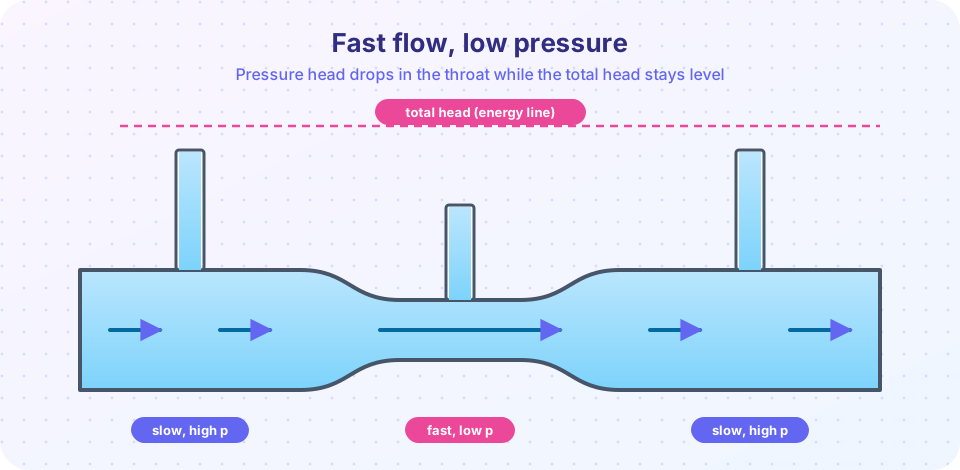
When fluid speeds up (V grows) the pressure or the elevation must fall. In a horizontal pipe, speed up means pressure down, which is the Venturi effect in the picture above.
Three kinds of energy
From ideal to real
When Bernoulli works, and when it does not
The equation assumes: steady flow, along one streamline, incompressible fluid (density constant), frictionless (no viscosity), and no pumps, turbines or heat transfer. Real flows break some of these:
| Situation | Assumption broken | What to do |
|---|---|---|
| Long pipe | Friction (viscous losses) | Add head loss h_L (energy equation) |
| Pump or turbine between points | Energy added or removed | Add h_p or h_T |
| Gases near the speed of sound | Incompressible | Use compressible flow (chapter 8) |
| Across a sudden expansion | Losses from eddies | Add a minor loss |
For short, smooth, accelerating flows (nozzles, inlets, flow around a streamlined body outside the boundary layer) Bernoulli is very accurate. Flow in a long pipe, or through a pump, needs the energy equation.
The lessons in this chapter
| Lesson | What you will do |
|---|---|
| The Bernoulli Equation | Derive it from Newton's second law and use it between two points. |
| Applications of Bernoulli | Torricelli's law, Pitot tubes, Venturi meters and siphons. |
| The Energy Equation and Grade Lines | Add pumps, turbines and losses; draw the EGL and HGL. |
| Chapter 4 Review | Consolidate with a recap and a mixed quiz. |
Warm-up: energy bookkeeping
Water at 3 m/s and 200 kPa gauge flows in a horizontal pipe that narrows so the speed becomes 12 m/s. What is the new pressure? Bernoulli (same elevation): p₂ = p₁ + ½ρ(V₁² − V₂²) = 200 000 + 0.5 × 998 × (9 − 144) = 132.6 kPa.
Press Run (or Ctrl + Enter) to see the result here.
Program input · what you'd type while the program runs
Type the answers before you press Run, one per line. Each time the program reads a line (with input()), it gets the next line from this box.
Press Run (or Ctrl + Enter) to see the result here.
Program input · what you'd type while the program runs
Type the answers before you press Run, one per line. Each time the program reads a line (with input()), it gets the next line from this box.
Notice that the three points do not share the same H. This is how engineers spot losses or machines: compare total head at two points.
Common misconceptions
"Bernoulli proves pressure is lower where the fluid moves faster, always." Only along a streamline, in the frictionless, steady, incompressible case. Across streamlines, rotational flow and boundary layers change the picture.
"Bernoulli is a separate law from energy conservation." It is energy conservation for a frictionless parcel, derived here from Newton's second law.
"A fast stream always has low pressure." A jet leaving a nozzle is at atmospheric pressure but is fast. Pressure and speed are linked within the flow, not to the outside atmosphere.
Check your understanding
Quick check · 4 questions
of 4 answered You scored / 4 · perfect!
-
1. In Bernoulli's equation p + ½ρV² + ρgz = constant, the term ½ρV² has units of
ρV² has the dimensions of pressure (Pa), as does every term. -
2. Dividing the equation by ρ g gives terms in
p/(ρg), V²/(2g) and z are all lengths, called heads. -
3. In a horizontal pipe, when water speeds up through a contraction, its pressure
With constant elevation, increasing ½ρV² requires p to decrease. -
4. Which of these breaks the assumptions of the basic Bernoulli equation?
Pipe friction and a pump add or remove energy.
Summary
- Bernoulli:
p + ½ρV² + ρgz = constantalong a streamline, i.e.p/ρg + V²/2g + z = H. - It is energy conservation for steady, frictionless, incompressible flow.
- Faster flow at the same height has lower pressure.
- Real systems need the energy equation with pumps, turbines and losses.
Next: The Bernoulli Equation
Track your progress
Create a free account to tick off lessons and pick up where you left off on any device.
of Fluid Mechanics lessons completed