


















Lesson 26 of 44 · Viscous Flow in Pipes
Chapter 6 overview: Viscous flow in pipes
A map of viscous pipe flow: laminar and turbulent regimes, friction factor, head loss, fittings and pumps, and how the chapter's lessons fit together.
Pipes carry almost everything fluid engineers care about: drinking water, oil, natural gas, blood in a vein, air in a duct. Every one of those flows loses pressure to friction, and someone must pay for the pump that pushes it along.
This chapter answers the practical question: how much pressure, or head, does it take to move a given flow through a given pipe? You will meet two very different kinds of flow, laminar and turbulent, one equation that covers both, and a systematic way to add up the extra losses from valves, bends and entrances.
What you will learn
- How the Reynolds number tells you which flow regime you are in.
- Why friction losses are written in terms of velocity head.
- How the four lessons in this chapter build on each other.
- How to estimate a regime in a few lines of code.
Key terms
Laminar flow: fluid moves in smooth layers; viscosity alone sets the friction.
Turbulent flow: fluid mixes in eddies; friction is much larger and depends on wall roughness.
Head loss (h_f): energy lost to friction per unit weight of fluid, measured in meters of fluid.
Friction factor (f): the dimensionless number that tells you how big the pipe friction is.
The big picture
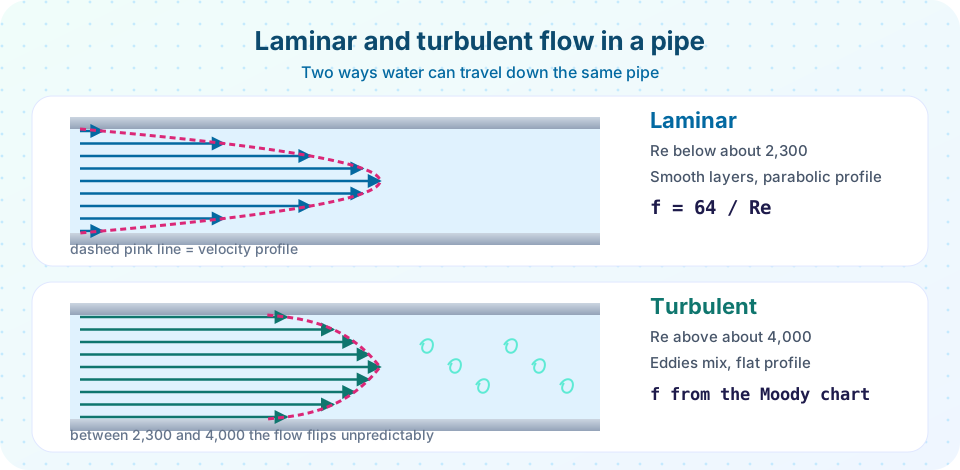
Osborne Reynolds showed in 1883 that a thread of dye in a glass pipe stays a straight line at low speed and breaks up into swirls at high speed. The switch depends on the single number Re = ρ V D / μ. For a round pipe:
Rebelow about 2,300: laminar.Rebetween about 2,300 and 4,000: transitional, unpredictable.Reabove about 4,000: turbulent.
Water at 1 m/s in a 25 mm pipe has Re ≈ 25,000, so everyday pipe flows are nearly always turbulent. Laminar flow appears for thick oils, tiny tubes (medical needles, microchannels) and slow seepage.
Whatever the regime, the pressure drop can be written with the Darcy-Weisbach equation:
h_f = f (L / D) V² / (2g)
The whole chapter is about finding f and then adding losses from fittings.
Two regimes
One loss law
Add the extras
How this chapter is organized
- Laminar flow in pipes: the exact Hagen-Poiseuille solution, parabolic profile, and
f = 64/Re. - Turbulent flow and the friction factor: roughness, the Colebrook equation and the Moody chart.
- Minor losses and pipe systems: valves, bends, entrances and solving real systems.
- Chapter review: a recap and ten practice questions.
Try it
Run the regime classifier for several common flows. Then try your own fluid and diameter.
Press Run (or Ctrl + Enter) to see the result here.
Program input · what you'd type while the program runs
Type the answers before you press Run, one per line. Each time the program reads a line (with input()), it gets the next line from this box.
Check your understanding
Quick check · 4 questions
of 4 answered You scored / 4 · perfect!
-
1. Which equation gives friction head loss for both laminar and turbulent pipe flow?
h_f = f (L/D) V^2 / 2g works in both regimes; only the friction factor f changes. -
2. A pipe flow has Re = 1,500. The regime is:
Below about 2,300 the flow in a round pipe is laminar. -
3. Why are most water pipes turbulent?
Water has a small viscosity, so even moderate speeds in moderate pipes give Re of tens of thousands. -
4. What does head loss h_f measure?
Head is energy per unit weight and has units of length, so h_f is a height of fluid column.
Summary
Re = ρVD/μseparates laminar (below about 2,300) from turbulent (above about 4,000) pipe flow.- Darcy-Weisbach,
h_f = f (L/D) V²/2g, covers both regimes. - The chapter finds
f, adds fittings, and solves real systems.
Next: Laminar flow in pipes
Track your progress
Create a free account to tick off lessons and pick up where you left off on any device.
of Fluid Mechanics lessons completed