


















Lesson 2 of 44 · Getting Started
What Is a Fluid?
Learn what makes a fluid different from a solid: continuous deformation under shear, the continuum idea, Newton's law of viscosity and non-Newtonian fluids.
Ask someone to define a fluid and they will say "something that flows", or "a liquid". Engineers need a sharper definition, because the equations you will use depend on it. The definition rests on a single idea: how a material responds when you try to shear it. This lesson builds that idea, introduces the quantity called viscosity, and shows why most everyday fluids obey a simple law found by Isaac Newton.
What you will learn
- The formal definition of a fluid in terms of shear stress.
- What the continuum hypothesis assumes and when it fails.
- How to use Newton's law of viscosity,
τ = μ du/dy, in a simple two-plate problem. - The difference between Newtonian and non-Newtonian fluids.
Key terms
Shear stress (τ): force acting parallel to a surface, divided by its area. Unit: pascal (Pa).
Normal stress: force acting perpendicular to a surface per unit area. In a fluid at rest this is the pressure.
Dynamic viscosity (μ): how strongly a fluid resists shear. Unit: Pa·s.
Velocity gradient (du/dy): how quickly the velocity changes as you move across the flow. Unit: 1/s.
No-slip condition: fluid touching a solid wall moves with the wall.
Defining a fluid by shear
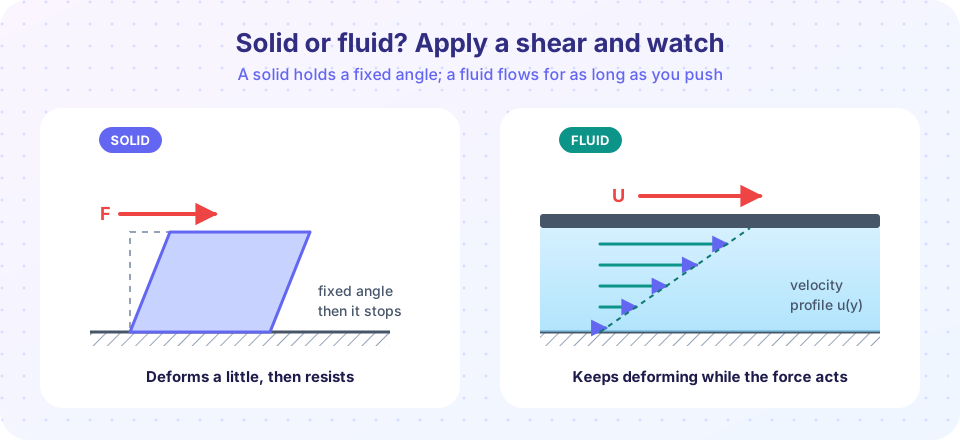
Press your hand flat on a block of rubber and push sideways. The rubber distorts, then stops at a certain angle, and springs back when you let go. Push the same way on a layer of water and it never settles: as long as you keep pushing, the top layer keeps sliding over the layers below.
That difference is the definition.
A fluid is a substance that deforms continuously for as long as any shear stress is applied, however small.
Note what is not in the definition. It does not mention density, color, or whether the substance fills its container. It only says what happens under shear. Honey is a fluid because it flows under shear, though slowly. A steel bar at room temperature is a solid because it settles at a finite deformation.
Fluids split into two groups:
| Liquids | Gases | |
|---|---|---|
| Volume | Nearly fixed (almost incompressible) | Fills any container |
| Free surface | Yes, at the top of a liquid | No |
| Density at sea level, 20 °C | Water about 998 kg/m³ | Air about 1.2 kg/m³ |
| Viscosity trend with temperature | Falls as it warms | Rises as it warms |
Both groups obey the same governing equations; they differ mainly in how density changes with pressure.
The continuum hypothesis
A glass of water contains about 10²⁵ molecules, far too many to track. Fluid mechanics treats the fluid as a smooth continuum: at every point there is a well-defined density, velocity and pressure, as if matter were spread without gaps. This works when the smallest length of interest, L, is much larger than the average distance a molecule travels between collisions, the mean free path λ.
The ratio Kn = λ / L is called the Knudsen number. For air at sea level λ is about 70 nanometers (0.07 μm). A flow around a car (L about 1 m) has Kn near 10⁻⁷: perfect continuum. The continuum picture starts to fail for Kn above about 0.01, as in the thin upper atmosphere or inside microscopic gaps in a hard disk drive.
Newton's law of viscosity
Put a fluid between two large parallel plates a distance h apart. Hold the bottom plate still and drag the top plate at speed U. Fluid touching a plate moves with it (no slip), so the speed rises from 0 at the bottom to U at the top. In the simplest case the profile is a straight line, called Couette flow.
Newton observed that, for most common fluids, the shear stress is proportional to the velocity gradient:
τ = μ · du/dy
The constant μ is the dynamic viscosity. For Couette flow the gradient is U/h, so τ = μU/h.
Worked example. Two plates are 2 mm apart with oil of viscosity μ = 0.10 Pa·s between them. The top plate has area 0.30 m² and moves at 0.50 m/s.
- Gradient:
U/h = 0.50 / 0.002 = 250 s⁻¹. - Shear stress:
τ = 0.10 × 250 = 25 Pa. - Force needed:
F = τ A = 25 × 0.30 = 7.5 N.
The run below checks the arithmetic and draws the velocity profile.
Press Run (or Ctrl + Enter) to see the result here.
Program input · what you'd type while the program runs
Type the answers before you press Run, one per line. Each time the program reads a line (with input()), it gets the next line from this box.
Typical dynamic viscosities near 20 °C are water 1.0 × 10⁻³ Pa·s, air 1.8 × 10⁻⁵ Pa·s and light motor oil about 0.1 Pa·s. Fluid Properties gives a fuller table.
Newtonian and non-Newtonian fluids
A fluid that follows τ = μ du/dy with a constant μ is Newtonian. Water, air, most oils, alcohol and gasoline are Newtonian. Many other fluids are not. Their apparent viscosity changes with the shear rate:
- Shear-thinning: viscosity falls as you shear harder. Ketchup, paint and blood behave this way, which is why paint is easy to spread but does not drip.
- Shear-thickening: viscosity rises with shear rate. A mixture of cornstarch and water is the classic example.
- Bingham plastics: they act as a solid until the stress passes a yield value. Toothpaste and mayonnaise are examples.
A common model is the power law, τ = K (du/dy)ⁿ. If n = 1 the fluid is Newtonian, n < 1 is shear-thinning and n > 1 shear-thickening. Compare the shapes below.
Press Run (or Ctrl + Enter) to see the result here.
Program input · what you'd type while the program runs
Type the answers before you press Run, one per line. Each time the program reads a line (with input()), it gets the next line from this box.
The printed apparent viscosity τ / (du/dy) stays constant for n = 1, falls for n = 0.5 and rises for n = 1.5. Most of this course concerns Newtonian fluids.
Common misconceptions
"Thick means solid." Thickness (high viscosity) is not the same as being solid. Honey and tar are fluids; they just need a long time to deform.
"A fluid cannot carry any force." A fluid at rest cannot carry shear stress, but it carries pressure easily. That is how a hydraulic jack lifts a car.
"Liquids are completely incompressible." They are only nearly incompressible. Water volume changes by about 0.045 % for a pressure rise of 1 MPa. Fluid Properties explains the bulk modulus.
Check your understanding
Quick check · 5 questions
of 5 answered You scored / 5 · perfect!
-
1. Which statement is the defining property of a fluid?
The definition is about the response to shear stress. Some fluids (like a gas) are compressible and some have density above 1000 kg/m³ (like mercury). -
2. Two plates 4 mm apart contain a fluid with μ = 0.2 Pa·s. The top plate moves at 0.2 m/s. What is the shear stress on the plate?
τ = μ U / h = 0.2 × 0.2 / 0.004 = 10 Pa. -
3. Ketchup becomes easier to pour when you shake the bottle. What kind of fluid is it?
Its apparent viscosity drops as the shear rate rises, which is shear-thinning behavior. -
4. The continuum hypothesis is valid when the Knudsen number λ/L is
A small Kn means the mean free path is tiny compared with the flow length scale, so the fluid behaves as a smooth continuum. -
5. What does the no-slip condition say?
At a solid boundary the fluid layer in contact with the wall moves with the wall, which is why a velocity gradient forms near it.
Summary
- A fluid deforms continuously under any shear stress; a solid settles at a finite deformation.
- The continuum hypothesis treats fluid as smooth matter and holds when the Knudsen number is tiny.
- Newton's law of viscosity:
τ = μ du/dy, so Couette flow givesτ = μU/h. - Newtonian fluids have constant μ; shear-thinning, shear-thickening and Bingham fluids do not.
- Liquids are nearly incompressible; gases are easily compressed.
Next: Units and Dimensions
Track your progress
Create a free account to tick off lessons and pick up where you left off on any device.
of Fluid Mechanics lessons completed