


















Lesson 10 of 44 · Fluid Properties and Statics
Buoyancy and Stability
Apply Archimedes' principle to floating and submerged bodies, find the fraction submerged, and test stability with the metacenter and metacentric height GM.
A steel ship floats; a steel nail sinks. A hot-air balloon rises; a diver can hover. All of this follows from one principle, supposedly noticed by Archimedes while stepping into a bath in the third century BC. Understanding why bodies float is only half the story: a ship that floats but flips over is useless. The second half of this lesson shows how engineers decide whether a floating body is stable.
What you will learn
- State Archimedes' principle and derive the buoyant force from pressure.
- Compute what fraction of a floating body is submerged.
- Locate the center of buoyancy and define the metacenter.
- Test stability with the metacentric height
GMfor a barge.
Key terms
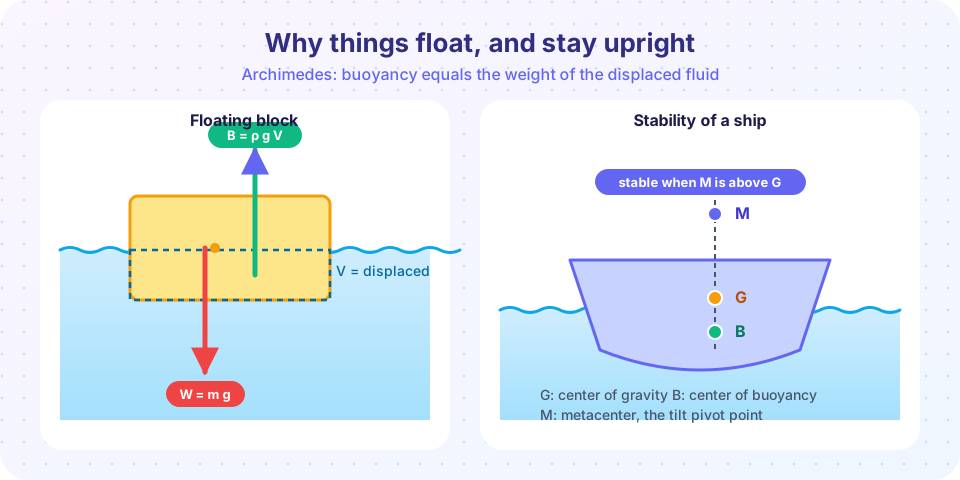
Buoyant force (F_B): the net upward force on a body from the surrounding fluid.
Center of buoyancy (B): the centroid of the displaced volume.
Center of gravity (G): where the body's weight effectively acts.
Metacenter (M): the point where the vertical line through B of a slightly tilted body meets the original center line.
Metacentric height (GM): the distance from G to M; positive when M is above G.
Archimedes' principle
The buoyant force on a body immersed in a fluid equals the weight of the fluid it displaces.
F_B = ρ_fluid g V_displaced
The derivation uses pressure only. Imagine a box submerged with its top at depth h₁ and bottom at h₂. The pressure on the bottom is ρ g h₂ and on top ρ g h₁, so the net upward force is ρ g (h₂ − h₁) A = ρ g V. The side forces cancel. (The run in the chapter overview showed this numerically.) For any shape, the same argument holds by splitting the body into thin vertical columns.
Three possibilities follow:
- If
ρ_body > ρ_fluid, the body sinks (weight exceeds buoyancy at full immersion). - If
ρ_body = ρ_fluid, it is neutrally buoyant and hovers anywhere (a submarine or diver). - If
ρ_body < ρ_fluid, it floats, partly submerged.
For a floating body in equilibrium, F_B = W, so
ρ_fluid g V_sub = ρ_body g V_total ⇒ V_sub / V_total = ρ_body / ρ_fluid
Worked example (iceberg). Ice has ρ = 917 kg/m³ and seawater about 1025 kg/m³. The fraction below water is 917/1025 = 0.895, so about 89.5 % of an iceberg is hidden. A freshwater iceberg in fresh water (998 kg/m³) would show only about 8 %.
Worked example (steel ship). A 10 000 tonne ship (mass 10⁷ kg) displaces 10⁷ / 1025 = 9756 m³ of seawater. A hull shaped to enclose lots of air reaches that volume easily, so the average density of the whole ship is below the water's. A solid block of the same steel (ρ ≈ 7850) would sink.
The buoyant force acts through the center of buoyancy B, which is the centroid of the displaced volume, not of the body.
Press Run (or Ctrl + Enter) to see the result here.
Program input · what you'd type while the program runs
Type the answers before you press Run, one per line. Each time the program reads a line (with input()), it gets the next line from this box.
Stability of a floating body
A floating body can be in equilibrium and still be unstable. Tilt a ship slightly: the shape of the submerged volume changes, so B shifts sideways. Weight (down through G) and buoyancy (up through the new B) now form a couple. If that couple tries to restore the original position, the ship is stable; if it increases the tilt, the ship capsizes.
The deciding point is the metacenter M, where the line of buoyancy through the new B meets the original centerline for small tilts.
MaboveG(GM > 0): restoring couple, stable.MbelowG(GM < 0): overturning couple, unstable.MatG: neutral.
The distance from the center of buoyancy to the metacenter is
BM = I_wl / V_sub
where I_wl is the second moment of the waterline area about the axis of tilt, and V_sub is the submerged volume. Then GM = BM − BG, with BG the distance between the centers of buoyancy and gravity (positive when G is above B).
Worked example (rectangular barge). A barge is 20 m long and 8 m wide, floating at a draft of 2 m. The center of gravity is 3.0 m above the keel.
- Submerged volume:
V = 20 × 8 × 2 = 320 m³. - Waterline second moment about the long axis (rolling):
I = L B³ / 12 = 20 × 8³ / 12 = 853.3 m⁴. BM = 853.3 / 320 = 2.667 m.Bis at half the draft, 1.0 m above the keel, soKM = 1.0 + 2.667 = 3.667 m.GM = KM − KG = 3.667 − 3.0 = 0.667 m. Positive: stable.
Raise the cargo so that KG = 4 m and GM = −0.333 m: the barge is now unstable. That is why heavy cargo is stowed low.
A larger GM gives a stiffer ship (a quick, uncomfortable roll); a small positive GM gives a slow, gentle but risky roll. Naval architects choose GM between those extremes.
Press Run (or Ctrl + Enter) to see the result here.
Program input · what you'd type while the program runs
Type the answers before you press Run, one per line. Each time the program reads a line (with input()), it gets the next line from this box.
Fully submerged bodies
For a submarine or a balloon, the stability condition is simpler: it is stable only if G is below B. Tilting does not change the shape of the displaced volume (all of it is submerged), so B does not move relative to the body. A submarine puts its heavy batteries and machinery low to keep G below B.
Common misconceptions
"A body sinks because it is heavy." It sinks if its average density exceeds the fluid's, not merely if it has a large weight. A supertanker is far heavier than a coin and floats.
"Buoyancy depends on how deep a body is." For an incompressible fluid, the buoyant force on a fully submerged body is the same at any depth.
"The stable position has G low and B high." Stability of a floating ship depends on the metacenter M, not on G being below B (which matters only for fully submerged bodies).
Check your understanding
Quick check · 5 questions
of 5 answered You scored / 5 · perfect!
-
1. A 0.02 m³ object is fully submerged in fresh water (998 kg/m³). The buoyant force is about
F_B = ρ g V = 998 × 9.81 × 0.02 ≈ 196 N. -
2. Oak (ρ = 700 kg/m³) floats in fresh water (998 kg/m³). The fraction of its volume that is submerged is about
V_sub/V = ρ_body/ρ_fluid = 700/998 ≈ 0.70. -
3. A ship is stable if its metacenter M is
GM = MG > 0 gives a restoring couple when the ship tilts. -
4. The metacentric height of a barge is GM = BM − BG. If BM = 2.667 m and the center of gravity G is 2.0 m above B, GM is
GM = 2.667 − 2.0 = 0.667 m, positive, so the barge is stable. -
5. A fully submerged submarine is stable when
A tilted submerged body keeps the same B, so a restoring couple needs G below B.
Summary
- Archimedes: buoyancy equals the weight of the displaced fluid,
F_B = ρ g V_displaced, acting through the center of buoyancy. - A floating body submerges the fraction
ρ_body / ρ_fluidof its volume. - A floating body is stable if its metacentric height
GM = I_wl / V_sub − BGis positive. - A submerged body is stable only when G is below B.
Next: Chapter 2 Review
Track your progress
Create a free account to tick off lessons and pick up where you left off on any device.
of Fluid Mechanics lessons completed