


















Lesson 23 of 44 · Dimensional Analysis
Buckingham Pi and dimensionless groups
Learn the Buckingham Pi theorem step by step: count variables and dimensions, form Pi groups, and see why drag and pipe flow collapse onto one curve.
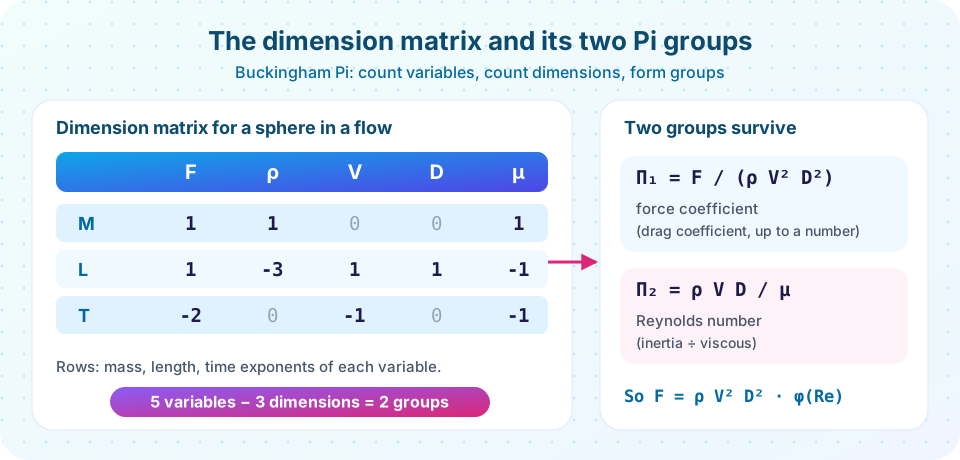
Suppose you want the drag force on a sphere. You might guess that it depends on the sphere's diameter, the speed of the flow, and the density and viscosity of the fluid. That is five variables. Testing every combination would take hundreds of experiments.
The Buckingham Pi theorem, published by Edgar Buckingham in 1914, says you only need n − k dimensionless groups, where n is the number of variables and k is the number of fundamental dimensions they involve. For the sphere that is 5 − 3 = 2 groups, which collapses the whole problem onto a single curve.
What you will learn
- How to count variables and fundamental dimensions.
- How to build the dimension matrix and read the groups from it.
- How the repeating-variables method works on a worked example.
- Why Pi groups are not unique and how to choose useful ones.
Key terms
Fundamental dimensions: the base set used to describe every quantity, usually mass M, length L and time T (add temperature Θ for heat problems).
Dimension matrix: a table whose columns are variables and whose rows are the exponents of M, L, T.
Pi group (Π): a dimensionless product of the variables.
Repeating variables: k variables that together contain all the dimensions, used to build each group.
Dimensions of the common quantities
Everything in fluid mechanics can be written with mass, length and time. You should know these by heart.
| Quantity | Symbol | Dimensions |
|---|---|---|
| Velocity | V |
L T⁻¹ |
| Acceleration | g |
L T⁻² |
| Force | F |
M L T⁻² |
| Pressure, stress | p, τ |
M L⁻¹ T⁻² |
| Density | ρ |
M L⁻³ |
| Dynamic viscosity | μ |
M L⁻¹ T⁻¹ |
| Kinematic viscosity | ν |
L² T⁻¹ |
| Surface tension | σ |
M T⁻² |
| Power | P |
M L² T⁻³ |
The principle underneath is dimensional homogeneity: every term added together in a valid equation must have the same dimensions. You can add a pressure to a pressure but never a pressure to a speed. That single rule is what lets the Pi theorem work.
The method, step by step
- List every variable the result can depend on, including the one you want (for example the force
F). Be honest: leaving out a real variable gives a wrong answer, and including a useless one just adds a group you can later find to be irrelevant. - Write the dimensions of each variable in terms of
M,L,T. - Count.
nis the number of variables.kis the number of fundamental dimensions that actually appear (the rank of the dimension matrix, almost always 3). - Pick
krepeating variables that between them containM,LandTand that cannot form a dimensionless group on their own. A good rule: choose one geometric variable (D), one kinematic (V) and one fluid property (ρ). - Form
n − kgroups. Multiply each remaining variable by the repeating variables raised to powers that make the result dimensionless. - Check that every group really is dimensionless, then write the final relation
Π₁ = φ(Π₂, …).
Worked example: drag on a sphere
Variables: force F, diameter D, speed V, density ρ, viscosity μ. So n = 5, and k = 3, giving two groups.
Choose ρ, V, D as the repeating variables. The first group contains F:
Π₁ = F · ρ^a · V^b · D^c
We need M L T⁻² · (M L⁻³)^a · (L T⁻¹)^b · L^c to have zero exponents:
- Mass:
1 + a = 0, soa = −1. - Time:
−2 − b = 0, sob = −2. - Length:
1 − 3a + b + c = 0, so1 + 3 − 2 + c = 0andc = −2.
Therefore Π₁ = F / (ρ V² D²). The second group contains μ:
Π₂ = μ · ρ^a · V^b · D^c gives a = −1, b = −1, c = −1, so Π₂ = μ / (ρ V D).
That is the inverse of the Reynolds number. Groups can be flipped or multiplied by constants without harm, so we call Π₂ = ρVD/μ = Re. The result is
F / (ρ V² D²) = φ(Re).
Now draw the standard drag coefficient. The conventional definition uses ½ ρ V² A with A = π D²/4, so C_D = F / (½ ρ V² · πD²/4) differs from Π₁ only by the constant π/8. Constants do not change the dimensions, so C_D = φ(Re): one curve for any sphere in any fluid at any speed.
A bigger example: pressure drop in a pipe
For a straight pipe the pressure drop Δp may depend on density ρ, speed V, diameter D, viscosity μ, length L and wall roughness ε. That is n = 7 variables and k = 3, so four groups:
Δp / (ρ V²) = φ(ρ V D / μ, L / D, ε / D)
Experiments show that Δp grows in direct proportion to L / D for a long pipe, so we can pull that ratio out: Δp = f(Re, ε/D) · (L / D) · ½ ρ V². The function f is the Darcy friction factor, which Chapter 6 develops in full. Dimensional analysis found its structure before any experiment was done.
Common misconceptions
"The groups are unique." They are not. Multiplying two groups together, or raising one to a power, gives another valid group. The number of independent groups is fixed, but their form is a choice. Pick forms with a clear physical meaning, such as Re rather than Re⁻¹.
"The Pi theorem gives the equation." It gives the structure only. The function φ has to come from experiment, theory or simulation.
"More variables always means a better model." Every extra variable adds a group and makes the experiment harder. Include only variables that physics says matter.
Try it
The first example lets a computer do the algebra. The dimension matrix has the variables as columns, and every vector in its null space is the exponent list of one Pi group.
Press Run (or Ctrl + Enter) to see the result here.
Program input · what you'd type while the program runs
Type the answers before you press Run, one per line. Each time the program reads a line (with input()), it gets the next line from this box.
The nullspace basis is not the same as the textbook groups. It is a valid set, and you can multiply and divide the lines above to recover Eu, Re, L/D and ε/D.
The second example shows why this is so powerful. In the slow Stokes regime the drag on a sphere is F = 3πμVD. The left panel plots the force against speed for three fluids and gets three different lines. The right panel plots the two Pi groups and all three fluids fall on one line. This is a model of the Stokes regime only, valid for Re below about 1.
Press Run (or Ctrl + Enter) to see the result here.
Program input · what you'd type while the program runs
Type the answers before you press Run, one per line. Each time the program reads a line (with input()), it gets the next line from this box.
Check your understanding
Quick check · 5 questions
of 5 answered You scored / 5 · perfect!
-
1. A problem has 6 variables involving mass, length and time. How many Pi groups?
n - k = 6 - 3 = 3 groups, assuming the dimension matrix has rank 3. -
2. Which set of dimensions describes dynamic viscosity?
Viscosity is shear stress (M L^-1 T^-2) divided by velocity gradient (T^-1), which gives M L^-1 T^-1. L^2 T^-1 is kinematic viscosity. -
3. Why can you replace Pi = mu/(rho V D) by its inverse Re?
Any product of dimensionless numbers, including powers and reciprocals, is dimensionless, so you choose the form with the clearest meaning. -
4. In the pipe example, which group is dropped from the pressure drop by pulling L/D out?
Experiments show the pressure drop is proportional to L/D, so that group multiplies the function of Re and epsilon/D. -
5. What can the Pi theorem NOT tell you?
The theorem gives structure only. The function connecting the groups must come from experiment, theory or computation.
Summary
- Count variables
nand fundamental dimensionsk; the number of independent groups isn − k. - Use a dimension matrix and its null space, or the repeating-variables method, to build the groups.
- The groups are not unique; choose forms with a clear physical meaning.
- Sphere drag becomes
C_D = φ(Re)and pipe pressure drop becomesEu = φ(Re, L/D, ε/D). - The method gives structure, never the function itself.
Track your progress
Create a free account to tick off lessons and pick up where you left off on any device.
of Fluid Mechanics lessons completed