


















Lesson 9 of 45 · What Is Ethics
Chapter 2 Review: What Is Ethics
Review chapter 2: the three branches of ethics, how ethics differs from law and etiquette, moral psychology and relativism, with a ten-question quiz.
You have now seen what ethics is trying to do and what it is not. Ethics studies how we ought to live. Its branches ask what morality is, what we should do and how to handle specific problems. It differs from law and etiquette, though they overlap. Psychology shows how we form moral judgments but cannot decide which judgments are correct. And relativism, the claim that culture decides right and wrong, is tempting but harder to defend than it looks.
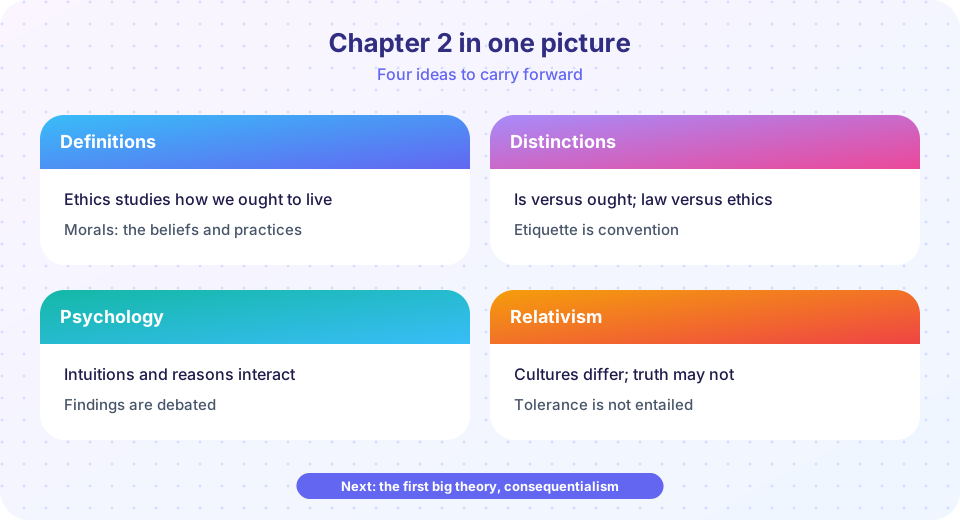
The chapter at a glance
| Lesson | Big idea | Key terms |
|---|---|---|
| What Is Ethics? The Big Picture | Three branches plus descriptive ethics. | Metaethics, normative ethics, applied ethics |
| Ethics, Law and Etiquette | Overlapping systems; unjust laws show morality is not law. | Convention, civil disobedience, harm principle |
| Moral Psychology | Intuition and reasoning both matter; findings are debated. | Dual process, dumbfounding, moral foundations |
| Relativism and Universalism | Diversity does not entail relativism. | Descriptive, meta-ethical, normative relativism; pluralism |
Connecting the ideas
Here is how the lessons fit. Metaethics asks whether moral claims can be true. Relativism is one answer: true only relative to a culture. Descriptive ethics, including the work of psychologists and anthropologists, supplies the data about what people actually believe. But because of the is-ought gap, the data cannot settle the question without a further argument. Law and etiquette provide contrasts that sharpen our idea of what morality is: it can criticize law, it carries more weight than etiquette, and it seems to claim authority beyond any one group.
Try it
This first demonstration draws a concept map of the chapter. Lines link ideas that depend on each other. It is a study aid: change the links list to add your own connections.
Press Run (or Ctrl + Enter) to see the result here.
Program input · what you'd type while the program runs
Type the answers before you press Run, one per line. Each time the program reads a line (with input()), it gets the next line from this box.
The second demonstration is a sorting drill for three kinds of claim. Decide whether each sentence is descriptive, normative or meta-ethical.
Check your understanding
Quick check · 10 questions
of 10 answered You scored / 10 · perfect!
-
1. Which branch of ethics studies whether moral claims can be true or false?
Metaethics studies the nature, meaning and status of moral claims. -
2. A psychologist records how often people say they would push someone off a bridge. This is
It reports what people say, without concluding what is right. -
3. The Fugitive Slave Act of 1850 illustrates
A law that most people now judge unjust shows that legal and right are different. -
4. Turiel's research suggests that children tend to see rules against harming others as
Children distinguish moral rules from conventional rules. -
5. Which pairing is correct?
Gilligan challenged Kohlberg; Haidt proposed intuitionism and moral foundations; Mill proposed the harm principle. -
6. Why can't a description of how people judge decide what is right?
Facts about beliefs and feelings need a further moral premise to yield a moral conclusion. -
7. The cultural differences argument runs from 'cultures differ' to 'no objective truth'. It is
Disagreement alone does not show there is nothing to be right about. -
8. Which is an objection to strong relativism?
If right is whatever a society approves, abolitionists who opposed their society were mistaken. -
9. Moral pluralism holds that
Pluralists accept multiple irreducible values and reject both a single formula and strong relativism. -
10. Mill's harm principle says that the state may limit liberty mainly to
In On Liberty (1859), preventing harm to others is the main justification for interference.
Summary
- Ethics has three branches (metaethics, normative, applied) beside descriptive studies of morality.
- Law, etiquette and morality overlap but differ; unjust laws show morality can criticize law.
- Moral psychology describes how we judge, but description does not decide what is right.
- Relativism has three forms; diversity does not entail it, and objections are serious; pluralism is a popular middle path.
Track your progress
Create a free account to tick off lessons and pick up where you left off on any device.
of Ethics lessons completed