


















Lesson 36 of 45 · Justice and Moral Progress
Rawls, Nozick and fair shares
Understand distributive justice: Rawls's veil of ignorance and two principles, Nozick's entitlement theory, desert, luck egalitarianism, priority and capabilities, with a simulation.
Imagine you must write the rules of a society, including who gets which jobs, schooling and taxes. There is a catch: you do not know whether you will be born rich or poor, strong or disabled, of any particular sex or beliefs. What rules would you choose?
This thought experiment, from John Rawls, is one of the most influential in modern philosophy. It is also controversial, and it has a famous rival: Robert Nozick's view that justice is about respecting rights over what you own, not about patterns of shares. This lesson sets out both, plus the main alternatives.
What you will learn
- How the original position and the veil of ignorance work, and why Rawls thinks they model fairness.
- The two principles of justice and the difference principle.
- The maximin argument and Harsanyi's reply.
- Nozick's entitlement theory and the Wilt Chamberlain argument.
- Desert, luck egalitarianism, prioritarianism, sufficientarianism and capabilities.
Key terms
Original position: Rawls's imagined situation in which people choose principles of justice for society.
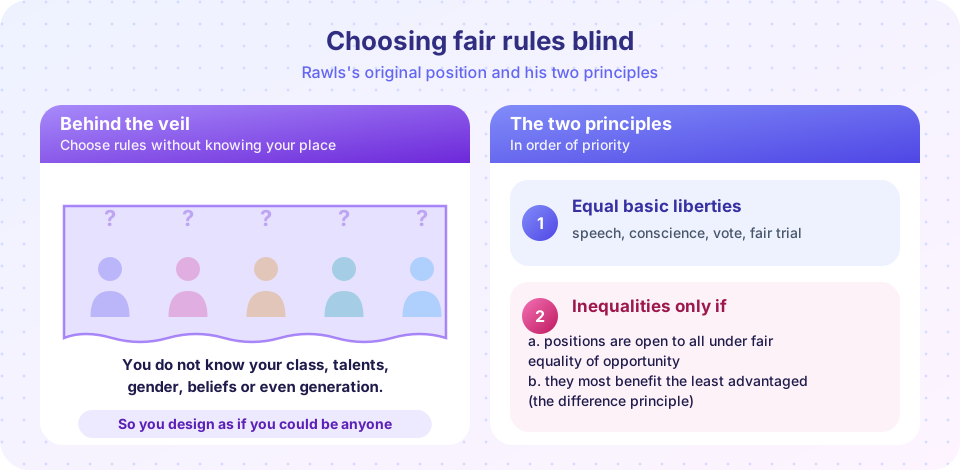
Veil of ignorance: the rule that choosers do not know their own class, abilities, sex, beliefs or generation.
Difference principle: social and economic inequalities are acceptable only if they are to the greatest benefit of the least advantaged.
Entitlement theory: Nozick's view that a distribution is just if it arose from just acquisition and transfer.
Brute luck / option luck: luck you could not choose (born with a disability) / luck from a gamble you chose to take.
Rawls: justice as fairness
In A Theory of Justice (1971) John Rawls wanted principles that free and equal people could accept. He argued that fairness requires ignoring features that are morally arbitrary: nobody earned their parents, talents or place of birth. Behind a veil of ignorance, choosers know general facts about society (economics, psychology) but not their own position. Since they must choose rules that might apply to them in any position, they cannot rig the rules in their favor.
Rawls argued that they would choose two principles, in order of priority:
- Equal basic liberties. Everyone has an equal claim to the same basic freedoms (speech, conscience, political participation, fair trial).
- Social and economic inequalities are allowed only if (a) the positions are open to all under fair equality of opportunity, and (b) the inequalities are to the greatest benefit of the least advantaged members of society (the difference principle).
The difference principle is not a demand for equality. It allows inequality when it makes the worst-off better off, for example if higher pay for scarce skills raises output and lifts the bottom. But it asks for justification: inequalities must pay their way to those with the least.
Maximin and its critics
Rawls argued that under uncertainty, people would follow something like a maximin rule: choose the option whose worst outcome is best, because the stakes (a whole life) are high and nobody knows the odds. John Harsanyi replied that rational choosers would instead maximize expected well-being, assuming equal chances of being anyone, and would end up with average utilitarianism. The debate turns on how to model risk and how seriously to take the worst case.
Other criticisms include:
- Communitarians (Michael Sandel) argue that the veil assumes a self detached from its attachments.
- Feminists (Susan Moller Okin, 1989) argue that the family is part of the basic structure and must be subject to justice.
- G. A. Cohen argued that if the talented truly accepted the difference principle, they would not need special incentives.
- Global theorists note that Rawls applied his principles within one society; Charles Beitz and Thomas Pogge asked why borders should matter (see the next lesson).
Nozick: entitlement
In Anarchy, State, and Utopia (1974) Robert Nozick rejected the idea that justice means achieving a pattern of shares. He proposed an entitlement theory with three principles: justice in the acquisition of holdings, justice in transfer (voluntary exchange, gift) and rectification of past injustices. If a distribution arises through just steps, it is just, whatever pattern results.
His Wilt Chamberlain argument goes like this. Start from any distribution you consider just. Suppose a million people each voluntarily pay a small amount to watch a famous basketball player. The player ends up much richer than others. Since each transfer was voluntary, the new unequal distribution is also just. So any pattern principle must either be violated by free choices or require constant interference with liberty.
Replies. Critics say the argument assumes the starting point is fair, but actual holdings often come from conquest, theft or discrimination, which require rectification. Others argue that markets depend on public goods and institutions, so we cannot assume wealth is purely "earned." Defenders respond that redistribution through taxation treats people as means to others' ends.
Desert, luck and priority
- Desert theorists say people should get what they deserve through effort or contribution. Critics respond that effort and talent are themselves influenced by upbringing and luck.
- Luck egalitarianism (Ronald Dworkin, 1981; G. A. Cohen, 1989) says inequalities that arise from choices may be acceptable, but those arising from brute luck are not. Critics worry that it seems harsh to people who made bad choices and that it demands intrusive judgments about who is responsible.
- Prioritarianism (Derek Parfit, 1991) says benefits matter more the worse off the recipient is. We need not care about equality itself, only about helping those with less.
- Sufficientarianism says what matters is that everyone has enough.
- The capability approach (Amartya Sen; Martha Nussbaum) shifts the focus from resources to what people are actually able to do and be, such as being healthy, educated, and able to take part in society. This helps with disability and gender because the same resources enable different people differently.
Common misconceptions
"Rawls says we should all be equal." He allows inequalities that benefit the least advantaged, within equal liberties and fair opportunity.
"The veil of ignorance is about real ignorance." It is a device for reasoning about fairness, not a claim that anyone is actually ignorant.
"Nozick says taxes are always unjust." He argues that redistribution beyond protecting rights is unjustified, but his view is debated even by libertarians.
"Maximin is obviously the rational rule." Many decision theorists doubt it, and Harsanyi's expected-utility argument is a serious rival.
Try it
Press Run (or Ctrl + Enter) to see the result here.
Program input · what you'd type while the program runs
Type the answers before you press Run, one per line. Each time the program reads a line (with input()), it gets the next line from this box.
Check your understanding
Quick check · 5 questions
of 5 answered You scored / 5 · perfect!
-
1. What is the purpose of the veil of ignorance?
Choosers who do not know their place cannot rig the rules in their own favor. -
2. What does the difference principle allow?
Inequality is acceptable only if it benefits those with least. -
3. What is the point of Nozick's Wilt Chamberlain argument?
If each voluntary transfer is just, the resulting inequality is just, challenging pattern theories. -
4. Who replied to Rawls that rational choosers would maximize expected well-being?
Harsanyi argued for average utility under equal chances of being anyone. -
5. The capability approach asks about
Sen and Nussbaum focus on real freedoms and functionings, not only on resources.
Summary
- Rawls uses the veil of ignorance to justify equal basic liberties, fair opportunity and the difference principle.
- Harsanyi, Cohen, communitarians and feminists challenge parts of the argument.
- Nozick bases justice on legitimate acquisition and transfer; the Wilt Chamberlain argument aims at pattern theories.
- Other views focus on desert, luck, priority to the worse off, sufficiency or capabilities.
- Choosing a theory means judging which unfair inequalities matter most.
Track your progress
Create a free account to tick off lessons and pick up where you left off on any device.
of Ethics lessons completed