


















Lesson 2 of 45 · Getting Started
How to Read and Build an Argument
Learn what an argument is, how to spot premises and conclusions, the difference between valid and sound arguments, and the fallacies that derail moral debates.
In everyday talk, an "argument" means a quarrel. In philosophy it means something calmer: a set of reasons offered in support of a claim. When someone says "eating meat is wrong because animals can suffer", they have given you an argument. Your job is to ask whether the reasons are true and whether they really lead to the conclusion.
Ethics lives or dies by arguments. Moral views are often held with strong feeling, and feelings are not worthless, but feelings alone cannot settle a disagreement between two people who feel differently. Arguments give us a shared way to examine why we believe what we believe.
What you will learn
- How to separate premises from conclusions and write an argument in standard form.
- The difference between valid and sound, and between deductive and inductive reasoning.
- How to uncover a hidden premise.
- Six common fallacies in moral debate, and how to answer them.
Key terms
Premise: a statement offered as a reason.
Conclusion: the statement the premises are meant to support.
Valid: the conclusion must be true if the premises are true.
Sound: valid, and all premises are in fact true.
Fallacy: a pattern of bad reasoning that looks persuasive.
Premises, conclusions and signal words
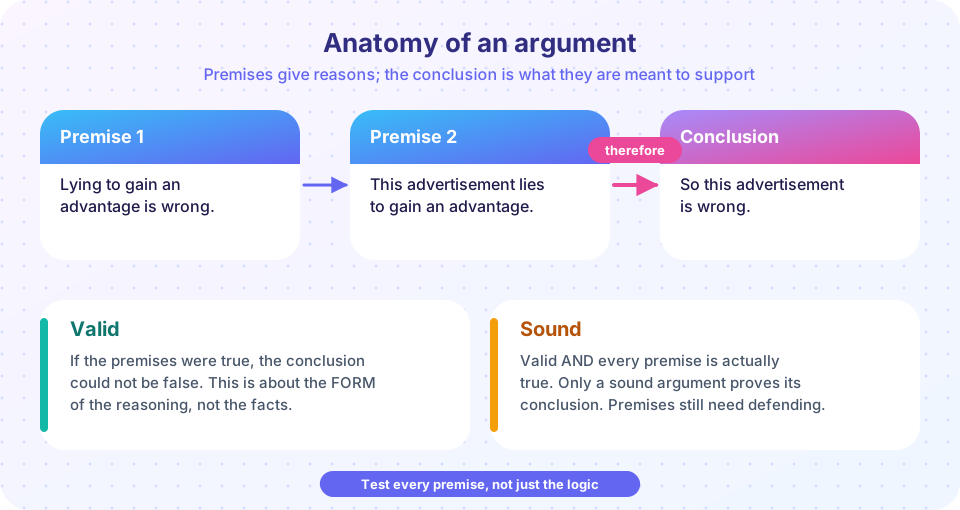
A premise is a claim used to support another claim. A conclusion is the claim being supported. English has signal words for each. "Because", "since", "given that" and "for" usually introduce premises. "Therefore", "so", "thus", "hence" and "it follows that" usually introduce conclusions.
Consider this short text: Since people deserve to know what they eat, and the label hides the sugar content, the label is deceptive. The conclusion is "the label is deceptive". The premises are "people deserve to know what they eat" and "the label hides the sugar content". Rewritten in standard form:
- People deserve to know what they eat.
- The label hides the sugar content.
- Therefore, the label is deceptive.
Standard form feels pedantic, but it has a purpose. Once the argument is laid out, each line can be examined separately. Most bad arguments survive only because they are vague.
Valid and sound
Two questions can be asked about any argument. The first is logical: if the premises were true, would the conclusion have to be true? If yes, the argument is valid. The second is factual: are the premises actually true? An argument that is valid and has all true premises is sound.
Look at this argument: All wrongdoers should be punished. Anyone who breaks a promise is a wrongdoer. So anyone who breaks a promise should be punished. It is valid: if both premises were true, the conclusion would follow. Yet it is not obviously sound, because the first premise is doubtful (should every minor wrongdoing be punished?) and the second may be too strong. A valid argument with a false premise proves nothing.
The reverse also happens. An argument can have true premises and a true conclusion and still be invalid, because the premises do not support the conclusion. Truth of the parts and quality of the connection are separate things.
Deductive and inductive
In a deductive argument, the aim is validity: the premises are supposed to guarantee the conclusion. In an inductive argument, the premises make the conclusion more or less likely: "every time we tested this drug, patients improved, so it will probably help the next patient." Inductive arguments are judged as strong or weak rather than valid or invalid. Moral philosophy uses both, plus a third style, inference to the best explanation, which says that a principle is credible because it explains many of our judgments.
Hidden premises
Most real arguments leave something unsaid. "Animals feel pain, so we should not treat them cruelly" skips a link: causing unnecessary pain is wrong. Such an unstated premise is called an enthymeme. Making it explicit is often where the real debate lies, because the missing premise is usually the controversial one.
A useful trick is to ask: "What would I need to add to make this argument valid?" Then ask whether you accept that addition. Applying it to "It's legal, so it's fine" yields the missing premise "whatever is legal is morally acceptable", which few people accept once they see it (slavery was once legal in many places).
Six fallacies to watch for
| Fallacy | What it does | Moral example |
|---|---|---|
| Ad hominem | Attacks the speaker rather than the argument | "She eats meat, so her argument for animal rights fails." |
| Straw man | Distorts the opposing view to refute it | "Utilitarians say we may torture anyone for a small gain." |
| Appeal to nature | Treats "natural" as "good" | "Competition is natural, so it is right." |
| Slippery slope | Predicts disaster without evidence | "Allow any exception and everything collapses." |
| Begging the question | Assumes the conclusion in a premise | "Lying is wrong because it is immoral." |
| False dilemma | Offers only two options when more exist | "Either ban it completely or accept the harm." |
Two points about the table. First, a bad argument for a conclusion does not show the conclusion is false: the animal-rights view may be right even if one defender argues badly. Second, a slippery slope is sometimes a real concern, when there is evidence that one step makes the next more likely; the fallacy lies in asserting it with no support.
Moral arguments and the is-ought gap
David Hume (1739) noticed that writers often move from statements about what is to statements about what ought to be without saying why. "People are selfish, so we ought to be selfish" does not follow. To reach a moral conclusion you need at least one moral premise. This is-ought gap is a useful check: when an argument has only descriptive premises and a moral conclusion, look for the missing moral premise and ask whether it is acceptable. Some philosophers think the gap can be bridged; we return to the debate in Chapter 6.
Common misconceptions
"A valid argument is a good argument." Validity only checks the form. A valid argument with a false premise is useless, and many valid arguments beg the question.
"If I cannot refute an argument, I must accept the conclusion." You might simply have missed the flaw. Philosophers sometimes say "one person's modus ponens is another's modus tollens": if the conclusion is clearly absurd, that can be a reason to reject a premise.
"Philosophical arguments are only for winning debates." Their purpose is to find out what is true, including finding out you are wrong.
Try it
First, a validity checker. It tests argument forms by trying every combination of true and false for the parts (a truth table). A form is valid if there is no row where all premises are true and the conclusion is false. This is a simple model of propositional logic, not a full reasoner.
Press Run (or Ctrl + Enter) to see the result here.
Program input · what you'd type while the program runs
Type the answers before you press Run, one per line. Each time the program reads a line (with input()), it gets the next line from this box.
Notice the invalid forms. "If a lie hurts someone, it is wrong; this lie is wrong; so it hurts someone" affirms the consequent: it might be wrong for another reason.
Now a quick sorting game: decide whether each argument is valid, then see the explanation.
Check your understanding
Quick check · 5 questions
of 5 answered You scored / 5 · perfect!
-
1. Which word usually signals a conclusion?
'Therefore' (like 'so' and 'thus') introduces a conclusion. The others usually introduce premises. -
2. An argument is valid when
Validity is about the connection between premises and conclusion, not about truth or popularity. -
3. What makes an argument sound?
Sound = valid + true premises. Only sound arguments establish their conclusions. -
4. 'Lying is wrong because it is immoral' commits which fallacy?
'Immoral' just restates 'wrong', so the premise assumes the conclusion. -
5. 'Humans have always eaten meat, so it is morally fine.' What is the most useful next step?
The argument moves from 'is' to 'ought'. The hidden premise, that what has long been done is right, needs defending.
Summary
- An argument is premises offered for a conclusion; standard form lays them out line by line.
- Valid means the form guarantees the conclusion; sound means valid with true premises.
- Hidden premises are often where the real disagreement lies.
- Common fallacies include ad hominem, straw man, appeal to nature, slippery slope, begging the question and false dilemma.
- Hume's is-ought gap reminds us that a moral conclusion needs a moral premise.
Track your progress
Create a free account to tick off lessons and pick up where you left off on any device.
of Ethics lessons completed