


















Lesson 42 of 45 · Projects and Practice
Practice cases
Six original practice cases in ethics, from whistleblowing to AI release and global giving, with guiding questions, two model outlines and a self-review checklist.
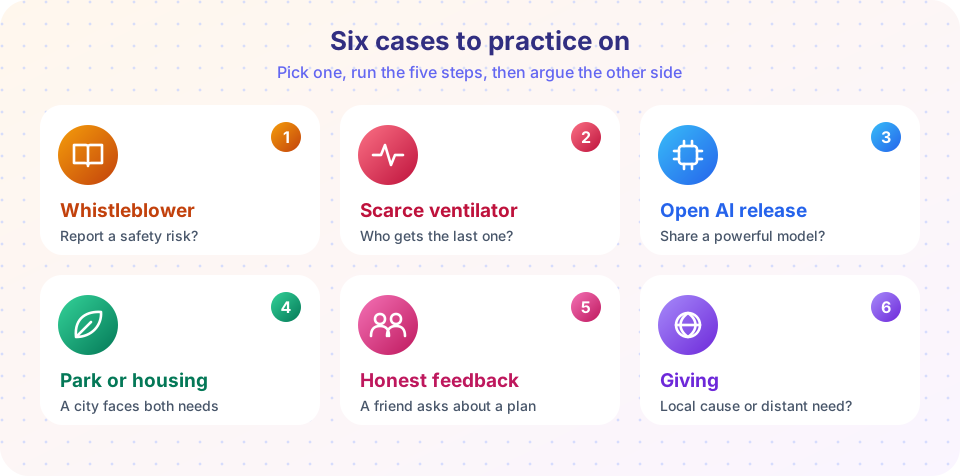
A method becomes a skill only through practice. This lesson gives you six original cases, guiding questions for each, outlines for two of them and a checklist for reviewing your own work. Choose one or two cases, write a page, and then try to argue against yourself.
What you will learn
- How to apply the five-step method to varied cases.
- How to write a one-page analysis with a clear structure.
- How to argue the strongest opposing view.
- How to review an analysis, yours or someone else's, with a checklist.
Key terms
Case analysis: a structured written argument about what to do in a specific situation.
Counterargument: the best reason against your conclusion.
Reply: your answer to the counterargument.
Triage: deciding who receives limited help first.
Open-source release: making software or a model freely available to anyone.
The six cases
Each case is invented and simplified. Real cases have more detail, and where they involve medicine, law or safety, professional guidance applies.
Case 1: The whistleblower
A water-treatment technician notices that a plant has skipped required tests for months. Her supervisor says everything is fine and asks her to keep quiet because an inspection is coming. She has two children and no savings.
Guiding questions: What are the possible harms to the public? What are the legal channels? What is the difference between internal and external reporting? What do duties of loyalty and duties of honesty ask? What would a courageous but prudent person do?
Case 2: One ventilator
A hospital has one ventilator available and two patients who need it. Both are equally likely to benefit in the short term. Hospital policy says to use clinical criteria, not wealth, status or age as such.
Guiding questions: What criteria are defensible (medical need, likelihood of benefit, order of arrival, a lottery)? What does fairness require? How would you design the rule before the crisis, behind a veil of ignorance? Who should decide and how should the decision be explained to families?
Case 3: The open AI release
A small lab has trained a powerful language model that can help students learn but could also help produce convincing scams. It can release the model openly, release it only through a controlled service, or not release it.
Guiding questions: Who benefits and who may be harmed? How likely and how serious are the harms? Can harms be reduced by safeguards? What does openness contribute to science and accountability? Who is responsible for misuse?
Case 4: Park or housing
A city owns a vacant lot. Neighbors want a park; a developer and many families on the waiting list want affordable housing. There is money for only one.
Guiding questions: Whose interests are at stake, including future residents? How should the city weigh concrete needs (housing) against shared goods (green space)? What fair process would make the decision legitimate? Is there a creative option, such as a smaller park on part of the site?
Case 5: Honest feedback
A close friend has just invested her savings in a restaurant. She asks whether you think it will work. You have noticed serious problems with the location.
Guiding questions: What does honesty require, and what does kindness require? What are your friend's actual needs and what does she want from you? How does timing matter? What would you want a friend to do for you?
Case 6: Giving
You have a modest, steady income and a chance to donate 5% of it. A local shelter has asked for help; so has an international health charity that independent evaluators rate highly.
Guiding questions: What do you owe your community and what do you owe strangers? How much should evidence of effectiveness matter? What do the recipients say they need? Is it permissible to prefer a cause for personal reasons?
A model outline: Case 1 (whistleblower)
- Facts. Known: tests were skipped; the supervisor asked for silence. Unknown: whether water quality has actually been affected; legal requirements; whether others know. First step: gather documentation and learn the official reporting channels.
- People. The public (health), the technician and her family, the supervisor, coworkers, the utility, regulators.
- Lenses. Outcomes: potential serious harm to many versus job loss and company disruption. Duties: a duty to the public that protects health, and a legal duty in many places; loyalty to an employer is limited when it demands wrongdoing. Character: courage and prudence. Care: the technician also cares for her children; a plan should protect her.
- Options. (a) Stay silent. (b) Re-run the tests herself and document the result. (c) Report to a higher internal authority. (d) Report to the regulator, using whistleblower protections. Objections: (a) risks harm to the public; (d) risks her job; (c) may be ignored.
- Decide. Document the facts, use the formal internal channel if one exists, and be ready to go to the regulator if it fails, taking legal advice on protections. What is lost: security and possibly relationships at work.
A model outline: Case 4 (park or housing)
- Facts. Need: how many families are waiting, how much green space already exists, costs and timing.
- People. Families on the waiting list, neighbors, children, future residents, taxpayers.
- Lenses. Outcomes: total well-being, including the health benefits of green space. Rights and fairness: a fair process where everyone's claims are heard; housing is closer to a basic need. Character: civic responsibility. Care: especially for those with the least power in the decision.
- Options. Park only; housing only; mixed use; use another site for one purpose.
- Decide. A mixed-use plan with a transparent process that gives extra weight to those in greatest need, and an agreed review. A defensible alternative is to prioritize housing and fund park improvements elsewhere.
Notice that both outlines end with a decision and a statement of what is lost or still uncertain.
Review checklist
Use it to review your own analysis or a classmate's.
- Are the facts separated from assumptions and values?
- Are all stakeholders named, including those without a voice?
- Are at least three options considered?
- Are at least two lenses used, with conflicts noted?
- Is the strongest counterargument stated fairly?
- Does the decision say what would change it and what is lost?
- Is the writing clear enough that a friend could disagree usefully?
Common misconceptions
"There is a right answer I must find." For many practice cases, thoughtful people disagree. A good answer is well reasoned and honest.
"My first intuition is the answer, so analysis is decoration." Analysis often changes or refines intuitions, and sometimes reveals why they conflict.
"Arguing the other side means I changed my mind." It tests your view and improves your reply.
Try it
Press Run (or Ctrl + Enter) to see the result here.
Program input · what you'd type while the program runs
Type the answers before you press Run, one per line. Each time the program reads a line (with input()), it gets the next line from this box.
Check your understanding
Quick check · 4 questions
of 4 answered You scored / 4 · perfect!
-
1. Why does the model analysis of the whistleblower case start with documentation?
Facts and proper channels shape what the options are. -
2. What is a good way to design a triage rule?
A veil-of-ignorance style design supports fairness and transparency. -
3. What should a good analysis do with the strongest counterargument?
Engaging the best objection strengthens your reasoning. -
4. Which ending is best for an analysis?
Honest endings show confidence and humility together.
Summary
- Practice cases build the skill of the five-step method.
- Model outlines show how to reach a decision and how to name what is lost.
- Use the review checklist and argue the other side before finalizing.
- Disagreement among thoughtful people is normal in hard cases.
Next: Glossary
Track your progress
Create a free account to tick off lessons and pick up where you left off on any device.
of Ethics lessons completed