


















Lesson 31 of 45 · Applied Ethics: Life, Technology and Environment
Life and death: bioethics, killing and letting die
A balanced introduction to bioethics: the four principles, informed consent, killing and letting die, double effect, assisted dying and abortion, with arguments on every side.
Few areas of ethics feel as personal as the beginning and end of life. They are also areas where law differs sharply between countries, where religious and secular traditions often take different views, and where thoughtful people can look at the same facts and disagree.
This lesson does not tell you what to conclude. It gives you the main concepts and the best arguments, so you can think clearly and discuss respectfully. It is educational information and not medical, legal or personal advice.
What you will learn
- The four principles of biomedical ethics and how they conflict.
- What informed consent requires and why it came to matter.
- The distinction between killing and letting die, and the case against it.
- The doctrine of double effect and its conditions.
- The main arguments in debates on assisted dying and abortion, laid out fairly.
Key terms
Autonomy: a person's right to make informed decisions about their own life and body.
Beneficence / non-maleficence: doing good / avoiding harm.
Informed consent: agreement given with enough information, understanding and freedom from pressure.
Active and passive euthanasia: ending a life by an act (for example, a lethal injection) versus by withholding or withdrawing treatment.
Double effect: a principle that allows a foreseen but unintended harm as the side effect of a good act under strict conditions.
The four principles
In Principles of Biomedical Ethics (first edition 1979) Tom Beauchamp and James Childress proposed four mid-level principles for clinical practice:
- Respect for autonomy. Competent patients decide about their own care.
- Non-maleficence. Do not cause needless harm.
- Beneficence. Act to benefit the patient.
- Justice. Distribute benefits, risks and costs fairly.
None is absolute. When they conflict, clinicians specify each principle for the case (what exactly does "harm" include here?) and balance them with attention to the facts. The approach is popular because people from different philosophical and religious backgrounds can often agree on these middle-level principles even when they disagree about foundations.
Consent and its history
Modern research ethics grew out of abuses. The Nuremberg Code (1947) was written after trials of doctors who had carried out cruel experiments in Nazi Germany, and its first point is that voluntary consent is essential. In the United States, the Tuskegee syphilis study (1932–1972) withheld treatment from Black men without telling them, and public outrage led to reforms in research ethics. Valid consent needs four things: the person is competent, is informed, understands, and decides voluntarily.
Killing and letting die
Many people feel that actively killing is worse than letting someone die. Doctors may withdraw futile treatment, they say, but may not inject a lethal dose. Is the difference morally real?
In 1975 James Rachels argued it is not, using a pair of cases: Smith drowns his young cousin in the bath to inherit money; Jones plans the same but finds the cousin slipping and lets him drown. Rachels says there is no moral difference between them, so the act/omission distinction cannot carry the weight placed on it. Critics reply that the cases are artificially equal in motive, and that in real situations other differences matter: who bears responsibility, what rights are infringed, what a society's rules do to trust in medicine. Others accept the distinction as a useful rule of thumb with exceptions.
Double effect
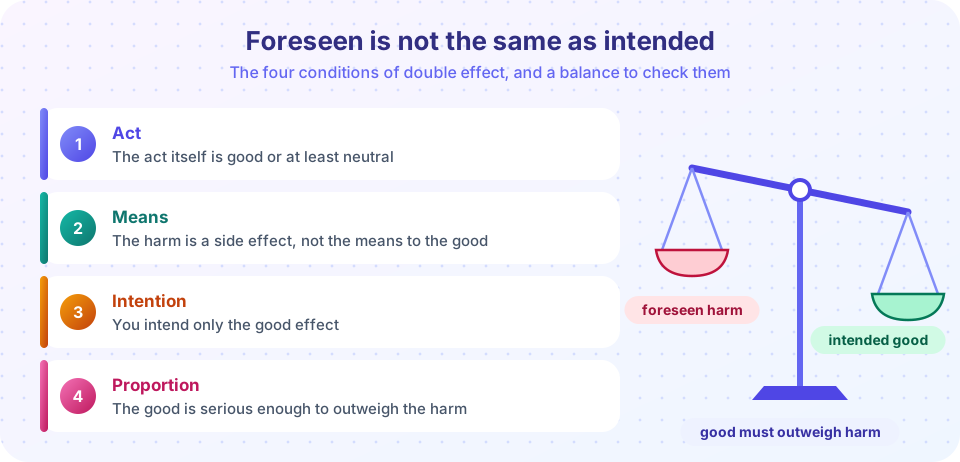
The doctrine of double effect, associated with Thomas Aquinas, says an act with a good effect and a foreseen bad effect may be permissible if four conditions hold:
- The act itself is good or at least neutral.
- The bad effect is not the means to the good effect.
- The agent intends only the good effect.
- There is proportionate reason: the good outweighs the harm.
Example: giving strong pain relief to a dying patient with the aim of relieving suffering, knowing it may hasten death. Defenders say the intention and means differ from giving a drug in order to cause death. Critics reply that the line between intended and merely foreseen is blurry, and that a person can disguise intention. The doctrine is widely used in medical and military ethics even among those who doubt it as a general theory.
Assisted dying
Practice differs by country. The Netherlands and Belgium legalized euthanasia in 2002; Oregon's Death with Dignity Act (approved by voters in 1994, in effect from 1997) permits physician-assisted dying under conditions; Canada introduced medical assistance in dying in 2016; in Switzerland, assisted suicide is tolerated if not motivated by selfish reasons. Many other places prohibit it.
Arguments in favor stress autonomy (people should control the end of their lives), compassion (to prevent suffering that cannot be relieved), and consistency (we already allow refusal of treatment).
Arguments against stress the sanctity or special protection of life, the risk of pressure on vulnerable people (the elderly, disabled or poor), the difficulty of ensuring truly voluntary choices, the slippery slope towards wider eligibility, and the claim that good palliative care should be improved first. Evidence from jurisdictions is debated, so check recent sources rather than rely on slogans.
Abortion
Here the central questions are about the moral status of the fetus and the extent of a person's rights over her own body. Philosophers have clarified the debate without ending it.
- Judith Jarvis Thomson (1971) offered the famous violinist analogy: if you woke up attached to a stranger who needs your body to survive for nine months, are you obliged to stay? She argued that even if the fetus is a person, the right to life may not include a right to use another person's body. Critics doubt that the analogy fits ordinary pregnancy, especially where the situation arises from consensual sex.
- Mary Anne Warren (1973) argued that full moral personhood requires traits such as consciousness, reasoning and self-awareness, which a fetus lacks. Critics say these criteria would also exclude newborns or some adults and that potential matters.
- Don Marquis (1989) argued that killing is wrong because it deprives a victim of a valuable future, and a fetus has such a future. Critics question whether that is the right account of why killing is wrong.
Societies reach different legal compromises (limits by gestation, conscience clauses, support for pregnant people). This lesson takes no side; an ethical analysis should name the values in conflict (life, bodily autonomy, equality, community) and be honest about uncertainty.
Common misconceptions
"Withdrawing treatment is the same as euthanasia." In law and ethics they are usually distinguished, though some philosophers question the distinction. Competent patients may refuse treatment.
"Double effect lets you do anything as long as you 'intend' something else." The conditions, including proportionality and the means condition, are strict.
"There is one 'correct' view that all reasonable people share." Careful, informed people disagree. The aim is to understand the arguments and give each other reasons.
Try it
Press Run (or Ctrl + Enter) to see the result here.
Program input · what you'd type while the program runs
Type the answers before you press Run, one per line. Each time the program reads a line (with input()), it gets the next line from this box.
Check your understanding
Quick check · 5 questions
of 5 answered You scored / 5 · perfect!
-
1. Which are the four principles of biomedical ethics of Beauchamp and Childress?
These mid-level principles are widely used in clinical ethics. -
2. What was the point of Rachels's Smith and Jones cases?
He held that, with motive and outcome equal, the act/omission difference by itself does not make a moral difference. Critics dispute this. -
3. Which condition belongs to the doctrine of double effect?
The harm may be foreseen but must not be the means by which the good is achieved. -
4. What did the Nuremberg Code (1947) stress?
Its first principle states that voluntary consent of the human subject is absolutely essential. -
5. Thomson's violinist analogy is mainly about
Thomson argued that even if the fetus is a person, the right to life may not entail use of another's body; critics doubt the analogy.
Summary
- The four principles (autonomy, non-maleficence, beneficence, justice) guide clinical ethics and must be specified and balanced.
- Informed consent rests on competence, information, understanding and voluntariness, and arose from historic abuses.
- Rachels challenged the moral weight of killing versus letting die; critics defend limited versions of the distinction.
- Double effect permits foreseen, unintended harm under four conditions.
- Debates on assisted dying and abortion involve conflicting values; informed people reach different conclusions.
Track your progress
Create a free account to tick off lessons and pick up where you left off on any device.
of Ethics lessons completed