


















Lesson 27 of 45 · Metaethics
Expressivism: when moral talk is not description
Learn expressivism in metaethics: emotivism, prescriptivism and quasi-realism, direction of fit, the Frege-Geach problem and how expressivists reply.
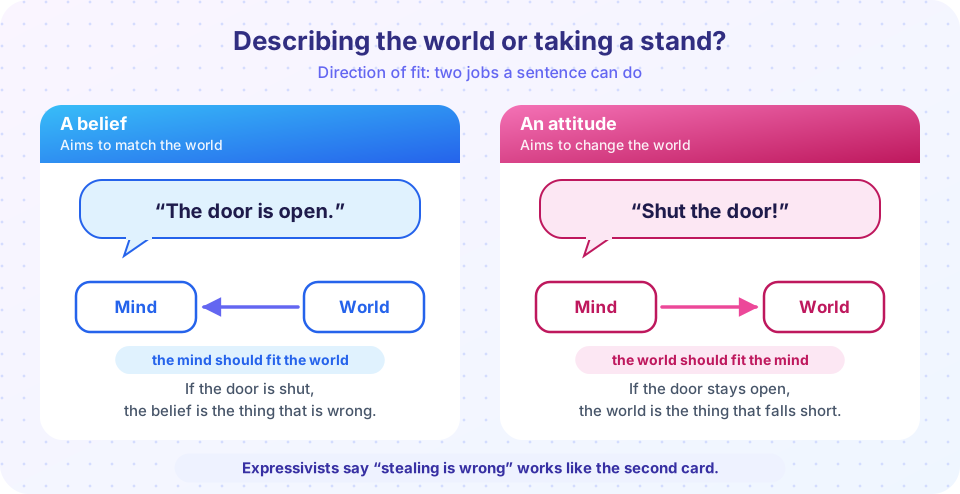
"The door is open" and "Shut the door!" are different kinds of speech. The first aims to describe how things are. The second aims to change how things will be. Now consider "Stealing is wrong." Does it work like the first, or like the second?
Expressivists answer: more like the second. Moral sentences do not describe special moral facts. They voice attitudes, plans or commands. This idea has a long history, runs through some of the cleverest work in 20th-century philosophy, and faces one famous problem that defines the whole debate.
What you will learn
- The idea of direction of fit and why it matters for moral talk.
- The main versions: emotivism (Ayer, Stevenson), prescriptivism (Hare), norm-expressivism (Gibbard) and quasi-realism (Blackburn).
- The Frege-Geach problem and the expressivist reply.
- The strengths of expressivism: motivation and a place for morality in a scientific world.
- Common objections.
Key terms
Direction of fit: whether a mental state should match the world (belief) or the world should match it (desire, plan).
Emotivism: the view that moral statements express emotions and try to influence others.
Prescriptivism: the view that moral judgments are universal commands (prescriptions).
Quasi-realism: Simon Blackburn's project of explaining, from an expressivist base, why moral talk behaves like talk of truth and fact.
Frege-Geach problem: the problem of explaining how moral sentences embedded in "if ... then" remain meaningful and take part in valid arguments.
Direction of fit
Imagine a shopper with a list and a detective with a list. If the shopper finds the milk missing from the basket, the shopper changes the world by buying milk. If the detective's list says "milk was bought" but the world shows it was not, the detective crosses it out. The two lists look alike but have opposite directions of fit. A shopping list tries to make the world fit the list. A record of what happened tries to make the list fit the world. Elizabeth Anscombe used this contrast in her book Intention (1957).
Beliefs have the detective's direction. Desires and plans have the shopper's. Expressivists point out that moral judgments are tightly tied to motivation: if someone truly thinks cruelty is wrong, they are normally moved to avoid it. A pure belief does not do that by itself. So perhaps moral judgments are not pure beliefs. They resemble the shopper's list.
A short history
- Hume (1739–40). David Hume held that reason alone cannot move us, and that moral distinctions come from sentiment: approval and disapproval. He is the ancestor of expressivism, though he did not state it in modern terms.
- A. J. Ayer (1936). In Language, Truth and Logic, Ayer argued that moral sentences cannot be verified by observation or logic, so they are not factual claims. "You acted wrongly in stealing the money" adds no fact to "You stole the money"; it expresses disapproval, as if said in a tone of horror. This is crude "boo/hooray" emotivism.
- C. L. Stevenson (1944). In Ethics and Language, Stevenson refined it: ethical sentences have emotive meaning, the power to express and evoke attitudes, and they are used to influence others. "Stealing is wrong" is roughly "I disapprove of stealing; do so as well."
- R. M. Hare (1952). In The Language of Morals, Hare analysed moral judgments as prescriptions: universal commands that anyone in the same situation should follow. This gave moral reasoning a logic, since universality constrains us (the person who judges must accept the same rule for themselves).
- Simon Blackburn (1984) and Allan Gibbard (1990). Blackburn's Spreading the Word proposed quasi-realism, and Gibbard's Wise Choices, Apt Feelings developed norm-expressivism, in which moral judgments express acceptance of norms for feeling and action.
The Frege-Geach problem
The problem was raised by Peter Geach (building on Frege) in the 1960s and pressed by John Searle. Take this argument:
- Lying is wrong.
- If lying is wrong, then getting your brother to lie is wrong.
- Therefore, getting your brother to lie is wrong.
This looks valid, an instance of modus ponens. Validity requires the same meaning for "lying is wrong" in premise 1 and in the if-clause of premise 2. But in premise 2 the speaker does not assert that lying is wrong or express disapproval; the clause is only supposed. If "lying is wrong" just means "Boo to lying!" then it cannot sensibly sit inside an "if." So how does the sentence mean the same in both places?
Expressivists have proposed several replies. Hare tried a logic of imperatives. Blackburn and Gibbard developed systems in which attitudes to attitudes can be combined: someone who accepts premises 1 and 2 would be committed to disapproving of getting a brother to lie, because failing to would be an inconsistency of attitude. Whether these solutions succeed is a live debate. Critics say the technical machinery grows heavy; defenders say it shows that logic is broader than truth and falsity.
Strengths and weaknesses
Strengths.
- It explains the link between moral judgment and motivation.
- It fits a scientific world picture: no spooky moral facts are needed.
- It treats moral disagreement as a disagreement in attitude, something that can still be reasoned about and changed.
Weaknesses.
- The embedding problem above.
- It may not capture how moral claims feel: we think "slavery was wrong" would be true even if everyone approved of it. Quasi-realists answer that they can say this too, because they hold the firm attitude that slavery would be wrong whatever attitudes people had.
- The risk of sliding into subjectivism: if "wrong" just expresses my attitude, is there room for mistakes? Expressivists say yes, because attitudes can be criticized as ill-informed, inconsistent or insensitive.
Common misconceptions
"Expressivists think morals are just feelings, so they do not matter." Expressivists hold moral views as firmly as anyone. They differ on what holding the view is.
"Expressivism means anything goes." Attitudes are open to reasoning, consistency checks and facts, so some are better than others.
"Emotivism is the same as subjectivism." Subjectivism says "wrong" means "I disapprove" (a report that can be true or false). Emotivism says "wrong" expresses disapproval, as a cry of pain expresses pain without describing it.
Try it
Press Run (or Ctrl + Enter) to see the result here.
Program input · what you'd type while the program runs
Type the answers before you press Run, one per line. Each time the program reads a line (with input()), it gets the next line from this box.
Check your understanding
Quick check · 5 questions
of 5 answered You scored / 5 · perfect!
-
1. What does 'direction of fit' distinguish?
Beliefs aim to fit the world; desires and plans aim to make the world fit them. -
2. Which philosopher developed quasi-realism?
Blackburn (Spreading the Word, 1984) explains how moral talk can behave like talk of truth from an expressivist base. -
3. What is the Frege-Geach problem?
If 'lying is wrong' only expresses disapproval, it is unclear how it can be supposed in an 'if' clause and still take part in valid reasoning. -
4. Which statement distinguishes emotivism from subjectivism?
Subjectivism treats 'wrong' as a report of my disapproval, which is true or false; emotivism treats it as an expression of disapproval. -
5. Which is a strength often claimed for expressivism?
Because moral judgments are attitude-like, it is not surprising that sincerely holding one moves us to act.
Summary
- Beliefs and desires differ in direction of fit; expressivists say moral judgments resemble desires or plans.
- Versions include emotivism (Ayer, Stevenson), prescriptivism (Hare), norm-expressivism (Gibbard) and quasi-realism (Blackburn).
- The Frege-Geach problem asks how moral sentences can be embedded in logical arguments.
- Strengths: motivation and a naturalistic picture; weaknesses: embedding and the feeling that moral claims are true.
- Expressivism is not "anything goes": attitudes can be criticized.
Track your progress
Create a free account to tick off lessons and pick up where you left off on any device.
of Ethics lessons completed