


















Lesson 4 of 45 · Getting Started
Chapter 1 Review: Getting Started
Review chapter 1 of the ethics course: the course map, arguments, validity, fallacies, thought experiments, intuitions and reflective equilibrium, with a ten-question quiz.
You now have the basic toolkit for the rest of the course. You know what an argument is and how to test it. You know that philosophers use imagined cases to probe principles, and that the method of reflective equilibrium adjusts principles and judgments until they agree. This review pulls the chapter together and helps you remember it.
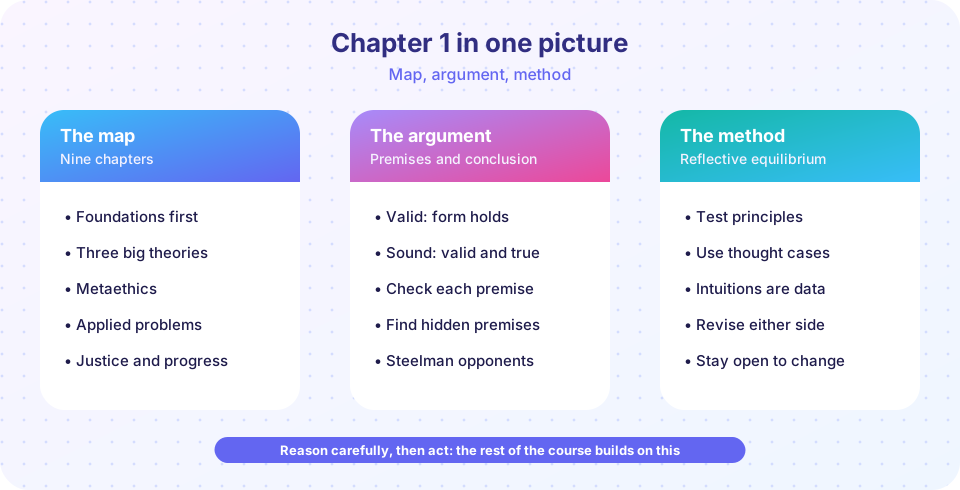
The chapter at a glance
| Lesson | Big idea | Key terms |
|---|---|---|
| Course Map | The course has nine chapters; study by reading, reconstructing, objecting and revising. | Ethics, normative, steelman |
| How to Read and Build an Argument | Reasons can be tested: validity checks form, soundness checks truth too. | Premise, conclusion, valid, sound, fallacy, is-ought gap |
| Thought Experiments and Moral Intuitions | Imagined cases isolate features; intuitions are fallible evidence. | Considered judgment, counterexample, reflective equilibrium |
What to carry forward
Four habits will serve you in every later chapter.
- State the argument. When you meet a moral claim, write the premises and the conclusion in plain sentences.
- Find the hidden premise. Ask what must be added to make the argument valid, and whether you accept it.
- Use cases. Test every principle against clear cases, including strange ones. A principle with a monstrous implication is in trouble.
- Stay revisable. Treat your own views as the current best fit, not as final.
Try it
Remembering terms needs repetition at growing intervals. This first demonstration plots a simple forgetting-curve model with reviews on days 1, 3, 7, 14 and 30. It is a simplified model of how review can slow forgetting (memory strength doubles after each review in this toy), not a prediction of your own memory.
Press Run (or Ctrl + Enter) to see the result here.
Program input · what you'd type while the program runs
Type the answers before you press Run, one per line. Each time the program reads a line (with input()), it gets the next line from this box.
The second demonstration is a set of flip cards for the chapter's key terms. Click a card to see the definition.
Check your understanding
Quick check · 10 questions
of 10 answered You scored / 10 · perfect!
-
1. In 'Since cruelty causes suffering and suffering is bad, cruelty is bad', which part is the conclusion?
The last claim is what the 'since' clauses support. -
2. An argument has true premises but the conclusion does not follow from them. It is
If the conclusion can be false while the premises are true, the argument is invalid. Soundness requires validity. -
3. Which statement about validity is correct?
Validity is about form. False premises make the argument unsound, not invalid. -
4. 'Everyone is selfish, so everyone ought to be selfish' is a problem because of
It moves from a claim about what is to a claim about what ought to be without a moral premise. -
5. A flash of disgust at an unfamiliar custom is best described as
Considered judgments come from calm, impartial reflection. A flash of disgust needs scrutiny. -
6. What was Singer's drowning child case designed to test?
It isolates a principle of rescue and then asks whether it also applies to distant strangers. -
7. Which is a reasonable response when a principle conflicts with a firm considered judgment?
Reflective equilibrium allows revision of either side and repeats the test. -
8. 'Either we ban it entirely or accept all the harm.' This is most likely
It offers two options and ignores middle ways such as regulation. -
9. Why might evidence of framing effects trouble a philosopher who relies on intuitions?
If wording changes verdicts, we should check which intuitions are stable before we lean on them. -
10. Which step comes first when analyzing a thought experiment?
Knowing what the case isolates tells you what it can and cannot show.
Summary
- An argument is premises plus a conclusion; check both the form (validity) and the truth of premises (soundness).
- Watch for hidden premises, the is-ought gap and common fallacies.
- Thought experiments isolate features; intuitions are fallible evidence that must be sifted.
- Reflective equilibrium revises principles and judgments until they cohere.
Track your progress
Create a free account to tick off lessons and pick up where you left off on any device.
of Ethics lessons completed