


















Lesson 41 of 45 · Projects and Practice
The dilemma lab
Experiment with weighting ethical lenses on three sample dilemmas, see how verdicts shift, and learn what sensitivity analysis can and cannot say about moral reasoning.
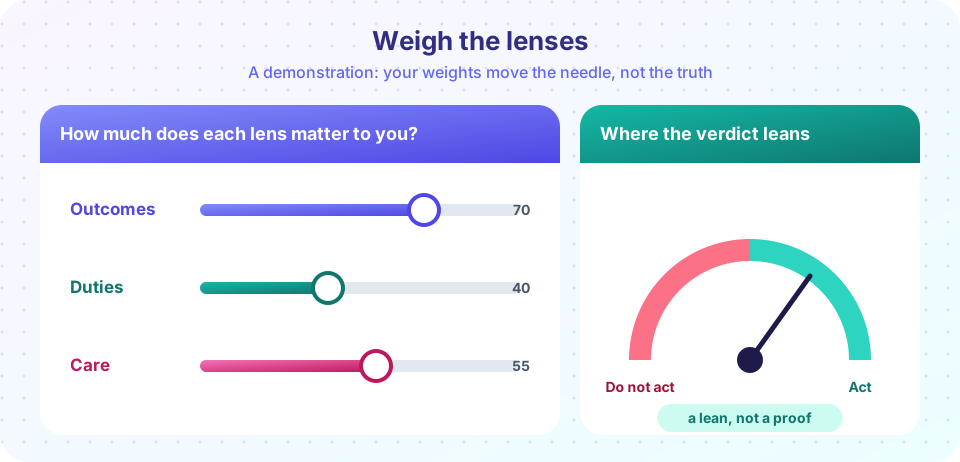
In the last lesson you built an analysis by hand. This lesson gives you a laboratory: a small tool where you can weight the four lenses and see how a verdict moves. The goal is not to compute morality. It is to feel how much of your conclusion depends on how much weight you give each lens, and to learn to tell robust conclusions from fragile ones.
What you will learn
- How to turn a qualitative analysis into a rough scoring table, and what that hides.
- How changing weights can flip a verdict.
- What a sensitivity analysis is and why robust conclusions deserve more confidence.
- Why numbers cannot replace judgment, and how they can still help.
Key terms
Weight: how much importance you give to a lens or value in a decision.
Verdict margin: the difference between the weighted scores of two options.
Sensitivity analysis: testing how a conclusion changes when assumptions change.
Robust conclusion: one that holds across many reasonable weightings.
Fragile conclusion: one that flips with small changes in weights or facts.
Turning an analysis into a table
Suppose you are weighing two options. For each, you give a score from -2 (strongly against) to +2 (strongly for) from the perspective of each lens: outcomes, duties and rights, character, and care. Then you choose weights for the lenses that add up to 1. The weighted score is the sum of weight times score.
This is a deliberate simplification. Real ethical reasoning is not an addition problem, rights may act as constraints and not as weights, and the scores themselves are judgments you must defend. But the table has one great virtue: it makes your assumptions visible. If the verdict depends on giving "care" almost no weight, that is worth knowing.
The sample cases
The three cases below use one analyst's rough ratings. You are welcome to disagree with the scores, and in the lab you can change the weights, although not the scores. In your own analyses you should change both.
- Honest feedback. A friend asks what you think of her business plan, which you think will probably fail. Option A: tell her clearly. Option B: stay positive and say nothing.
- Recital or move. Your sibling's recital and a friend's move-out day fall on the same afternoon. Option A: attend the recital. Option B: help your friend move.
- Whistleblowing. You find serious problems at work. Option A: go public immediately. Option B: escalate internally first.
Using the lab
Choose a case, move the sliders and watch the needle. Then click "Test sensitivity": the lab draws many random weightings and shows how often each option wins. A case where one option wins in nearly every weighting has a robust answer. A case close to 50/50 is one where the lenses truly disagree, and your decision rests on a value judgment you should state openly.
Reading the results
- If one option wins in more than about 90% of weightings, your confidence in it can be high unless the scores themselves are wrong.
- If the split is near even, look to the facts. Could you reduce uncertainty about outcomes? Could you find a creative third option that scores well on all lenses?
- If the verdict flips only when one lens gets almost all the weight, you have learned that your preference depends on a single-lens view, which should make you cautious.
Limits of the lab
The tool cannot capture rights as side constraints, severity (a small chance of a catastrophe), uncertainty about the facts, or the fact that lenses are not independent. A rough numeric score of "duties" hides which duty and how stringent. Use the lab as a thinking aid, never as an authority. If a score table ever "proves" something you know is deeply wrong, trust the alarm and recheck the table.
Common misconceptions
"A higher number means the option is morally correct." The numbers reflect your ratings and weights, not an independent truth.
"Weights should be equal." Equal weights are one choice among many; justify yours.
"Sensitivity analysis removes disagreement." It shows where disagreement lies and how large it is.
Try it
Press Run (or Ctrl + Enter) to see the result here.
Program input · what you'd type while the program runs
Type the answers before you press Run, one per line. Each time the program reads a line (with input()), it gets the next line from this box.
Check your understanding
Quick check · 5 questions
of 5 answered You scored / 5 · perfect!
-
1. What is the main value of turning an analysis into a scoring table?
A table shows scores and weights so others can see where they disagree. -
2. What does a sensitivity analysis do here?
It shows whether a conclusion is robust or fragile. -
3. If option A wins in about 98% of random weightings, what is a fair conclusion?
Robustness to weights does not guarantee that the ratings are right. -
4. Which is a limit of a weighted-sum lab?
Some moral considerations do not trade off smoothly. -
5. A near 50/50 split across weightings suggests
Name the value judgment openly and look for facts or creative options that reduce the conflict.
Summary
- Scoring tables make assumptions visible, but they simplify.
- Weights drive verdicts; sensitivity analysis shows how much.
- Robust conclusions deserve more confidence; fragile ones need more facts or better options.
- Never let a table overrule a deep moral alarm; recheck it instead.
Next: Practice cases
Track your progress
Create a free account to tick off lessons and pick up where you left off on any device.
of Ethics lessons completed