


















Lesson 39 of 45 · Justice and Moral Progress
Chapter 8 review: justice, duties and progress
Review chapter 8 with a one-picture summary of fair shares, global duties and moral progress, a recap table of positions, and a ten-question mixed quiz.
Chapter 8 moved from personal choices to the shape of whole societies and the whole world. This review lines up the main positions, reminds you of the arguments that carry them, and tests whether the names, ideas and distinctions have settled.
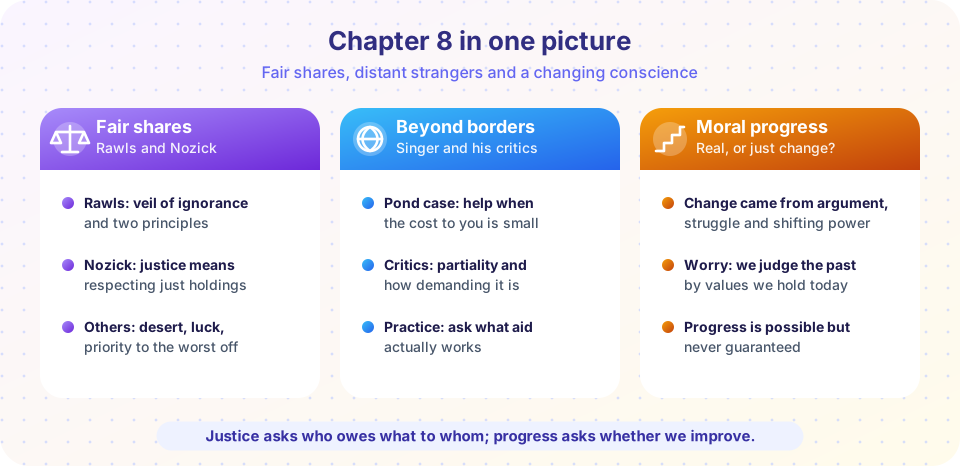
What you will review
- The main theories of distributive justice and their key arguments.
- Singer's argument, the main objections and the alternatives from justice.
- What moral progress might mean and what explains moral change.
Key terms
Veil of ignorance / difference principle: Rawls's device and his principle for allowing inequalities.
Entitlement theory: Nozick's view that just acquisition and transfer produce just holdings.
Luck egalitarianism: inequalities from brute luck are unjust; inequalities from choices may be acceptable.
Demandingness objection: a theory that asks too much undermines integrity and projects.
Threshold model: adoption depends on how many others have already adopted.
Recap table
| Topic | Position or idea | Key thinkers | Main objection or reply |
|---|---|---|---|
| Distributive justice | Two principles chosen behind a veil | Rawls 1971 | Harsanyi: maximize expected well-being; Cohen on incentives; Okin on the family |
| Distributive justice | Entitlement from just acquisition and transfer | Nozick 1974 | Initial holdings may be unjust; rectification |
| Distributive justice | Luck, priority, sufficiency, capabilities | Dworkin, Cohen, Parfit, Frankfurt, Sen, Nussbaum | Harsh to bad choosers; hard to measure |
| Global justice | Duty to prevent suffering at little cost | Singer 1972 | Demandingness (Williams), partiality (Scheffler) |
| Global justice | Duty not to harm; duty of assistance | Pogge 2002; Rawls 1999 | Causal claims disputed; too limited (Beitz) |
| Moral progress | Standards: inclusion, harm, reasoning, rights | Lecky, Singer, Appiah, Pinker | Whig bias; backsliding; circularity |
Arguments to remember
- Veil of ignorance: if you do not know your place, you will choose rules that are fair to every place.
- Wilt Chamberlain: free exchanges disturb any pattern, so pattern principles need constant interference.
- Pond argument: if you would save a child at the cost of your shoes, consistency suggests you should help distant children at similar cost.
- Demandingness: a principle that requires nearly everything may be too much, or our comfort may be the problem.
- Expanding circle: moral concern has widened from kin to humanity and perhaps beyond.
- Threshold models: small differences in who joins can decide whether change cascades.
Common misconceptions
"Rawls and Nozick agree about equality." They differ sharply: Rawls allows only inequalities that help the least advantaged; Nozick says just holdings may be unequal.
"Effective altruism is Singer's theory." It applies Singer-like reasoning but is a broader, evolving movement with internal debates.
"Moral progress is an illusion." Skeptical points are important, but some changes (ending slavery) are very strongly supported as improvements.
Try it
Press Run (or Ctrl + Enter) to see the result here.
Program input · what you'd type while the program runs
Type the answers before you press Run, one per line. Each time the program reads a line (with input()), it gets the next line from this box.
Press Run (or Ctrl + Enter) to see the console output here.
No output.
Check your understanding
Quick check · 10 questions
of 10 answered You scored / 10 · perfect!
-
1. Which theorist proposed the original position and veil of ignorance?
Rawls introduced them in A Theory of Justice (1971). -
2. Which statement describes the difference principle?
Inequality must be justified by its benefit to those with least. -
3. Nozick's entitlement theory judges a distribution by
History matters, not the pattern; rectification covers past injustice. -
4. What is the central premise of Singer's pond argument?
This principle drives the conclusion that affluent people should give much more. -
5. Who raised the integrity objection to utilitarian demands?
Williams argued that such demands can undermine our personal projects and commitments. -
6. Prioritarianism holds that
Parfit (1991) distinguished priority from equality. -
7. Which is a plausible explanation of moral change?
Most accounts combine several factors. -
8. What did the 1948 Universal Declaration of Human Rights do?
It shaped later treaties and rights language. -
9. In the threshold model, why can changing one person stall a cascade?
If no one has a threshold equal to the current number, the process stops. -
10. Which pair correctly matches thinker and idea?
The other pairings are mismatched.
Summary
- Rawls, Nozick, luck egalitarians, prioritarians and capability theorists offer different standards for fair shares.
- Singer argues for a strong duty to help; objections and alternatives come from integrity, partiality and justice.
- Moral progress needs a standard; explanations are plural and doubts are real.
- Models of tipping show how change can be sudden and fragile.
Track your progress
Create a free account to tick off lessons and pick up where you left off on any device.
of Ethics lessons completed