


















Lesson 34 of 45 · Applied Ethics: Life, Technology and Environment
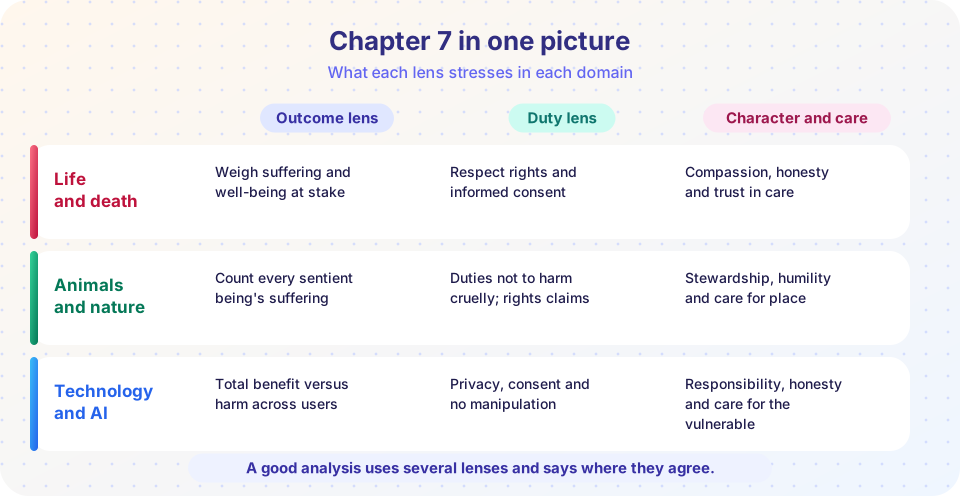
Chapter 7 review: three domains, four lenses
Review chapter 7 with a matrix of domains and ethical lenses, a recap of key cases and arguments, and a ten-question quiz on bioethics, animals, climate and AI.
You have applied ethical thinking to life and death, to animals and nature, and to technology. This review collects what was shared across the three fields and checks that the main ideas have stuck.
What you will review
- The key concepts in each field.
- How the four lenses pull in different directions.
- The numbers and names worth remembering.
Key terms
Informed consent: competent, informed, voluntary agreement.
Double effect: foreseen harm allowed under four conditions.
Equal consideration of interests: like interests count equally whoever has them.
Discount rate: annual reduction of future value.
Proxy: a stand-in measure that can distort a system's goal.
Recap
| Field | Key ideas | People and works | Typical conflict |
|---|---|---|---|
| Life and death | Four principles, consent, killing versus letting die, double effect | Beauchamp and Childress 1979; Rachels 1975; Thomson 1971; Nuremberg Code 1947 | Autonomy versus protection of life and the vulnerable |
| Animals and nature | Sentience, equal consideration, rights, land ethic, intergenerational justice | Bentham; Singer 1975; Regan 1983; Leopold 1949; Parfit 1984 | Individual welfare versus ecosystem health; present versus future |
| Technology and AI | Privacy, bias, proxies, fairness metrics, responsibility gap | Warren and Brandeis 1890; Obermeyer 2019; Kleinberg et al. 2016; Matthias 2004 | Fairness definitions conflict; benefit versus privacy and power |
Patterns across the chapter
- Facts decide how well any lens works. Whether an algorithm is biased or an animal can suffer is partly empirical.
- The most vulnerable are the test. Patients, animals, future generations and people subject to algorithmic decisions cannot always speak for themselves.
- Value choices hide inside technical choices. A discount rate, a proxy or a fairness metric embodies an ethical stance.
- Compromise and honesty. Good analysis says what is uncertain and what is lost in the chosen option.
Common misconceptions
"Applied ethics always ends in a verdict." Sometimes the best result is a clearer map of the disagreement.
"Rules from one field apply directly to others." Principles are adapted, since the facts and power relationships differ.
"Technical numbers are neutral." They are shaped by choices that deserve scrutiny.
Try it
Press Run (or Ctrl + Enter) to see the result here.
Program input · what you'd type while the program runs
Type the answers before you press Run, one per line. Each time the program reads a line (with input()), it gets the next line from this box.
Press Run (or Ctrl + Enter) to see the console output here.
No output.
Check your understanding
Quick check · 9 questions
of 9 answered You scored / 9 · perfect!
-
1. Which set lists the four principles of biomedical ethics?
Beauchamp and Childress proposed these four mid-level principles. -
2. Which condition is part of the doctrine of double effect?
The bad effect may be foreseen but cannot be the means by which the good effect occurs. -
3. Equal consideration of interests means
It is about weighing interests, not giving identical treatment. -
4. Whose ethic says an action is right if it preserves the integrity, stability and beauty of the biotic community?
That is the land ethic from A Sand County Almanac (1949). -
5. Why is the discount rate an ethical choice?
A higher rate makes distant harms count for less. -
6. What did the Obermeyer et al. study find about a health-care algorithm?
Less had historically been spent on Black patients at the same level of illness. -
7. Which statement about fairness metrics is correct?
This is the impossibility result of Kleinberg et al. and Chouldechova. -
8. Which philosopher drew the thought experiment of the violinist?
Thomson (1971) used it to argue about whether the right to life includes the right to use another's body. -
9. What is a responsibility gap?
Matthias named it in 2004; many argue that humans and organizations must remain accountable.
Summary
- Each domain has distinctive concepts, but the same four lenses help.
- Facts, vulnerable stakeholders and hidden value choices recur across fields.
- A careful analysis names the uncertainty and the costs of the chosen option.
Track your progress
Create a free account to tick off lessons and pick up where you left off on any device.
of Ethics lessons completed