


















Lesson 22 of 45 · Virtue Ethics and Other Theories
Modern virtue ethics and the situationist challenge
How Anscombe, Foot, MacIntyre and Hursthouse revived virtue ethics, and how experiments on helping and obedience led to the situationist challenge to character.
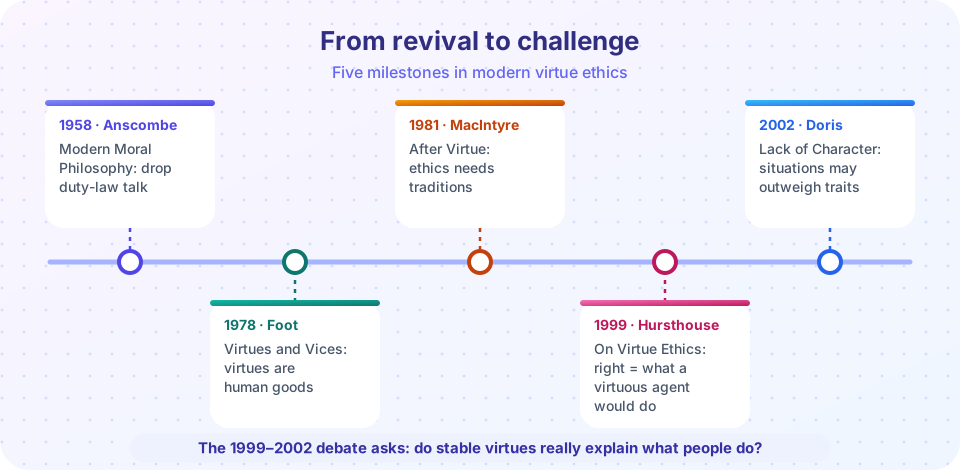
For centuries after the Middle Ages, most English-speaking moral philosophy was a contest between duty and consequences. In 1958 a short paper by the philosopher G. E. M. Anscombe suggested that both camps were using concepts that had lost their home. That paper helped start a revival of Aristotle-style thinking, and by 1999 Rosalind Hursthouse could state a full modern theory. Almost at once, psychologists and philosophers asked a hard question: do the stable character traits the theory relies on really exist?
This lesson tells that story, then lets you test the question with a simulation.
What you will learn
- What Anscombe's 1958 paper argued and why it mattered.
- The distinctive contributions of Foot, MacIntyre and Hursthouse.
- How Hursthouse defines right action and answers the "no guidance" objection.
- What the situationist challenge says, which experiments it cites, and how defenders reply.
- Why the evidence is more limited than it first appears.
Key terms
Moral obligation (the "moral ought"): the idea that morality gives binding commands, like laws without a lawgiver.
Natural goodness: Philippa Foot's idea that virtues are goods for a living kind, as roots are good for a plant.
v-rule: Hursthouse's term for a rule drawn from virtue and vice words, such as "act honestly" or "do not act cruelly".
Situationism: the claim that features of the situation predict behavior far better than stable personal traits.
Global trait: a disposition to act the same way across very different situations (for example, honest in all circumstances).
Anscombe: a call to change the subject
G. E. M. Anscombe's 1958 paper "Modern Moral Philosophy" made three claims. First, the notions of moral obligation and the moral "ought" belong to a framework of divine law. Take God away and they float free, like a law without a lawgiver. Second, philosophers cannot make progress until they have a better philosophy of psychology: an account of intention, action and what a human being needs. Third, consequentialism and rule ethics should be dropped as ways of thinking, and we should go back to concepts like virtue, vice and flourishing.
Whether or not you agree, the paper reframed the debate. It also introduced the word "consequentialism" into English philosophy, in the sense now used. It gave later writers permission to take Aristotle seriously again.
Foot, MacIntyre and Hursthouse
Philippa Foot (her essays are collected in Virtues and Vices, 1978, and developed in Natural Goodness, 2001) argued that virtues are not optional decorations. They are qualities that a human needs, just as a wolf needs to hunt in cooperation with a pack. A virtue benefits its possessor and others, and judging a person good is a factual evaluation of a living creature, like saying a plant has healthy roots. Critics ask whether human "kind" is a firm enough category to settle moral questions.
Alasdair MacIntyre, in After Virtue (1981), argued that modern morality is a collection of fragments from lost traditions, so moral debates seem endless. He wanted to rebuild ethics around practices (such as medicine, chess or farming, activities with their own standards of excellence), a narrative unity of a human life and traditions that carry shared goods across generations. This makes virtue ethics a historically situated theory, and critics ask how it handles societies with more than one tradition.
Rosalind Hursthouse, in On Virtue Ethics (1999), set out the most carefully worked theory. Her central claim reads: an action is right if and only if it is what a virtuous agent would characteristically do in the circumstances. She answers the guidance worry with v-rules. "Be honest," "do not be cruel," "help those in need" are all rules, even though they are expressed in virtue terms. And she says a novice can use them by consulting a role model (someone she admires) and asking what that person would do.
Notice what she does not claim. The virtuous agent does not have to be perfect; the agent need only be someone with the virtues. Tragic dilemmas (where every option involves a moral loss) are real, and a virtuous agent will feel remorse about the loss even when choosing well.
The situationist challenge
Virtue ethics assumes stable, wide-ranging character traits. Psychologists asked whether that assumption is true. Three famous results are often cited.
- Milgram's obedience studies (1960s). In Stanley Milgram's experiments, many participants continued to give what they believed were painful shocks when told to by an experimenter in a lab coat. The figures varied a lot between versions, and the studies have been criticized on ethical and methodological grounds, but they show how powerful an authority figure can be.
- The Good Samaritan study (Darley and Batson, 1973). Seminary students were asked to walk to another building to give a talk, some in a hurry and some not. On the way they passed a person slumped in a doorway. About one in ten of the students who had been told they were late stopped to help, compared with roughly six in ten of those with time to spare. Whether they had been asked to speak about the Good Samaritan parable made little difference. The sample was small (40 students), so the exact percentages should not be pushed too far.
- Other classics include experiments on bystander intervention and on small mood effects on helping. Several of these have attracted failed replications or methodological critiques.
The philosophers Gilbert Harman (1999) and John Doris (Lack of Character, 2002) argued from such results that the "global traits" virtue ethics needs are rare or absent. People are not reliably brave, honest or kind across situations; they act on local cues. If so, an ethics built on character rests on a false psychology.
Replies
Defenders of virtue ethics make several points.
- Virtue is rare and hard. Aristotle never claimed most people are virtuous. A study of ordinary participants says little about the few who have developed real virtue.
- Traits are not all-or-nothing. A trait can be a stable pattern of how people interpret situations, not a reflex. Hurry changes what a seminarian notices, not necessarily his values.
- Averages hide differences. Even in the experiments, some people did help and some did not. Individual differences are real, and personality research finds moderate stability across time, although not across all situations.
- Replication. Large parts of the social-psychology evidence base have been questioned, so the empirical challenge is less decisive than it was once thought to be.
- Ethics should also shape situations. If situations influence conduct, the lesson may be that good people need to build good environments (sleep, time, institutions), which is a practical-wisdom conclusion Aristotle might accept.
The debate is still open. A balanced conclusion is that traits and situations both matter, and virtue theorists need a more modest, psychologically informed view of character.
Common misconceptions
"The experiments prove people have no character." They show situations matter a lot. They do not show that traits matter zero, and individual differences persist within each experiment.
"Anscombe wanted to bring back ancient Greek society." She wanted better concepts, not ancient institutions, and she argued for a better philosophy of psychology.
"Hursthouse's theory is circular and so useless." She argues virtue and right action can be explained together with an independent account of what human beings need to flourish.
Try it
Press Run (or Ctrl + Enter) to see the result here.
Program input · what you'd type while the program runs
Type the answers before you press Run, one per line. Each time the program reads a line (with input()), it gets the next line from this box.
Check your understanding
Quick check · 5 questions
of 5 answered You scored / 5 · perfect!
-
1. What was one of Anscombe's main claims in 'Modern Moral Philosophy' (1958)?
Anscombe argued that obligation language lacks its original lawgiver and urged a return to virtue and psychology. -
2. How does Hursthouse define a right action?
That is her core thesis; v-rules like 'be honest' supply practical guidance. -
3. Which book did Alasdair MacIntyre publish in 1981?
After Virtue (1981) argued that modern ethics is a set of fragments and proposed practices and traditions as a base for virtue. -
4. What did the Darley and Batson study suggest about helping?
Students told they were late were far less likely to stop, though the sample was small. -
5. Which reply to the situationist challenge is reasonable?
Defenders point out that virtue is hard and rare, and that parts of the evidence base have been questioned.
Summary
- Anscombe (1958) criticized the "moral ought" and urged a return to virtue and psychology.
- Foot tied virtues to natural goodness, MacIntyre to practices and traditions, and Hursthouse built a full theory with v-rules.
- Situationists such as Harman and Doris used experiments on helping and obedience to question global character traits.
- Replies stress that virtue is rare, traits can be interpretive, and evidence has limits.
- A sensible lesson is that both traits and situations matter.
Track your progress
Create a free account to tick off lessons and pick up where you left off on any device.
of Ethics lessons completed