


















Lesson 25 of 45 · Metaethics
Chapter 6 overview: what is morality, really?
A map of metaethics: realism, error theory, expressivism, constructivism and the psychology of moral judgment, with questions to carry through chapter 6.
Normative ethics asks, "What should I do?" Metaethics asks the questions behind that one. When someone says "cruelty is wrong," what are they doing? Describing a fact? Expressing a feeling? Giving an order? And if it is a fact, how could anyone know it?
These questions can seem abstract, but they shape how we talk about disagreement, how seriously we take moral claims, and what we think a moral education is for. This chapter gives you a map of the main positions and the tools to evaluate them fairly.
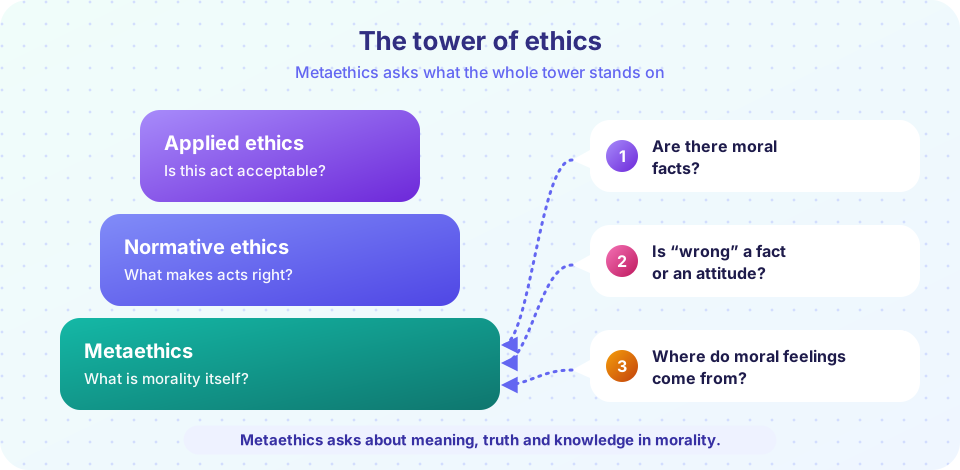
What you will learn
- How metaethics differs from normative and applied ethics.
- The four big options: realism, error theory, expressivism and constructivism.
- Why philosophers disagree about the semantics, metaphysics and epistemology of morality.
- What empirical psychology adds and what it cannot settle.
Key terms
Metaethics: the study of the meaning, nature and knowledge of moral claims.
Cognitivism: moral sentences express beliefs that can be true or false.
Non-cognitivism: moral sentences express attitudes or commands, not beliefs.
Moral realism: there are moral facts that hold independently of what anyone thinks.
Is-ought gap: the idea that facts about how things are do not by themselves entail how things ought to be.
Three families of question
Metaethicists sort their questions into three groups.
- Semantic: What do moral words mean? Is "wrong" a description, an expression of disapproval, or something else?
- Metaphysical: Are there moral facts or properties? If so, what are they made of, and how do they fit with a scientific picture of the world?
- Epistemological: If there are moral truths, how could we know them? Is there a moral sense, reason or reflection?
The map of metaethics
Realism
Lesson 2
Anti-realism
Lessons 2 and 3
Moral psychology
Lesson 4
A walk through the chapter
- Moral realism and its rivals. The family tree of positions, and the arguments for and against them.
- Expressivism: when moral talk is not description. From the emotivism of the 1930s to quasi-realism, and the problem that has shadowed it.
- Moral psychology: intuition, reason and evolution. What studies suggest about how people judge, and what evolutionary debunking arguments claim.
- Chapter review. A two-question map of all the positions and a ten-question quiz.
Why does this matter?
Suppose two friends disagree about whether it is wrong to eat animals. If realism is true, at least one of them is mistaken about a fact, and the argument is a search for the truth. If expressivism is true, they are voicing and trying to influence attitudes; the argument is still rational but works differently. If error theory is true, both statements are false and the argument is pointless in one sense, though we may still want to keep moral language because it is useful.
These pictures also affect how we teach children. Do we teach moral facts, as we teach facts in geography? Or do we cultivate dispositions and attitudes? And they affect how we treat people with opposing views: as mistaken, or as holding attitudes that differ from ours?
Common misconceptions
"Metaethics tells you what is right and wrong." It does not. A realist and an expressivist can both oppose cruelty. They differ about what that opposition amounts to.
"If morality is not factual, anything goes." Not even most anti-realists believe this. They give accounts of how moral standards can be firm, shared and open to reasoning.
"Science has shown that morals are just evolved feelings." Science can tell us how moral feelings may have arisen. Whether that undermines their authority is a philosophical question (lesson 4).
Try it
Press Run (or Ctrl + Enter) to see the result here.
Program input · what you'd type while the program runs
Type the answers before you press Run, one per line. Each time the program reads a line (with input()), it gets the next line from this box.
Check your understanding
Quick check · 4 questions
of 4 answered You scored / 4 · perfect!
-
1. Which question is a metaethical question?
Metaethics studies the meaning, nature and knowledge of moral claims, not which acts are right. -
2. Cognitivism says moral sentences
Cognitivists treat moral sentences as belief-expressing, truth-apt claims. -
3. The is-ought gap is the idea that
It is associated with Hume and is discussed in lesson 4. -
4. Which position holds that all positive moral claims are false?
Error theory (Mackie) says moral claims aim at objective facts that do not exist.
Summary
- Metaethics asks about the meaning, reality and knowability of morality.
- The main positions are realism, error theory, expressivism and constructivism.
- These questions affect how we treat disagreement and moral education.
- Metaethics does not tell you which acts are right.
- Psychology and evolution give data, but philosophy decides what the data show.
Track your progress
Create a free account to tick off lessons and pick up where you left off on any device.
of Ethics lessons completed