


















Lesson 1 of 45 · Getting Started
Course Map: How This Ethics Course Works
Start here: a map of the nine chapters of this ethics course, who it is for, what you need beforehand and how to study moral philosophy well.
Should you tell a friend a painful truth? Is it fair that some people are born into wealth and others into poverty? Does an animal's suffering count as much as yours? Ethics is the careful study of questions like these. It does not hand you answers to memorize. It teaches you how to think about what we ought to do, and how to tell a good reason from a bad one.
This course is a guided tour of that study. It is written for curious readers from about age 14 upward, for students meeting philosophy for the first time, and for adults who want to argue about right and wrong with more skill and less heat. You need no background. You need patience with hard questions and willingness to change your mind.
What you will learn
- What the course covers and how the nine chapters fit together.
- Who the course is for and what you should already know (very little).
- A study method that works for philosophy: read, reconstruct, object, revise.
- How the interactive demonstrations in each lesson should and should not be read.
Key terms
Ethics: the systematic study of how we ought to live and what we owe to one another.
Morality: the beliefs, norms and practices about right and wrong that people actually hold.
Normative: about what ought to be, as opposed to what is.
Argument: a set of reasons (premises) offered in support of a conclusion.
Thought experiment: an imagined case built to test a principle.
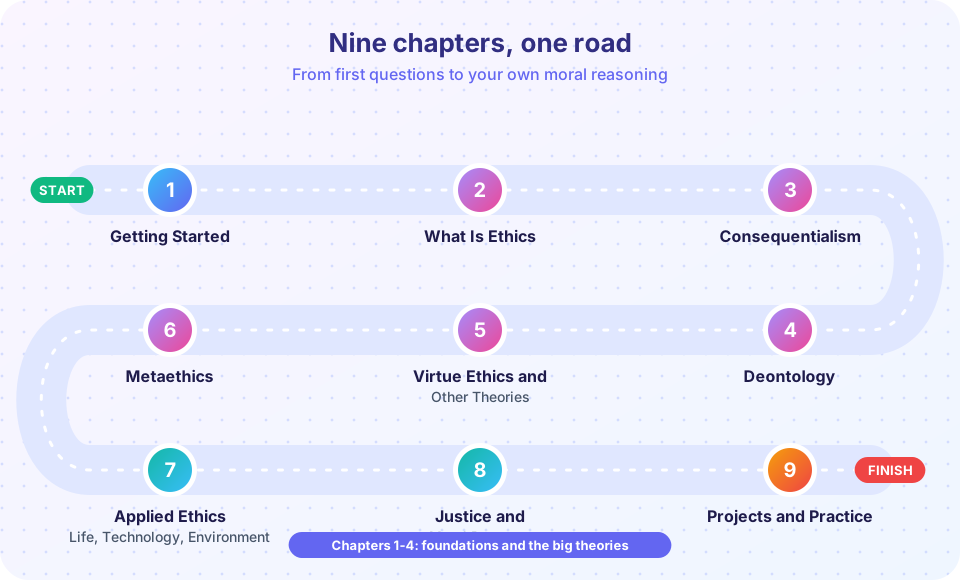
The nine chapters
Part 1: Tools and foundations
- Getting Started
- What Is Ethics
- Consequentialism
Part 2: The big theories
- Deontology
- Virtue Ethics
- Metaethics
Part 3: Using ethics
- Applied Ethics
- Justice
- Projects
Each chapter starts with an overview and ends with a review quiz.
This tutorial is organized as a course. Chapter 1 gives you the thinking tools: how to read and build an argument, and how philosophers use imagined cases. Chapter 2 asks what ethics even is, how it differs from law and etiquette, what psychology says about moral judgment, and whether right and wrong might be relative to culture. Chapters 3 to 5 present the three classic families of theory, which answer the question "what makes an act right?" in three ways: by its results, by the duties it respects, or by the character it expresses. Chapter 6 steps back and asks about the nature of moral claims themselves. Chapter 7 applies the theories to life and death, technology and the environment. Chapter 8 turns to justice and to the idea that moral understanding has improved over time. Chapter 9 is practice: case studies, a glossary, a cheat sheet and ideas for further study.
The chapters build on each other, but you can use them in different orders. If you are in a hurry to discuss artificial intelligence or climate change, read Chapters 1 and 3 to 5 first and then jump to Chapter 7. If theory bores you, start with a case from Chapter 9 and return to the earlier lessons when a concept confuses you.
How the lessons are built
Every content lesson uses the same skeleton so you always know where you are: what you will learn, key terms, the main text with worked examples and a picture, common misconceptions, interactive demonstrations, a short quiz and a summary. Overview lessons open each chapter with the big picture, and review lessons close it with a summary picture and a longer quiz.
The interactive parts are demonstrations. They are small programs that make an idea visible: a utilitarian calculator, a truth-table checker, a map of how norms vary. They are labeled as models. They are not experiments, and they are not tests of your character or your moral worth.
This course is educational. Ethics is full of questions where thoughtful people disagree, such as abortion, euthanasia, animal use, wealth and war. The lessons present the strongest arguments on several sides and name the thinkers behind them. They do not tell you what to conclude, and they are not legal, medical or professional advice.
How to study moral philosophy
Reading philosophy is not like reading a story. A good routine has four steps.
- Read for the claim. After each section, say in one sentence what the author is trying to prove.
- Reconstruct the argument. Write the premises and the conclusion in plain numbered sentences. You will learn how in the next lesson.
- Object. Find the weakest premise and try to counter it. Then find the best reply to your objection. Philosophers call this "steelmanning": making the other side as strong as possible before you argue against it.
- Revise. Decide what you now believe and why. It is fine to end with "I am torn", provided you can say exactly what the tension is.
A common beginner's mistake is to treat the first theory you meet as the truth. Another is to treat every disagreement as pure opinion. The goal sits between the two: hold views for reasons, and be ready to give those reasons up when better ones arrive.
Try it
Pick a chapter and see the key question it answers. This is a small interactive demonstration, not a quiz.
Now plan your own pace. This calculator turns the weekly time you can spare into a schedule. The hour estimates are illustrative guesses, not measurements.
Press Run (or Ctrl + Enter) to see the result here.
Program input · what you'd type while the program runs
Type the answers before you press Run, one per line. Each time the program reads a line (with input()), it gets the next line from this box.
Change hours_per_week to 2 or 8 and run it again.
Check your understanding
Quick check · 4 questions
of 4 answered You scored / 4 · perfect!
-
1. Which description fits ethics best?
Ethics is normative and systematic. Laws, etiquette and surveys of belief are related but different things. -
2. What is 'steelmanning' an opposing view?
You earn the right to reject a view only after you have understood its best version. -
3. How should you treat the interactive demonstrations in this course?
They are small models and demonstrations, labeled as such, and they support the text. -
4. Which chapter introduces the three classic families of normative theory?
Consequentialism, deontology and virtue ethics (with contractualism and care) fill Chapters 3 to 5.
Summary
- The course has nine chapters: tools, what ethics is, three theory families, metaethics, applied ethics, justice and projects.
- No background is needed; the study method is read, reconstruct, object, revise.
- The interactive parts are labeled demonstrations, not experiments or tests.
- The material is balanced and educational, not advice on how to decide your own case.
Track your progress
Create a free account to tick off lessons and pick up where you left off on any device.
of Ethics lessons completed