


















Lesson 14 of 45 · Consequentialism
Chapter 3 Review: Consequentialism
Review chapter 3: utilitarianism, Bentham and Mill, theories of well-being, act and rule consequentialism and the four classic objections, with a ten-question quiz.
Consequentialism is simple to state and hard to apply. It says that the right act has the best consequences, counted impartially. In this chapter you saw how Bentham and Mill built that idea into utilitarianism, how the theory depends on a view of well-being, how act and rule versions differ, and why four objections keep philosophers arguing.
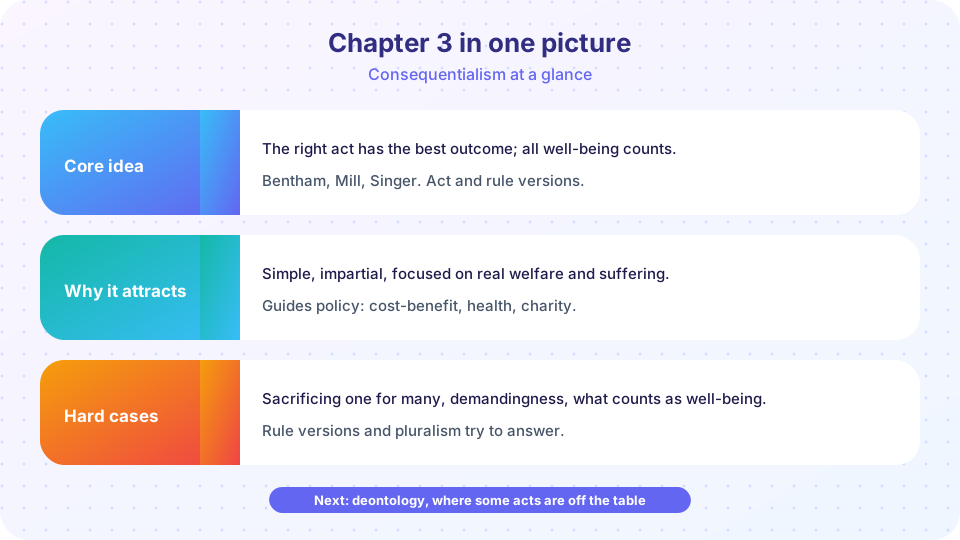
The chapter at a glance
| Lesson | Big idea | Key terms |
|---|---|---|
| Consequentialism: Judging Actions by Results | Outcomes decide rightness; versions differ on value, scope and method. | Impartiality, maximizing, expected outcome |
| Classical Utilitarianism | Maximize total well-being; Bentham's calculus; Mill's higher pleasures. | Principle of utility, felicific calculus, aggregation |
| Well-Being and Welfare | Hedonism, preferences or an objective list? Measures such as QALYs. | Experience machine, adaptive preference, QALY |
| Act, Rule and the Objections | Two ways to apply the principle; four classic objections. | Collapse, demandingness, integrity, two-level view |
Connecting the ideas
A consequentialist has to answer three questions, and each answer opens a debate. What counts as good (value)? Whose good counts (scope)? And what is the test applied to (act or rule)? Hedonism, preference theory and objective-list theories give different answers to the first; impartial summing gives the standard answer to the second; and the act/rule distinction handles the third.
The objections are best read as stress tests for these answers. The utility monster tests whether totals alone are the right measure. Demandingness tests impartiality. Rights and justice test whether results can explain why some acts are forbidden. Integrity tests whether the agent's own commitments belong in the theory. Each test has produced refinements, including prioritarianism, satisficing, agent-centered prerogatives and two-level views, and each refinement has a cost. Knowing the costs is the real learning.
Try it
The first demonstration compares three ways of ranking two societies: summing well-being (utilitarian), summing a concave transformation that gives extra weight to the worse off (a prioritarian view), and looking only at the worst-off person (maximin, a different principle used by Rawls and discussed in Chapter 8). The distributions are invented to show how rankings can differ, not to settle which is correct.
Press Run (or Ctrl + Enter) to see the result here.
Program input · what you'd type while the program runs
Type the answers before you press Run, one per line. Each time the program reads a line (with input()), it gets the next line from this box.
Notice that the total favors Y, the unequal society, while the prioritarian and maximin rules favor X. That one disagreement is the heart of the utility monster objection and of many debates about equality.
The second demonstration is a set of flip cards for chapter 3. Click a card to see the definition.
Check your understanding
Quick check · 10 questions
of 10 answered You scored / 10 · perfect!
-
1. Which pair correctly matches thinker and idea?
Bentham proposed the felicific calculus; Mill the higher pleasures; Nozick the experience machine. -
2. What is the main claim of consequentialism?
Consequences are the standard of rightness. -
3. A person is content but has never been able to learn anything beyond a narrow routine. Which theory most naturally says their life could go better?
An objective list counts goods such as knowledge as good for people whether or not they want them. -
4. Which approach asks which general rules would do the most good?
Rule consequentialism evaluates codes of rules by their consequences. -
5. The transplant case is usually used as an objection from
It suggests that sums of benefits can seem to justify violating an innocent person's rights. -
6. Which reply to the demandingness objection permits extra weight on one's own projects?
Scheffler's proposal gives agents a prerogative to favor their own projects, at some cost to impartiality. -
7. In the chapter's ranking example, which rule favored the unequal society Y?
Y has the higher total (45 versus 40), while concave weighting and maximin favor the more equal X. -
8. QALYs weight years of life by
Quality weights run from 0 (death) to 1 (full health). -
9. Why might a utilitarian say you should keep a promise even when breaking it gives slightly better results this time?
Rule and two-level utilitarians appeal to the value of reliable practices. -
10. Which is NOT one of the three questions dividing consequentialist theories?
The three dividing questions are value, scope and method (acts versus rules).
Summary
- Consequentialism judges actions by their results, counted impartially.
- Utilitarianism adds that the standard is total well-being, and different theories of well-being give different pictures of the good.
- Act and rule versions apply the standard to acts or to rules; four objections test the theory.
- The disputes over totals, impartiality, rights and integrity set up the contrast with deontology in the next chapter.
Track your progress
Create a free account to tick off lessons and pick up where you left off on any device.
of Ethics lessons completed