


















Lesson 16 of 45 · Deontology
Kant and the Categorical Imperative
Understand Kant's ethics: the good will, acting from duty, the universal law and humanity formulas of the categorical imperative, worked examples and objections.
Immanuel Kant (1724 to 1804) lived most of his life in Königsberg, then in Prussia, and wrote some of the hardest books in philosophy. His ethics, set out mainly in the Groundwork of the Metaphysics of Morals (1785), is easier to state than his metaphysics. Morality, he argued, is a matter of reason. A moral requirement is not based on what we want or on what will happen. It is a demand that applies to anyone who can reason, whatever they happen to desire.
This idea is both liberating and strict. It means that you cannot excuse a wrong by saying "everybody does it" or "it worked out well". It also means that morality does not depend on luck, wealth or talent: anyone can act well. In this lesson you will learn Kant's central test, the categorical imperative, apply it to examples and weigh the main objections.
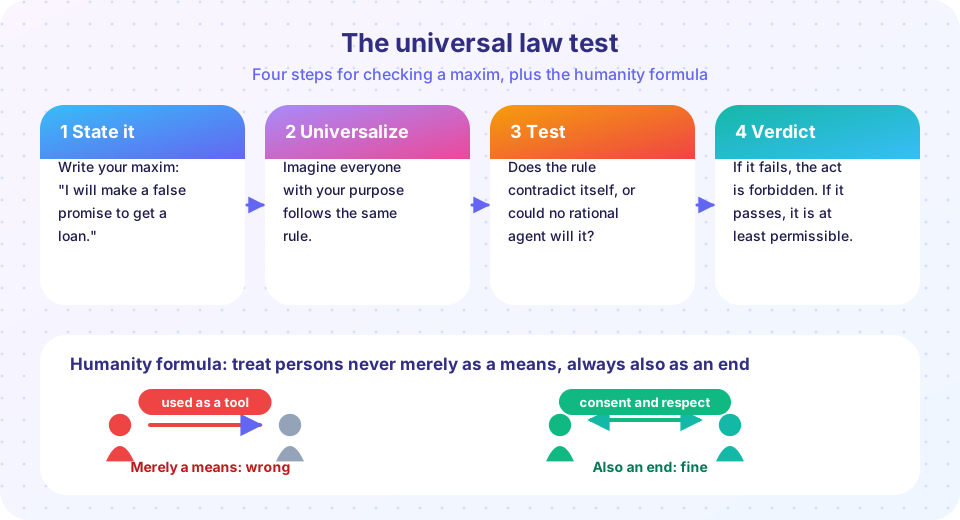
What you will learn
- Why Kant starts with the good will and acting from duty.
- The difference between hypothetical and categorical imperatives.
- How to apply the universal law formula and the humanity formula.
- Standard objections and replies.
Key terms
Good will: the will that acts out of respect for the moral law, which Kant calls the only thing good without qualification.
Maxim: the personal principle on which you act ("I will do X in circumstances Y in order to Z").
Hypothetical imperative: a command that depends on a goal ("if you want a degree, study").
Categorical imperative: a command that applies to rational beings whatever their goals.
Autonomy: governing oneself by principles one gives oneself through reason.
The good will and acting from duty
Kant opens the Groundwork by asking what is good "without qualification". Intelligence, courage, wealth and even happiness can be used badly. Only a good will is good in every circumstance: the will to do what is right because it is right. A good will is good not because of what it achieves, but in itself.
To illustrate the difference between acting from duty and acting merely in line with duty, Kant describes a shopkeeper who gives correct change to all customers, including children. It would be bad for business to cheat them. The shopkeeper's act matches duty, but if the motive is only self-interest, it has no moral worth. Moral worth appears when someone acts honestly because it is right, particularly when inclination points the other way.
Kant is often misread as saying that we must act without feeling or that natural kindness is worthless. He says that helping others out of sympathy is "amiable", but that its moral worth requires a more reliable ground, since sympathy can fail.
Hypothetical and categorical imperatives
An imperative is a command of reason. Many are hypothetical: they say what to do if you have a certain goal. "If you want to keep fit, exercise." Rational people can drop the goal and the command falls away.
Moral requirements, Kant argues, are not like this. "Do not lie" is not conditional on your wanting something. It binds you whatever you want. Such an unconditional command is a categorical imperative. Kant gives several formulations that he says express one law. Two are most useful.
The universal law formula
Act only according to that maxim by which you can at the same time will that it should become a universal law.
To apply it:
- State your maxim clearly: "I will do this action in these circumstances in order to this goal."
- Universalize it: imagine that everyone adopted the maxim.
- Test for contradiction: could the maxim even exist in that world (a contradiction in conception)? Or, if it could, could you rationally want to live in that world (a contradiction in the will)?
- Verdict: if it fails, acting on it is forbidden.
Example: the false promise. You need money and will promise to repay a loan though you know you cannot. Universalize: everyone in need makes false promises. Then nobody would believe promises, and the practice of promising would break down, including the one that the loan relies upon. The maxim defeats itself: it is a contradiction in conception. So the false promise is forbidden. Kant treats this as a perfect duty (one that admits no exceptions), such as a duty not to deceive.
Example: refusing to help. Suppose your maxim is never to help anyone in need. A world of universal refusal is conceivable. But could you will it? You may someday need help yourself, and willing a world in which no one helps would conflict with your own needs. This is a contradiction in the will. It grounds an imperfect duty to help others sometimes, with latitude about when and how.
The humanity formula
Act so that you treat humanity, whether in your own person or in that of anyone else, always at the same time as an end and never merely as a means.
Persons are not just tools. A false promise treats the lender merely as a means: it works only if she cannot share your plan. But treating someone as a means is not forbidden in itself: you use a shop assistant to buy groceries. The difference is whether the person remains a rational agent whose consent and goals count. Consent matters: if she knew your real intention, she would refuse, so she is used.
Kant argues that persons have dignity, a worth beyond price, because they can set their own ends and govern themselves by moral law. A third formula, the kingdom of ends, asks you to act as a lawmaking member of a community in which everyone's ends are respected.
Objections and replies
- The murderer at the door. In 1797 Kant wrote that it would be wrong to lie even to a murderer asking where your friend is hiding. Most readers find this absurd. Replies: Kant's own statement reflects an excessive version of his view; many Kantians (Christine Korsgaard and others) argue that the universal law test, properly applied, allows deception against someone who is themselves acting wrongly, because they have forfeited the claim to honest answers.
- Conflicting duties. What if two duties clash? Kant says that real conflicts of duties are impossible, which many find implausible. Ross later developed a rival picture (next lesson).
- Formalism. The test seems to be an empty form that can justify anything depending on how the maxim is described. "I will cheat on exams when this is the only way to pass" could be described so narrowly that universalizing it seems harmless. Kantians reply that maxims must be described with the real intention and that the humanity formula gives a second check.
- Emotion and relationships. Critics ask whether an ethics of duty leaves out love and friendship. Kantians such as Barbara Herman argue that duty can structure how we express care without replacing it.
- Rigid rules. Kant's ethics seems to leave no room for exceptions. Modern Kantians, including Onora O'Neill, emphasize maxims and judgment more than a list of unbreakable rules.
Common misconceptions
"The universal law test asks 'what if everyone did it?' in the sense of bad consequences." Kant's test is about contradiction, either in conceiving the world or in willing it, not a forecast of bad results.
"Kant says to follow the rules of your society." Autonomy means giving yourself the law of reason. Kant urged people to think for themselves ("dare to know"), not to submit to custom.
"Kantian ethics ignores consequences." Consequences matter to what we do, but Kant holds that the moral worth of an action depends on its principle, not its results.
Try it
The first demonstration is a toy model of Kant's false promise example. Suppose a fraction of the population would make false promises. Lenders only lend if they believe the promise, and belief declines as false promises become common. The model is a simplification: it shows how the maxim undermines itself as it spreads, which is the point of a contradiction in conception, though Kant's argument is about logic, not statistics.
Press Run (or Ctrl + Enter) to see the result here.
Program input · what you'd type while the program runs
Type the answers before you press Run, one per line. Each time the program reads a line (with input()), it gets the next line from this box.
The second demonstration walks through the test on five maxims. Choose one to see each step. The verdicts follow standard Kantian readings, and some, such as the exam case, are contested.
Check your understanding
Quick check · 5 questions
of 5 answered You scored / 5 · perfect!
-
1. What did Kant call the only thing good without qualification?
In the Groundwork he argued that all other goods can be used badly; a good will is good in itself. -
2. A shopkeeper gives honest change only because cheating would hurt business. According to Kant, the act
Moral worth requires acting from duty, not just in line with it. -
3. Which of these is a categorical imperative?
A categorical imperative commands without any 'if you want' condition. -
4. The false promise fails the universal law test because
This is the contradiction in conception: the maxim cannot exist in a world where it is universal. -
5. The humanity formula tells us never to treat persons
We may use others' help but must also respect them as ends.
Summary
- Kant grounds ethics in reason: a good will acts from duty and obeys the categorical imperative.
- The universal law test checks maxims for contradictions in conception or will; the humanity formula forbids treating persons merely as means.
- Duties can be perfect (no exceptions, like not deceiving) or imperfect (latitude, like helping).
- Objections include the murderer at the door, conflicts of duty and formalism, with serious Kantian replies.
Next: Duties and Rights
Track your progress
Create a free account to tick off lessons and pick up where you left off on any device.
of Ethics lessons completed