


















Lesson 32 of 45 · Applied Ethics: Life, Technology and Environment
Animals and the environment: who and what counts?
Explore animal ethics and environmental ethics: sentience, Singer and Regan, land ethic, deep ecology, climate justice and discounting the future, with arguments and a calculator.
For most of history, moral thought focused on human beings. Two developments challenged that focus. One was growing knowledge that many animals feel pain and have rich mental lives. The other was growing evidence that human activity changes the planet in ways that will shape life for centuries.
These raise one question in two forms: who or what has moral standing? And then a second: what do we owe those beings, including people who do not yet exist?
What you will learn
- What moral status is and the arguments that sentience matters.
- Singer's utilitarian case and Regan's rights case for animals, and what critics say.
- Leopold's land ethic, deep ecology and the difference between individuals and ecosystems.
- Why climate change is an ethical problem: justice, responsibility and discounting.
- How to weigh the interests of future generations.
Key terms
Sentience: the capacity to feel, especially to suffer or enjoy.
Speciesism: giving less weight to interests just because the being belongs to a different species (a term coined by Richard Ryder, popularized by Peter Singer).
Anthropocentrism: the view that only human beings have intrinsic moral value.
Intrinsic value: value a thing has in itself, not merely as a means.
Discount rate: the yearly percentage by which future costs and benefits are reduced in present value.
Moral status and the moral circle
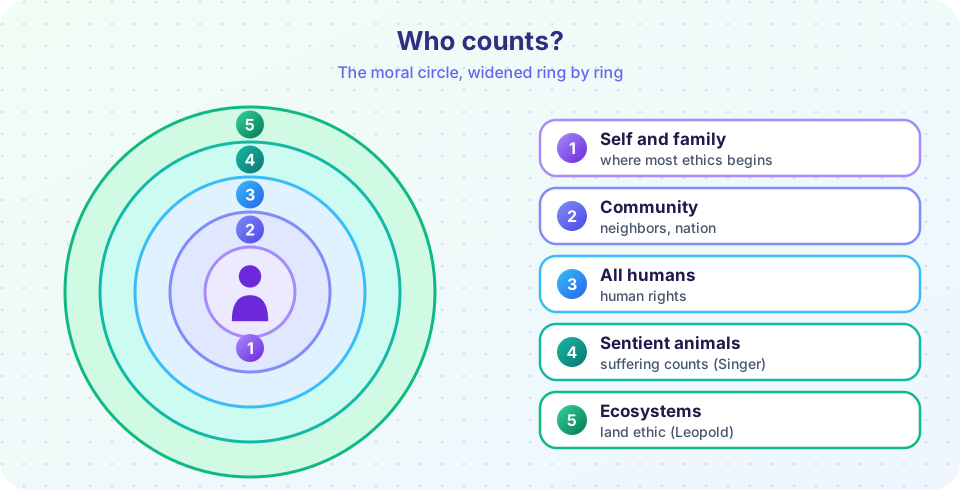
W. E. H. Lecky (1869) and, later, Peter Singer (The Expanding Circle, 1981) described moral history as the gradual widening of the circle of beings whose interests count, from family and tribe towards all humanity. Singer argues that the logical next step includes animals.
Why might sentience be the key? Jeremy Bentham wrote in 1789 that the question about animals is not whether they can reason or talk but whether they can suffer. If suffering is bad when it happens to you, it is bad for the same reasons when it happens to a pig or a chicken. The Cambridge Declaration on Consciousness (2012), signed by a group of neuroscientists, stated that many nonhuman animals possess the neurological substrates for conscious states. Scientists still debate how far consciousness extends, for example to fish and insects.
Singer and Regan
Peter Singer (Animal Liberation, 1975) applies a utilitarian principle of equal consideration of interests: similar interests count equally whoever has them. Causing a pig as much suffering as a human for a small benefit (taste) is hard to justify. He opposes factory farming and many experiments, but is not an absolutist: if a small amount of animal suffering could save many lives, the calculation is different.
Tom Regan (The Case for Animal Rights, 1983) rejects the utilitarian approach. Animals that are subjects-of-a-life (they have beliefs, desires, memory and a welfare that matters to them) have inherent value and rights, and may not be treated merely as means. He argues for abolition of animal use in farming and research, regardless of benefits.
Christine Korsgaard (Fellow Creatures, 2018) offers a Kantian argument: if we value our own ends, we must also recognize the ends of other beings who have them.
Critics make several points. Some deny that animals are moral equals, citing differences in rational capacity. Others argue that duties arise from relationships and social contracts that animals cannot join (contractualists often treat animals through indirect or separate duties). Others emphasize the cultural, economic and nutritional importance of animal use. Singer's reply is that none of these differences justifies ignoring suffering.
Practical questions include factory farming, animal research (where the "three Rs" of replacement, reduction and refinement guide practice), wildlife management and pets.
Environmental ethics
Environmental ethics asks whether nature has value beyond its usefulness to humans.
- Anthropocentrism values the environment because of its effects on people: clean air, food, recreation.
- Aldo Leopold's land ethic (A Sand County Almanac, 1949) holds that an action is right when it tends to preserve the integrity, stability and beauty of the biotic community. The unit of concern is the community, not just the individual.
- Deep ecology, named by the Norwegian philosopher Arne Næss (1973), claims all living things have intrinsic value and urges a deep change in outlook.
- Individualists such as Singer and Regan worry that holistic views could sacrifice individuals for the whole (killing animals to protect a species, for example). Holists reply that individuals are not the only things that matter.
Climate change: a problem of ethics
Climate change raises distinctive moral questions.
- Responsibility. Wealthy countries have emitted the most historical greenhouse gases, while poorer countries often suffer the earliest and heaviest effects. What does fairness require?
- Intergenerational justice. Emissions now harm people who have no voice or vote. Derek Parfit's non-identity problem (Reasons and Persons, 1984) points out that policies change who will be born, so it is hard to say that future people are "harmed" by the policy that made their existence possible. Many philosophers conclude that we can still wrong future people, though the explanation is debated.
- Discounting. Economists multiply future costs by a discount factor. The higher the rate, the less distant harms matter in present value. The Stern Review (2006) used a very low pure time-preference rate (0.1% a year) on the ground that it is unfair to value people less merely because of when they live; others such as William Nordhaus argued for higher rates reflecting market returns. The choice is partly an ethical judgment.
- Collective action. The Paris Agreement (2015) aims to hold warming well below 2 °C and to pursue efforts for 1.5 °C. Whether individuals or governments bear the duty to act, and how to share costs, remain disputed.
Moral theories each speak. Consequentialists weigh total harms and benefits, Kantians emphasize duties not to treat future people as mere means, virtue theorists emphasize humility and care for place, and care ethicists emphasize responsibility to those who depend on us.
Common misconceptions
"Animal ethics means giving animals the same rights as humans." Singer and others say equal consideration of interests, not identical treatment. A pig has no interest in voting.
"The land ethic means humans are just another animal to be sacrificed." Leopold wanted respect for the biotic community. Interpreting how this applies to humans is disputed.
"Discounting is just economics." The rate embodies a view about how to value people across time, which is an ethical claim.
Try it
Press Run (or Ctrl + Enter) to see the result here.
Program input · what you'd type while the program runs
Type the answers before you press Run, one per line. Each time the program reads a line (with input()), it gets the next line from this box.
Check your understanding
Quick check · 5 questions
of 5 answered You scored / 5 · perfect!
-
1. Which principle does Peter Singer use in Animal Liberation?
Similar interests count equally whoever has them, whatever the species. -
2. What is the central claim of Tom Regan's The Case for Animal Rights?
Regan argued that being a subject-of-a-life gives inherent value that forbids treating animals merely as means. -
3. Aldo Leopold's land ethic says an action is right when it
The land ethic enlarges the moral community to soils, waters, plants and animals. -
4. Why does a high discount rate matter ethically?
The choice embodies a view about how to value people across time. -
5. Parfit's non-identity problem points out that
Because different policies lead to different people existing, it is hard to say who is made worse off by the policy.
Summary
- Many philosophers argue moral concern should follow sentience, and the circle has widened over time.
- Singer (utility) and Regan (rights) defend animals on different grounds; critics appeal to rational capacity or relationships.
- Environmental ethics ranges from human-centered views to Leopold's land ethic and deep ecology.
- Climate ethics involves responsibility, intergenerational justice, the non-identity problem and the discount rate.
- Moral theories offer different but overlapping answers.
Next: Technology and AI
Track your progress
Create a free account to tick off lessons and pick up where you left off on any device.
of Ethics lessons completed