


















Lesson 37 of 45 · Justice and Moral Progress
Global poverty and the duty to help
Examine Singer's drowning-child argument, the demandingness and partiality objections, Pogge on harm, Rawls on duties between peoples, and what evidence says about aid.
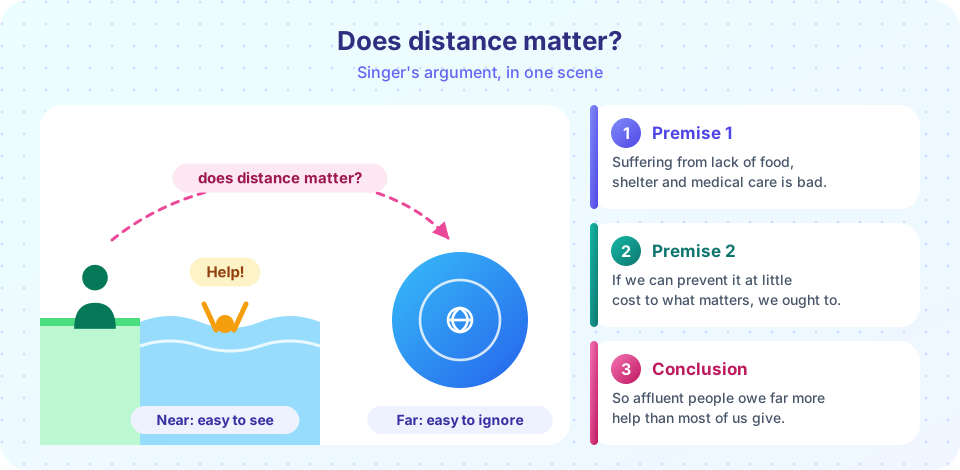
You are walking to work and notice a small child struggling in a shallow pond. You could wade in and pull the child out, but your good shoes would be ruined and you would be late. Almost everyone says you must save the child. Now suppose that, for roughly the cost of those shoes, you could help prevent a child's death from a preventable disease in a country you will never visit. Does the same reasoning apply?
Peter Singer argued in 1972 that it does, and the debate that followed shapes modern thinking about global justice.
What you will learn
- Singer's argument from "Famine, Affluence, and Morality" step by step.
- The main objections: demandingness, partiality, proximity, and whether aid works.
- The alternative argument from justice by Thomas Pogge and the position of Rawls.
- What empirical evidence on aid can and cannot settle.
- How effective altruism tries to apply the argument.
Key terms
Positive duty: a duty to help or benefit others.
Negative duty: a duty not to harm others.
Demandingness objection: the worry that a moral theory asks too much of ordinary people.
Partiality: special concern for family, friends and community, which many see as morally legitimate.
Effective altruism: a movement that uses evidence and reasoning to decide how to do the most good with limited resources.
Singer's argument
In "Famine, Affluence, and Morality" (1972), written in response to famine in what was then East Bengal, Peter Singer argued:
- Suffering and death from lack of food, shelter and medical care are bad.
- If it is in our power to prevent something bad from happening, without sacrificing anything of comparable moral importance, we ought, morally, to do it.
- Therefore, affluent people ought to give much more than they do, up to the point where giving more would sacrifice something of comparable importance.
He adds that distance and nationality do not matter morally in themselves. If I can save someone, it makes no difference whether they are ten metres or ten thousand kilometres away. And the fact that many others could also help does not remove my responsibility. His later book The Life You Can Save (2009) applies the argument with concrete suggestions.
Notice how the argument works: it starts from a judgment almost everyone accepts (rescue the child), states the principle behind it (premise 2), and applies it consistently. Critics can attack the principle, the analogy, or the facts about what donations achieve.
Objections
Demandingness
If the principle is taken literally, it asks us to give until further giving would cost us something of comparable importance, which could mean most of our income. Bernard Williams (1973) argued that such a theory violates our integrity, our ability to live by our own projects and commitments. Singer replies that moral demands are what they are, and that if the conclusion is uncomfortable the correct response is to question our comfort, not the argument. Others offer more moderate standards: give a fixed share of income, or what a fair share would be if everyone contributed (the "fair share" view).
Partiality
Samuel Scheffler and others note that we justifiably care more about our family and friends than about strangers. A parent who buys a child a birthday present instead of donating the cost is not doing wrong. Singer's critics say his view cannot honor relationships; he replies that the claim is about when sacrifice is small, not about neglecting those close to us.
Proximity and responsibility
Some say duties diminish with distance, because we can see and know what local people need, and because institutions closer to us can be held accountable. Others, such as Shelly Kagan or Peter Unger, argue that moral importance does not fall with geography. A middle view: distance may matter practically (how reliably we can help) without mattering morally.
Does aid work?
The empirical question is real. Studies of some interventions, especially in health (such as bed nets against malaria and vaccination), show large effects per dollar. Other aid projects have failed or caused harm, and critics such as William Easterly have argued that top-down aid often disappoints. Researchers such as Abhijit Banerjee, Esther Duflo and Michael Kremer (who shared the 2019 economics Nobel Prize) pioneered randomized evaluations to find what works. The takeaway is that how to give matters, and that the best estimates for cost-effectiveness vary widely between programs.
Duties of justice: Pogge and Rawls
Not everyone treats global poverty as a matter of charity. Thomas Pogge (World Poverty and Human Rights, 2002) argues that wealthy countries impose and uphold a global economic order that foreseeably worsens poverty. If so, the duty is a negative duty not to harm, which is stronger than a duty to help. Critics dispute the empirical claims about causation.
John Rawls (The Law of Peoples, 1999) rejected a global difference principle between individuals, but held that well-ordered peoples have a duty of assistance to help "burdened societies" become well-ordered. Critics such as Charles Beitz say that this is too limited, since nationality is morally arbitrary just as class of birth is.
Effective altruism
The effective altruism movement, which took that name around 2011, takes Singer's reasoning and asks practical questions: Which problems are largest, most neglected and most tractable? What does the evidence say about particular charities? How should individuals choose careers to do the most good? Supporters value its emphasis on evidence and impartial concern. Critics worry about neglect of justice and systems change, about reliance on quantification, and about uncertain long-term claims. Like any movement, it has made mistakes and had controversies, and its arguments should be assessed on their merits.
Applying the four lenses
- Outcomes: Large benefit per donation, if the program works.
- Duties: Are there duties to rescue or to rectify harm? Do promises or special roles limit them?
- Character: Generosity, compassion and humility versus self-righteousness.
- Care: What do the recipients say they need? Aid that ignores their voice can disrespect them.
Common misconceptions
"Singer says you must give away everything." His principle is demanding, but he has also suggested more moderate, achievable standards for motivating people.
"All aid is wasted." Some is, and some is highly effective. The evidence is mixed, so evaluation matters.
"Distance is irrelevant in every sense." It may matter for practical reasons, such as knowledge and accountability, even if it does not alter the moral worth of the person.
Try it
Press Run (or Ctrl + Enter) to see the result here.
Program input · what you'd type while the program runs
Type the answers before you press Run, one per line. Each time the program reads a line (with input()), it gets the next line from this box.
Check your understanding
Quick check · 5 questions
of 5 answered You scored / 5 · perfect!
-
1. Which premise sits at the heart of Singer's argument?
This principle, together with the claim that famine is bad, yields the conclusion that affluent people should give much more. -
2. What is the demandingness objection?
Williams and others argued that the principle may require giving up most of what makes a life one's own. -
3. What is Thomas Pogge's key claim?
If we are causing harm, the duty is stronger than a duty of charity; critics dispute the empirical claims. -
4. What did randomized evaluations contribute to the debate?
Banerjee, Duflo and Kremer's methods improved evidence on effectiveness. -
5. How does Rawls's Law of Peoples treat global poverty?
Critics such as Beitz say this is too limited.
Summary
- Singer argues that if we can prevent suffering at little cost to ourselves, we ought to, regardless of distance.
- Objections include demandingness, partiality, proximity and doubts about aid; each has replies.
- Pogge reframes poverty as a harm we help cause; Rawls proposes a limited duty of assistance.
- Evidence on effectiveness matters and varies widely between programs.
- Effective altruism applies the reasoning, and it is open to criticism like any other view.
Track your progress
Create a free account to tick off lessons and pick up where you left off on any device.
of Ethics lessons completed