


















Lesson 17 of 45 · Deontology
Duties and Rights: Ross and Rights Theory
Learn W. D. Ross's seven prima facie duties, how to weigh conflicting duties, and the theory of rights: claims, liberties, human rights and rights as trumps.
Suppose you promised to help a friend move on Saturday morning. On the way, you see a stranger collapse on the pavement. Your promise says to go on. Your concern for the stranger says to stop. Kant's theory has trouble with this kind of clash, because he held that duties cannot truly conflict. Most people think they can, and that there is no formula for settling them. They think you decide by judgment, knowing that something real is lost whichever way you go.
The Scottish philosopher W. D. Ross built a deontological theory around that experience. In this lesson you will meet his list of duties and his method of weighing them, and then turn to a second tradition in deontology, the theory of moral rights, which asks what claims persons have against one another and against the state.
What you will learn
- What "prima facie duty" means and Ross's list of seven.
- How Ross says we decide when duties conflict, and what critics say.
- The main types of right (Hohfeld) and the idea of rights as trumps.
- Disputes about negative and positive rights.
Key terms
Prima facie duty: a duty that holds unless it is outweighed by a stronger duty in the circumstances (Latin for "at first sight").
Actual duty: what you ought to do all things considered.
Moral intuitionism: the view that basic moral truths are known directly through reflection, not by deduction from other truths.
Claim right: a right that imposes a duty on someone else (for example, a right not to be harmed).
Rights as trumps: Ronald Dworkin's image of rights as considerations that outrank ordinary appeals to the general good.
Ross's seven duties
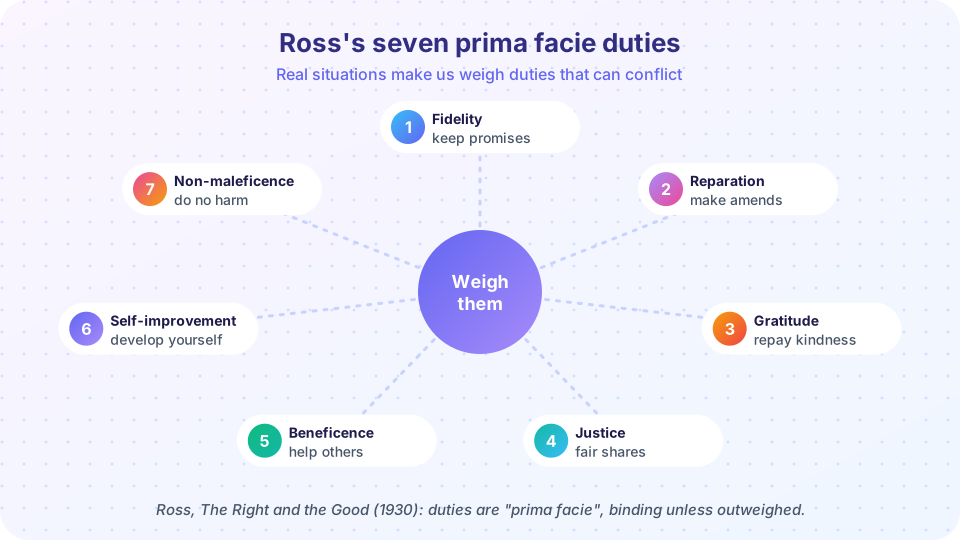
In The Right and the Good (1930), Ross argued that common sense recognizes several distinct duties, none reducible to the others. He listed them as follows.
| Duty | Idea |
|---|---|
| Fidelity | Keep promises and be truthful. |
| Reparation | Make amends for wrongs you have done. |
| Gratitude | Return kindness and benefits. |
| Justice | See that benefits and burdens are fairly shared. |
| Beneficence | Help others improve their condition. |
| Self-improvement | Develop your own abilities and character. |
| Non-maleficence | Do not harm others. |
Ross called them prima facie duties because each is binding unless a stronger duty applies. In the case of the collapsed stranger, your duty of fidelity is real, but the duty of beneficence is stronger, since a life may be at stake. After you help, the leftover duty of fidelity shows up as a duty of reparation: you should explain and apologize to your friend. In Ross's view, the failure to keep a promise leaves a moral "residue" that does not disappear, which is a way that his view explains why we feel regret or owe an apology.
How to decide
Ross rejected the idea of a master principle that ranks duties in advance. Instead, he believed that moral agents must use judgment, informed by experience. We can see that, in general, non-maleficence is more stringent than beneficence (not harming someone usually outweighs helping someone else), but this is a rule of thumb. To find your actual duty, ask:
- Which prima facie duties are relevant?
- How strong is each in this situation? A trivial promise weighs less than a solemn one; a minor need weighs less than a life.
- Which combination of duties has the greatest total weight?
Ross held that the basic duties are self-evident to anyone who thinks about them carefully, much as mathematical axioms are. This is the position called intuitionism.
Critics raise three problems. Arbitrariness: why these seven, and could there be more? No decision procedure: with no ranking, two reasonable people may weigh differently and have no way to resolve it. Epistemology: what makes a claim "self-evident", given that people disagree? Defenders reply that moral judgment, like medical or legal judgment, can be trained and reliable without a formula, and that a list of duties captures what ordinary morality already recognizes.
Rights
A second tradition focuses on what persons are owed. The American jurist Wesley Hohfeld (1913) distinguished four things people mean by "a right":
| Kind | Meaning | Correlative |
|---|---|---|
| Claim | You can demand that someone do or not do something. | The other person has a duty. |
| Liberty | You are free to do something; no duty against it. | No one has a claim against you. |
| Power | You can change legal or moral relations (for example, by promising or consenting). | Others are liable to be affected. |
| Immunity | Others cannot change your position. | Others lack the power. |
If you have a claim right not to be assaulted, others have a duty not to assault you. Hohfeld's analysis helps to untangle arguments in which "the right to X" is used in several senses at once.
Where do rights come from? John Locke (1689) grounded natural rights to life, liberty and property in a law of nature. The 1948 Universal Declaration of Human Rights, drafted after the Second World War, grounds rights in the inherent dignity of all members of the human family. Kantians ground them in the dignity of rational persons. Utilitarians such as Mill ground them in utility. Jeremy Bentham dismissed natural rights as "nonsense upon stilts". The question of their foundation is disputed even by those who agree that rights matter.
What do rights do? Ronald Dworkin (1977) described rights as trumps: they win over ordinary appeals to the general welfare. A person's right to free speech is not outweighed by the fact that many people would prefer not to hear them. Robert Nozick (1974) argued that rights are side constraints that limit what may be done to a person, whatever the benefit to others.
Negative and positive rights. Negative rights require others to refrain (not to kill, not to imprison). Positive rights require others to provide something (healthcare, education, subsistence). Libertarians such as Nozick recognize mainly negative rights; others argue that a right to life is empty without some positive rights, and that the distinction is blurry, since protecting negative rights requires police and courts, which cost money.
Conflicts. Rights can conflict: free speech versus privacy, religious freedom versus equality. Rights theorists often say that rights have limits, or distinguish their core from their periphery, or hold that some rights, such as the right not to be tortured, are close to absolute. How to resolve conflicts is a live topic in constitutional courts around the world.
Common misconceptions
"A prima facie duty is only an apparent duty." Ross meant that it is a genuine duty with real weight; it is merely defeasible. Even when it is outweighed, it leaves a moral residue.
"Having a right means you are always right to exercise it." You can have a right to do something wrong, such as insulting a friend. Rights concern what others may do about it.
"Human rights come from governments." Governments recognize and enforce them, but the claim of human rights is that they belong to people as people, which is why they can be used to criticize governments.
Try it
The first demonstration models Ross-style weighing, with a warning: Ross insisted that judgment, not arithmetic, decides. Treat the code as a way to see how changing the facts changes which duty weighs more, not as a decision procedure. Each scenario sets the strength (0 to 10) of a duty of fidelity (how serious the promise is) and beneficence (how great the need is).
Press Run (or Ctrl + Enter) to see the result here.
Program input · what you'd type while the program runs
Type the answers before you press Run, one per line. Each time the program reads a line (with input()), it gets the next line from this box.
The second demonstration is a Hohfeld explorer. Choose a kind of right to see its meaning, an example and what it correlates with in other people.
Check your understanding
Quick check · 5 questions
of 5 answered You scored / 5 · perfect!
-
1. What does 'prima facie duty' mean in Ross's theory?
Prima facie duties are genuine but defeasible; your actual duty is found by weighing them. -
2. Which is NOT one of Ross's seven duties?
Ross's list is fidelity, reparation, gratitude, justice, beneficence, self-improvement and non-maleficence. -
3. A common criticism of Ross is that
Without a ranking, different people may weigh duties differently, and no procedure settles it. -
4. In Hohfeld's analysis, a claim right correlates with
If you have a claim, someone else has a corresponding duty. -
5. Dworkin's 'rights as trumps' means that rights
A right overrides the argument that the majority would be happier if it were violated.
Summary
- Ross argued that there are seven distinct prima facie duties, weighed by judgment since no formula ranks them.
- Hohfeld distinguished claims, liberties, powers and immunities; claims correlate with duties.
- Rights have been grounded in natural law, human dignity or utility, and described as trumps or side constraints.
- Disputes remain about negative versus positive rights and about resolving conflicts between rights.
Track your progress
Create a free account to tick off lessons and pick up where you left off on any device.
of Ethics lessons completed