


















Lesson 40 of 45 · Projects and Practice
The five-step case method
Learn a five-step method for analyzing any ethical case: facts, people, lenses, options and decision, with a fully worked example and a template you can reuse.
You now have many ideas: outcomes, duties, virtues, contracts, care, metaethical positions and applied fields. The final chapter is about using them. A good analysis is not a lucky guess or a speech. It is a method that slows you down, shows your reasoning and makes it possible for someone else to disagree usefully.
This lesson teaches a five-step method and applies it to a worked case. The next lessons give you a lab to experiment with and practice cases to try.
What you will learn
- A five-step method for analyzing ethical cases.
- How to separate facts from values and avoid common mistakes.
- How to use several ethical lenses and weigh them honestly.
- How to write a short, clear justification that invites disagreement.
Key terms
Stakeholder: anyone whose interests are affected by the decision.
Option: a realistic action you could take, including less obvious middle paths.
Objection: the strongest reason someone might give against your chosen option.
Justification: the reasons that support your decision, stated so others can evaluate them.
Moral residue: the regret that remains when a good choice still involves a loss.
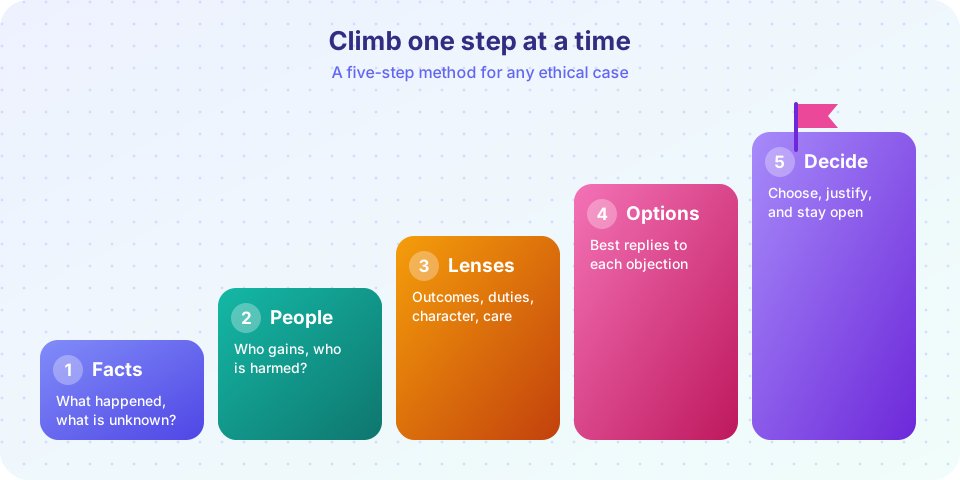
The five steps
- Facts. What happened? What is known, what is assumed and what is unknown? Who says so? Separate observations from interpretations.
- People. Who is affected, directly or indirectly, now or later? Include people who have no voice in the decision. What does each stand to gain or lose?
- Lenses. Apply the four lenses: outcomes, duties and rights, character, and care. Note where they agree and where they conflict. Add metaethical or justice questions where relevant.
- Options. List at least three realistic options. For each, give the best reasons for it and the strongest objection to it. Look for creative middle options before choosing between two extremes.
- Decide. Choose, say why, and say what would change your mind. State what is lost, honestly.
Two habits keep the method honest. First, write the strongest version of a view you reject before replying to it (the "steel man"). Second, check whether you would accept the same reasoning if your position and someone else's were swapped, which is the veil-of-ignorance test in miniature.
A worked case: the timing bug
The case (invented for practice). Priya is a junior engineer at a company that makes firmware for insulin pumps. During testing she finds a rare timing error: in about 1 in 100,000 uses, the pump may deliver a wrong dose. A fix is possible in about three weeks, but a formal report would delay a planned launch by three months. Her manager says the bug is "within normal tolerance" and asks her to log it as low priority. A competitor is expected to launch soon, and the company's finances are tight.
Step 1: Facts. Known: the bug exists, it is rare, a wrong dose could harm users. Unknown: how serious the harm would be in the worst case, whether any regulation requires reporting, whether other engineers know. Claimed: "within normal tolerance" is the manager's judgment. Priya should check the company's safety procedures and the relevant regulations before deciding anything else.
Step 2: People. Insulin pump users (health and life at stake), their families, Priya (job, reputation, conscience), her manager, colleagues, shareholders, the company's employees (jobs depend on the launch), regulators and, in the future, other patients who need trustworthy devices.
Step 3: Lenses.
- Outcomes: A delayed launch costs money and risks the company; a harmful dose may cause serious injury or death, though rarely. With enough users, even rare events happen.
- Duties and rights: Users have a right not to be exposed to undisclosed risks in a medical device; Priya has professional duties of honesty and safety; there may be legal duties to report.
- Character: Honesty, courage and prudence. A good engineer is neither reckless nor timid, and neither naive nor self-righteous.
- Care: Users depend on the device and on engineers to be careful. Colleagues also depend on the company; care includes finding a way that protects patients without needless harm to workers.
Step 4: Options.
| Option | Best reason | Strongest objection |
|---|---|---|
| A. Log it as low priority as asked | Avoids conflict and protects the launch | Exposes patients to a known risk; may be illegal |
| B. Fix it quietly without reporting | Solves the technical problem fast | May hide the issue from safety oversight; undocumented changes are risky |
| C. Report it formally and propose the three-week fix | Follows procedure; protects patients; documents the problem | Delays the launch and may strain relations with the manager |
| D. Report it internally, and if ignored, escalate to a regulator | Protects patients even if the company resists | Career risk; harm to the company if the fear was exaggerated |
Step 5: Decide. Option C, with D as the fallback, is the one that best fits all four lenses: it protects the people most at risk, respects duties of honesty and safety, expresses courage with prudence, and tries to limit harm to colleagues by offering a quick fix. Priya should document everything and ask for a written risk assessment. What would change her mind? Strong evidence that the risk is far lower than she believes or that the fix itself creates a larger risk. What is lost? A friendly relationship with her manager and possibly a launch date; some residual regret even if she acts well.
Notice that other thoughtful analysts might weigh the lenses differently and reach a different final step. What matters is that the reasoning is visible.
Common mistakes
- Rushing to a verdict. Skipping facts and people makes the analysis shallow.
- One-lens analysis. Using only your favorite theory and ignoring the rest.
- False dilemmas. Treating two options as the only choices.
- Hiding the loss. Pretending the chosen option is cost-free.
- Confusing the law with ethics. Laws matter, but they can be incomplete or unjust, and some legal acts are wrong.
Common misconceptions
"The method gives one correct answer." It gives a transparent, defensible answer. Reasonable people may differ.
"Facts are the easy part." Facts are often uncertain, and false assumptions cause many ethical errors.
"Weighing lenses is just opinion." Weights can be explained and criticized by reference to stakes, rights and evidence.
Try it
Press Run (or Ctrl + Enter) to see the result here.
Program input · what you'd type while the program runs
Type the answers before you press Run, one per line. Each time the program reads a line (with input()), it gets the next line from this box.
Check your understanding
Quick check · 5 questions
of 5 answered You scored / 5 · perfect!
-
1. What is the first step of the five-step method?
Many ethical errors come from skipping or guessing at the facts. -
2. Why should you list at least three options?
Real cases rarely reduce to two extremes. -
3. What does it mean to 'steel man' an opposing view?
This keeps the analysis fair and tests your own view. -
4. Which is an example of confusing law with ethics?
Laws matter, but they can be incomplete or unjust. -
5. Why does the final step state what is lost?
Naming the loss reflects moral residue and invites informed disagreement.
Summary
- The five steps are facts, people, lenses, options and decision.
- Use several lenses, list at least three options and steel man objections.
- State what would change your mind and what is lost.
- Different analysts may weigh the lenses differently; what matters is transparent reasoning.
Next: The dilemma lab
Track your progress
Create a free account to tick off lessons and pick up where you left off on any device.
of Ethics lessons completed