


















Lesson 45 of 45 · Projects and Practice
Further study: where to go next
Plan your next steps after the ethics course: related tracks on this site, a reading ladder from classics to current debates, and habits that keep your thinking sharp.
You have covered the main theories, the foundations, four fields of application and the big questions of justice and progress. Ethics rewards a lifetime of attention, so this lesson helps you decide what to study next, which neighboring subjects deepen your thinking, and how to keep practicing.
What you will learn
- Which related subjects extend each part of the course.
- A reading ladder from short classics to longer works.
- How to keep a practice routine that improves your reasoning.
Key terms
Primary source: a work by the thinker themselves, such as Aristotle's Nicomachean Ethics.
Secondary source: a book or article that explains or criticizes primary sources.
Reading group: a small group that meets regularly to discuss a text.
Journal: a regular written record of cases you have analyzed and what you learned.
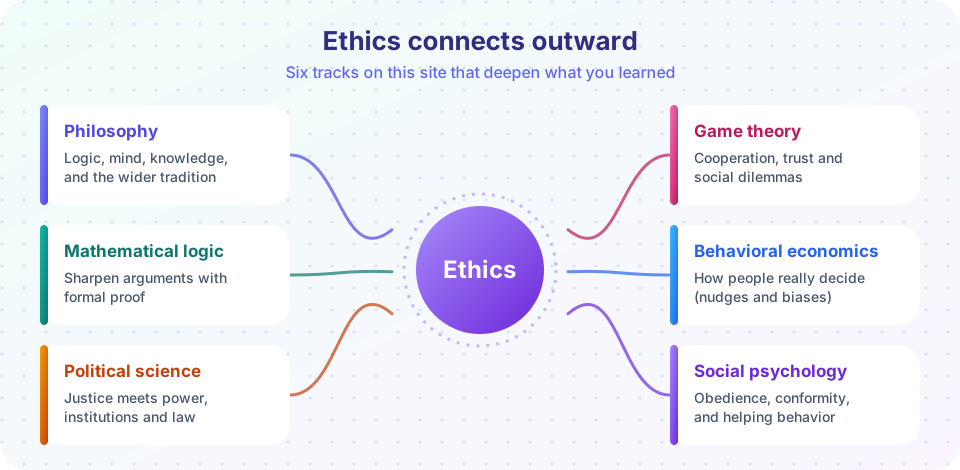
Related tracks on this site
- Philosophy. Ethics is one branch of philosophy. The wider subject adds logic, knowledge, mind and the history of ideas, which help with metaethics and with judging arguments.
- Mathematical logic. Formal tools for checking whether arguments are valid, useful for the Frege-Geach problem and for clarity in all argument.
- Political science. Justice meets institutions: how states, laws and power shape what theories can achieve.
- Game theory. Cooperation, trust and social dilemmas, the formal cousins of contractualism's problems.
- Behavioral economics. How people actually decide, including biases and nudges, which matters for applied ethics and policy.
- Social psychology. Obedience, conformity and helping behavior, the evidence behind the situationist debate.
A reading ladder
Start with short, readable pieces and move to larger works. Choose one from each rung that interests you.
- Short pieces. Peter Singer's essay "Famine, Affluence, and Morality" (1972); Judith Jarvis Thomson's "A Defense of Abortion" (1971); G. E. M. Anscombe's "Modern Moral Philosophy" (1958); James Rachels on active and passive euthanasia (1975).
- Core texts. Aristotle's Nicomachean Ethics; Mill's Utilitarianism; Kant's Groundwork of the Metaphysics of Morals; Rawls's A Theory of Justice (selections first).
- Modern books. T. M. Scanlon, What We Owe to Each Other; Rosalind Hursthouse, On Virtue Ethics; Virginia Held, The Ethics of Care; Peter Singer, The Life You Can Save; Kwame Anthony Appiah, The Honor Code.
- Metaethics. J. L. Mackie, Ethics: Inventing Right and Wrong; Simon Blackburn, Ruling Passions; Christine Korsgaard, The Sources of Normativity.
- Applied fields. Beauchamp and Childress, Principles of Biomedical Ethics; Tom Regan, The Case for Animal Rights; recent work on AI ethics and fairness, including primary studies and regulations.
Read slowly. Summarize each argument in your own words, list its premises and write one objection and one reply. A good test of understanding is to explain a text to someone who has not read it.
Habits that keep your thinking sharp
- Keep a case journal. Write a short analysis of one real or imagined case each week, using the five steps. Look back after a month and note where your views changed and why.
- Practice charitable reading. Before criticizing a view, state it so well that its defenders would say "yes, that is what I mean."
- Argue the other side. Defend a position you reject, to see its force.
- Follow evidence. Many ethical questions depend on facts. Read primary studies, data and laws, and notice uncertainty.
- Seek disagreement. Talk to people from different backgrounds and traditions; ethics is a shared project.
- Act. Ethics is not only a subject; it is a way of living. Small actions and honest conversations matter.
A final word on humility and courage
Ethics asks for two things that can pull in different directions. Humility: you may be wrong, and thoughtful people disagree. Courage: some questions need an answer, and doing nothing is also a choice. The best thinkers hold both. They offer arguments, listen for replies, change their minds when they should, and act when they must.
Common misconceptions
"After a course, I know what is right." A course gives tools. Applying them is lifelong work.
"Only experts can do ethics." Everyone does ethics. Training helps you do it with more clarity and fairness.
"More reading always means better reasoning." Practice, discussion and reflection matter as much as reading.
Try it
Press Run (or Ctrl + Enter) to see the result here.
Program input · what you'd type while the program runs
Type the answers before you press Run, one per line. Each time the program reads a line (with input()), it gets the next line from this box.
Check your understanding
Quick check · 4 questions
of 4 answered You scored / 4 · perfect!
-
1. Which habit does this lesson recommend for steady improvement?
Regular practice with cases and reflection builds skill. -
2. What is charitable reading?
It prevents attacking a weak version of a view. -
3. Why study game theory alongside ethics?
Social dilemmas link strategy and morality. -
4. Which source type is Aristotle's Nicomachean Ethics?
It is the thinker's own work.
Summary
- Related tracks (philosophy, logic, political science, game theory, behavioral economics, social psychology) deepen each part of ethics.
- A reading ladder runs from short essays to core texts, modern books, metaethics and applied fields.
- Practice habits: case journal, charitable reading, arguing the other side, following evidence and seeking disagreement.
- Ethics needs both humility and courage, and a good life of thinking includes acting.
You have finished the second half of the ethics course. Return to the Ethics track to revisit any lesson, and keep practicing.
Track your progress
Create a free account to tick off lessons and pick up where you left off on any device.
of Ethics lessons completed