


















Lesson 8 of 45 · What Is Ethics
Relativism and Universalism
Does culture decide right and wrong? Compare descriptive, meta-ethical and normative relativism, the strongest arguments on each side, and the middle positions.
Travel far enough and you find that people disagree about burial, marriage, food, honor, punishment and much else. Some customs seem harmless variations. Others, such as practices of caste or of treating women as property, seem to many outsiders and many insiders deeply wrong. This raises one of the oldest questions in ethics: are moral standards universal, or do they depend on the culture one lives in?
The question has practical weight. If moral claims are only relative to a culture, then criticizing another society seems arrogant, and criticizing your own seems to mean criticizing the standard that defines right for you. If moral claims are universal, then they apply to everyone, but we need to explain how we know them and avoid imposing our own prejudices on others.
What you will learn
- The difference between descriptive, meta-ethical and normative relativism.
- The "cultural differences argument" and why it is invalid as it stands.
- Four objections to relativism, and how relativists reply.
- Middle positions such as moderate universalism and pluralism.
Key terms
Descriptive relativism: the empirical claim that moral beliefs and practices differ across cultures.
Meta-ethical relativism: the claim that the truth of a moral judgment depends on a culture or framework.
Normative relativism: the claim that we ought to tolerate other cultures' practices.
Universalism: the view that some moral standards apply to everyone, whatever their culture.
Pluralism: the view that there are several legitimate moral values or ways of life, which can conflict.
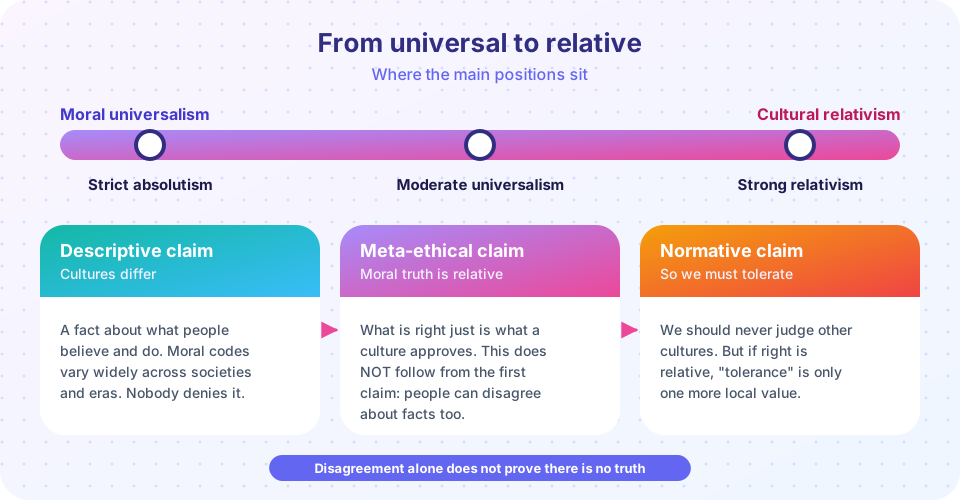
Three claims called "relativism"
The word covers three claims that should be kept apart.
-
Descriptive relativism says that cultures differ in their moral codes. Herodotus, the Greek historian, told how the Persian king Darius asked some Greeks what it would take for them to eat their dead fathers, and asked the Callatiae, who did eat theirs, what it would take to burn them. Each group was horrified by the other's custom. The point still holds: practices differ widely. Anthropologists such as Ruth Benedict (1934) made the case at length. Nearly everyone accepts this claim, though how deep the differences go is debated.
-
Meta-ethical relativism says that there is no culture-independent truth about right and wrong: an act is right for a culture if that culture approves of it. This is a claim about what moral statements mean or about what makes them true.
-
Normative relativism (tolerance) says that we ought not to judge or interfere with other cultures. This is a moral claim, not a theory about the nature of morality.
The cultural differences argument
Many people slide from the first claim to the second:
- Different cultures have different moral codes.
- Therefore, there is no objective truth in morality.
This argument is invalid. James Rachels pointed out that the same form would prove absurd things: cultures once disagreed about the shape of the Earth, yet we do not conclude that the Earth has no shape. Disagreement shows that people disagree. It does not show there is nothing to be right about. The relativist needs more: for instance, a reason to believe that moral disagreements, unlike factual ones, cannot be resolved even in principle.
Relativists can reply that moral disagreement is different: it often persists after everyone agrees on the facts, and there is no agreed method like experiment to settle it. This is a serious point. But it supports at most a measured skepticism, not the thesis that each culture's code is correct by its own standard.
Why relativism attracts people
- Humility. History is full of confident people who imposed their values on others, often cruelly. Relativism seems to protect against arrogance.
- No neutral standpoint. Everyone reasons from within some tradition. Who can claim a view from nowhere?
- Respect for diversity. Differences in food, family and ritual often seem harmless and worth preserving.
These are real concerns, but they can be met without meta-ethical relativism. Humility about our beliefs is compatible with thinking some claims are true. And respect for diversity can be grounded in universal principles, such as the equal dignity of persons.
Four objections
- It makes criticism of other societies impossible. If right is whatever a culture approves, then a society that approves of slavery or genocide is, for itself, correct. Few people can accept this.
- It makes reformers wrong. Abolitionists and suffragists rejected the moral code of their own societies. On relativism they were mistaken at the time, which makes moral progress meaningless: change would be just change.
- It conflicts with its own tolerance. If relativists say we should tolerate other cultures, they assert a universal moral claim. If tolerance is only one culture's value, then intolerant cultures are equally correct.
- Cultures are not unified. Every society has dissenters, subcultures and overlapping groups. Which group's approval makes an act right for me?
Relativists answer in several ways. Some limit the thesis: relativism applies to disputed customs but not to core principles of harm and fairness, which turns it into a middle position. Others reply that tolerance is a value shared by many cultures and not a universal truth. Debates here are active and the replies are not trivial.
Middle positions
Many philosophers hold that morality has a shared core with local variation. H. L. A. Hart argued that any viable society needs rules protecting life, property and promises, a "minimum content" grounded in human vulnerability and limited altruism. Bernard Williams distinguished "real" from "notional" confrontations with other ways of life, arguing that we can only judge a society when its outlook is a live option for us (his "relativism of distance"). Others defend moral pluralism: there are several real values (liberty, equality, loyalty, welfare) that cultures weigh differently, and no formula ranks them. Pluralism rejects relativism because some ways of life are not acceptable, and it rejects strict universalism because there is no single correct ranking.
Empirical work has tried to see how far morals are shared. One analysis of ethnographic accounts from 60 societies (Curry, Mullins and Whitehouse 2019) reported that cooperation-promoting behaviors such as helping family, returning favors and respecting property were judged morally good in all of them, though the weight given to them varied. Such studies are suggestive but depend on how the records are coded and cannot by themselves decide the philosophical question.
Common misconceptions
"Relativism and tolerance are the same." Tolerance is a moral view; a relativist who says "everyone should be tolerant" has contradicted the thesis, and a universalist can consistently be tolerant.
"Universalists think their culture has all the answers." A universalist claims there are moral truths, not that they are already known. Many universalists are humble and revise their views.
"Cultural differences prove that morality is subjective." They prove that people differ. Whether there is something to be right or wrong about requires a separate argument.
Try it
The first demonstration models how much agreement a "shared core" could leave. It simulates 12 imaginary societies and 12 norms. Each norm has a chance of being accepted, which you set below. The percentages are a modeling assumption chosen for this lesson, not data, so the output shows only what would follow if the assumed numbers were true: high variation on some norms is compatible with strong agreement on others.
Press Run (or Ctrl + Enter) to see the result here.
Program input · what you'd type while the program runs
Type the answers before you press Run, one per line. Each time the program reads a line (with input()), it gets the next line from this box.
The second demonstration compares what each position says about three cases. Click a case.
Check your understanding
Quick check · 5 questions
of 5 answered You scored / 5 · perfect!
-
1. 'People in different societies hold different moral beliefs.' This is
It is an empirical claim about what people believe, which nearly everyone accepts. -
2. Why is the cultural differences argument invalid?
Cultures once disagreed about the shape of the Earth without making that a matter of opinion. -
3. Which objection says that relativism undermines its own call for tolerance?
If 'we should tolerate' is meant universally, relativism is false; if it is only local, intolerant cultures are equally correct. -
4. What does moral pluralism hold?
Pluralists accept multiple values (liberty, equality, loyalty, welfare) and also hold that some ways of life are unacceptable. -
5. Hart's 'minimum content' idea claims that
He argued that human vulnerability and limited altruism make some basic rules necessary.
Summary
- "Relativism" covers three claims: cultures differ (descriptive), truth is culture-relative (meta-ethical), and we should tolerate (normative).
- The step from diversity to relativism is invalid as it stands.
- Objections include the problem of criticism, reformers, self-undermining tolerance and non-unified cultures.
- Many philosophers defend moderate universalism or pluralism: a shared core with real local variation.
Next: Chapter 2 Review
Track your progress
Create a free account to tick off lessons and pick up where you left off on any device.
of Ethics lessons completed